The K-Beauty Playbook: 7 Proven Tactics That Win Amazon

What are Korean skincare brands actually doing differently on Amazon? Well, it's not luck and it's not a single trick.
Anua, COSRX, Medicube, and a handful of brands close behind are running a small, repeatable set of moves, turning` ingredient-led products into category-dominating sellers and a category that topped $2 billion in US sales in 2025.
The tactics below break the pattern into its parts, each illustrated with the brand running it cleanest and the Amazon Brand Analytics search data that proves it works.
A Quick Note on the Numbers
Amazon stripped out a lot of bot-inflated search volume from its Brand Analytics report starting Week 14 of 2026. Where year-over-year growth shows up below, it reflects real shopper interest sitting on top of cleaner data — so the trends are stronger, not weaker.
What Are the Major K-Beauty Brands on Amazon Right Now?

Five brands carry most of the load:
- Anua — Built around heartleaf. Entered US Amazon in late 2022. Now around $414 million in trailing twelve-month revenue.
- COSRX — Built around snail mucin. Founded in Seoul in 2013, now sold in more than 120 countries. The most established name in the group.
- Medicube — Built around PDRN and toner pads. Parent company APR saw sales rise 218%, powered largely by Medicube. The fastest mover.
- BIODANCE — Built around its collagen mask. A more recent entrant that owns the “collagen face mask” search and is expanding outward.
- Dr. Althea — A smaller brand with one breakout product. Useful as a live example of the same playbook running at smaller scale.
None of them launched a giant catalog at once. None of them led with brand-name marketing. Each one started with a single ingredient or a single product, built real credibility there, and only then expanded.
Tactic 1: Anchor the Brand to an Ingredient, Not a Promise
Western beauty has spent forty years building brands around outcomes — glow, anti-age, confidence — vague promises shoppers can't check before they buy.
K-beauty brands sell specific ingredients: heartleaf, snail mucin, PDRN. Things with real names, real mechanisms, and a TikTok or Reddit thread already explaining what they do.
Why it works on Amazon: when someone shows up to buy, they've already done their homework somewhere else. They arrive at the product page to buy, not to compare.
The data:
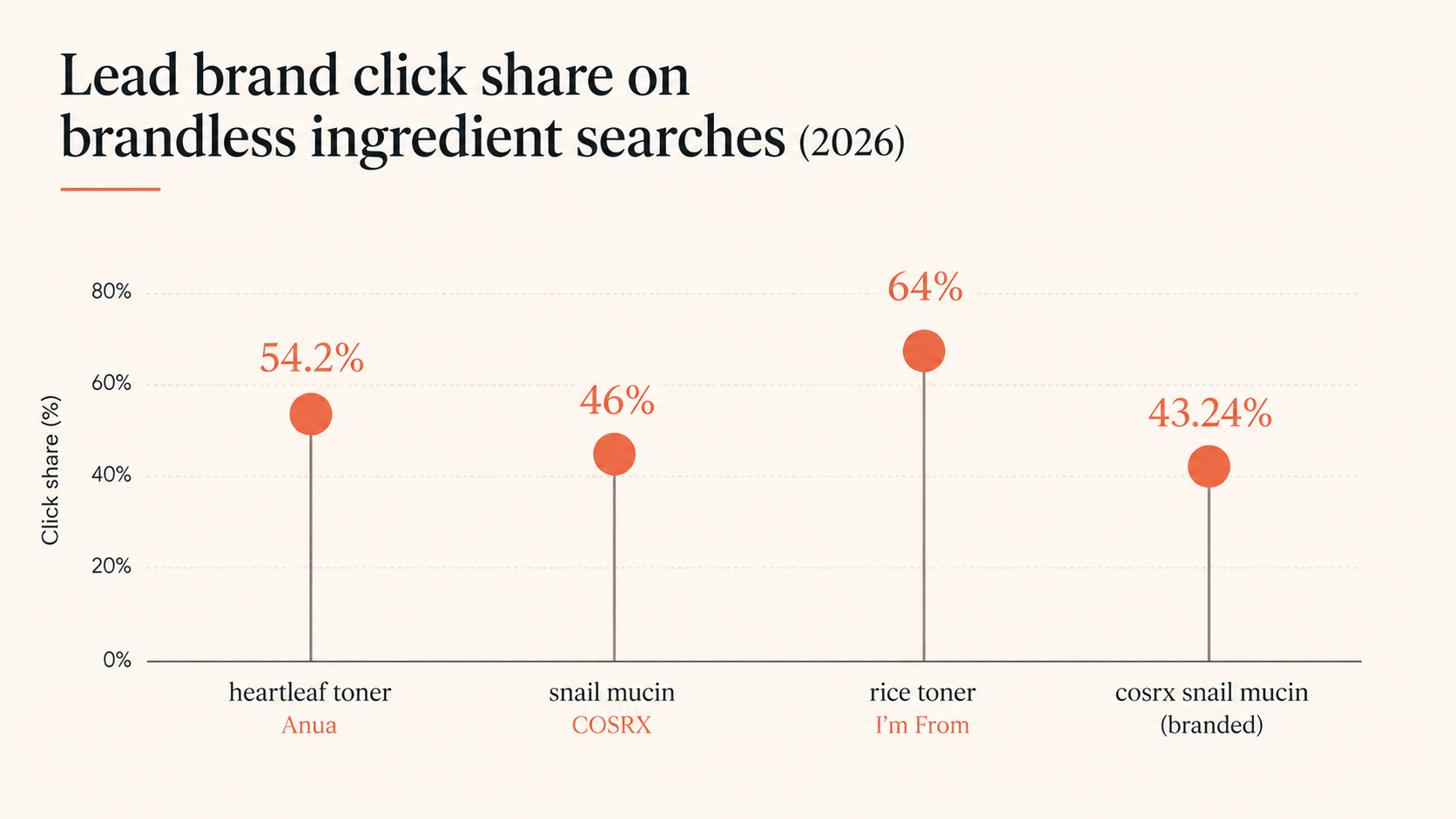
- On the search “heartleaf toner” (no brand attached), Anua's Heartleaf 77 Soothing Toner gets 54.22% of the clicks and 66.09% of the sales (Brand Analytics, 2026).
- On “snail mucin,” COSRX's Repairing Serum leads with about 46% of clicks and 49% of sales. The brands behind it are mostly generic copycats — proof of how completely COSRX owns the ingredient.
- When people search “cosrx snail mucin” specifically, the same hero product takes 43.24% of clicks. Both the ingredient search and the branded search funnel into the same SKU.
- Anua's brand-name searches grew sharply year over year — its search popularity rank moved from 684 in 2025 to 434 in 2026 (lower rank = more searched). Real growth, even after Amazon's bot cleanup.
To put it simply, the brand and the ingredient become the same thing in the shopper's mind. Whether someone searches “heartleaf toner” or “anua heartleaf toner,” the same product wins.
Tactic 2: One Hero Product, Then Expand the Catalog Around It
Every brand in this group followed the same sequence. Launch one SKU. Get that one SKU to dominate its ingredient search. Then expand into nearby products in the same ingredient line. Then add a second ingredient line. Then a third.
Anua's order:
Heartleaf 77 Soothing Toner → Heartleaf Cleansing Oil → Heartleaf Cleansing Foam → niacinamide → rice → PDRN. COSRX's order: Snail Mucin Essence → Snail Mucin Moisturizer → Snail Mucin Cleanser → peptides → retinol → vitamin C.
Why this matters on Amazon: the algorithm rewards proven SKUs much more than it rewards new brands launching wide. Stacking sales, reviews, and conversion data on one product creates a ranking lead that a multi-product launch can't match.

BIODANCE is the clearest live example. Brand Analytics caught the pattern in motion:
- 2025: BIODANCE Bio-Collagen Real Deep Mask took 74.15% of clicks on the search “biodance bio-collagen real deep mask.”
- 2026: Same product, 63.55% of clicks.
That looks like a loss but it really isn't.
Total brand search volume grew over the same period — the “biodance” search popularity rank moved from 3,471 to 2,172 — and the dropping hero share came from BIODANCE launching collagen toner pads, peptide serums, cleansing oils, jelly mists, and PDRN masks under the same brand.
The hero shrank as a percentage because the catalog widened, not weakened.
The shrinking share is the tactic working. The hero product builds the brand's Amazon ranking and gets the shopper comfortable; the catalog expansion captures more searches and more average spend — but only after the brand has its position locked in.
Tactic 3: Treat TikTok and Amazon as One Funnel

K-beauty content lives on TikTok — ingredient explainers, before-and-afters, dermatologists doing breakdowns — and the actual purchase happens on Amazon. These brands treat the two as one continuous path, not separate channels.
The big-picture numbers: K-beauty is the top-selling beauty category on TikTok Shop, with sales up 132% in 2025.
According to NielsenIQ, 70% of K-beauty sales now happen online.
What that looks like in practice:
- Turning a viral moment into a SKU. Anua launched a special-edition KPop Demon Hunters version of its Zero-Cast Sunscreen in 2026 — bottling a viral TikTok moment into a real Amazon listing. The special version pulled about 7% of clicks on the “anua sunscreen” search. Small in absolute terms, but a clean example of turning a cultural moment into something shippable within months.
- What “already convinced” shoppers look like in the data. When someone arrives at Amazon already familiar with the product, conversion runs unusually high: 75.52% of clickers buy on “anua heartleaf toner,” and 83.74% buy on “anua heartleaf 77 soothing toner” (Brand Analytics, 2026). Numbers that high mean the shopper has already made up their mind — TikTok did the convincing.
The takeaway: pouring ad spend into Amazon alone doesn't recreate this. The funnel only works if the content lives where the discovery actually happens.
Tactic 4: Win the Generic and Ingredient Searches, Not Just Your Own Brand Name
Most brands focus on winning their own brand name in search, accept that generic searches are too expensive to chase, and move on. The K-beauty group treats their own brand name as the minimum — of course they win it — and then goes after the generic and ingredient searches above it.
Three layers, from broad to specific:
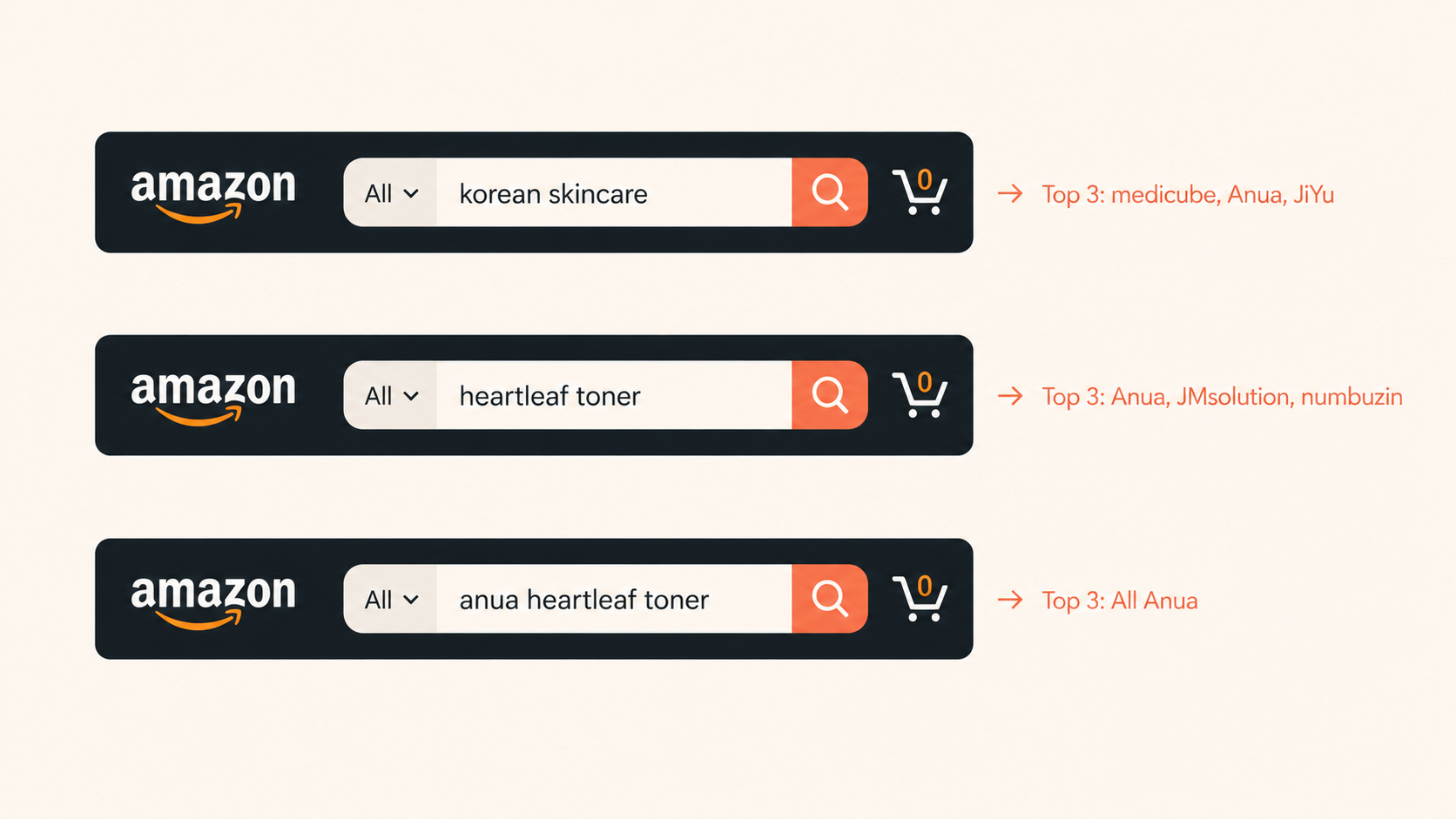
- Generic category terms like “korean skincare” — top three clicked brands all Korean (medicube, Anua, JiYu in 2026).
- Brandless ingredient terms like “heartleaf toner,” “snail mucin,” “rice toner,” “pdrn” — Korean brands take the top three on every one.
- Branded terms like “anua heartleaf toner” — Korean brand takes 70–85% of clicks.
How do they win the broader searches without outspending US brands on ads?
Well, they don't.
Amazon's algorithm rewards conversion rate, and the branded and ingredient layers feed data into the generic ranking. A SKU that converts at 81% on its branded search teaches Amazon that it deserves the top slot on the ingredient and generic searches above it too. The funnel runs both directions.
Tactic 5: Feed Amazon's Algorithm What It Rewards
Amazon's ranking system cares about three things most: how often clicks turn into purchases, how fast the sales come in, and how steadily new reviews show up.

The K-beauty group engineers all three at once — by funneling TikTok-warmed traffic into a small number of SKUs that convert at very high rates and stack reviews quickly.
Medicube is the most extreme example, and the number is genuinely remarkable.
The bare-brand “medicube” search sits at a popularity rank of 21–30 across both years. To put that in perspective: that puts “medicube” among the top 30 most-searched terms across all of Amazon US — alongside the most-searched generic shopping queries on the entire platform. By comparison:
- “anua” sits at rank 434–684
- “cosrx” sits at rank ~4,070
- “medicube” sits at rank 21–30
Medicube has built brand-name search demand on a completely different scale. That demand is what makes Amazon's algorithm hand them top slots on neighboring searches — “korean skincare,” “k beauty,” “collagen jelly cream,” “pdrn.” Every conversion on a branded search feeds the score that wins the broader queries.
The whole point is that the layers feed each other. Medicube's parent company APR saw sales rise 218% in 2024, growth that only happens when every part of the funnel is feeding the next.
Tactic 6: Use the Korean Manufacturing Edge

Korea has the most concentrated network of contract cosmetic manufacturers in the world — companies that handle the research, the formulation, and the production, so a brand can put its money into marketing instead.
The scale is hard to overstate. Cosmax alone manufactures for more than 600 brands worldwide, and 15 of the 20 largest global cosmetics companies — including L'Oréal — entrust their manufacturing to it. It was the first Korean contract manufacturer to land L'Oréal as a client.
What this means in practice:
- A new Korean brand can launch at prestige-grade quality without owning a lab.
- The cost structure lets them price aggressively; prestige formulas at mid-tier US prices.
- Reformulating a product or extending a line is fast, because the manufacturer already has the capability sitting there.
For a US operator, the takeaway isn't necessarily “outsource to a Korean factory” — though some do, and it's worth considering. It's that the price-to-quality ratio K-beauty brands run on is built on a manufacturing base that didn't appear overnight and isn't going to get replicated in the US any time soon.
Tactic 7: Play the Long Game and Get Ahead of the Next Ingredient Wave
These brands don't pick one ingredient and stop. They pick the current one, build dominance, and then quietly position themselves on whatever is coming next — usually the next ingredient making the jump from clinical or medical use into mainstream skincare.
Snail mucin made that jump in the 2010s. PDRN is making it right now.
Dr. Althea is the cleanest live example. Brand Analytics caught them mid-pivot:
- 2025 listing: “Dr.Althea 345 Relief Cream | Moisturizer for Soothing Recovery and Blemish Care with Tea Tree Leaf Water & Niacinamide“
- 2026 listing: Same product code (B0FKGJYFC8), same product name, reformulated to: “Soothing Recovery and Blemish Care with PDRN & Niacinamide“
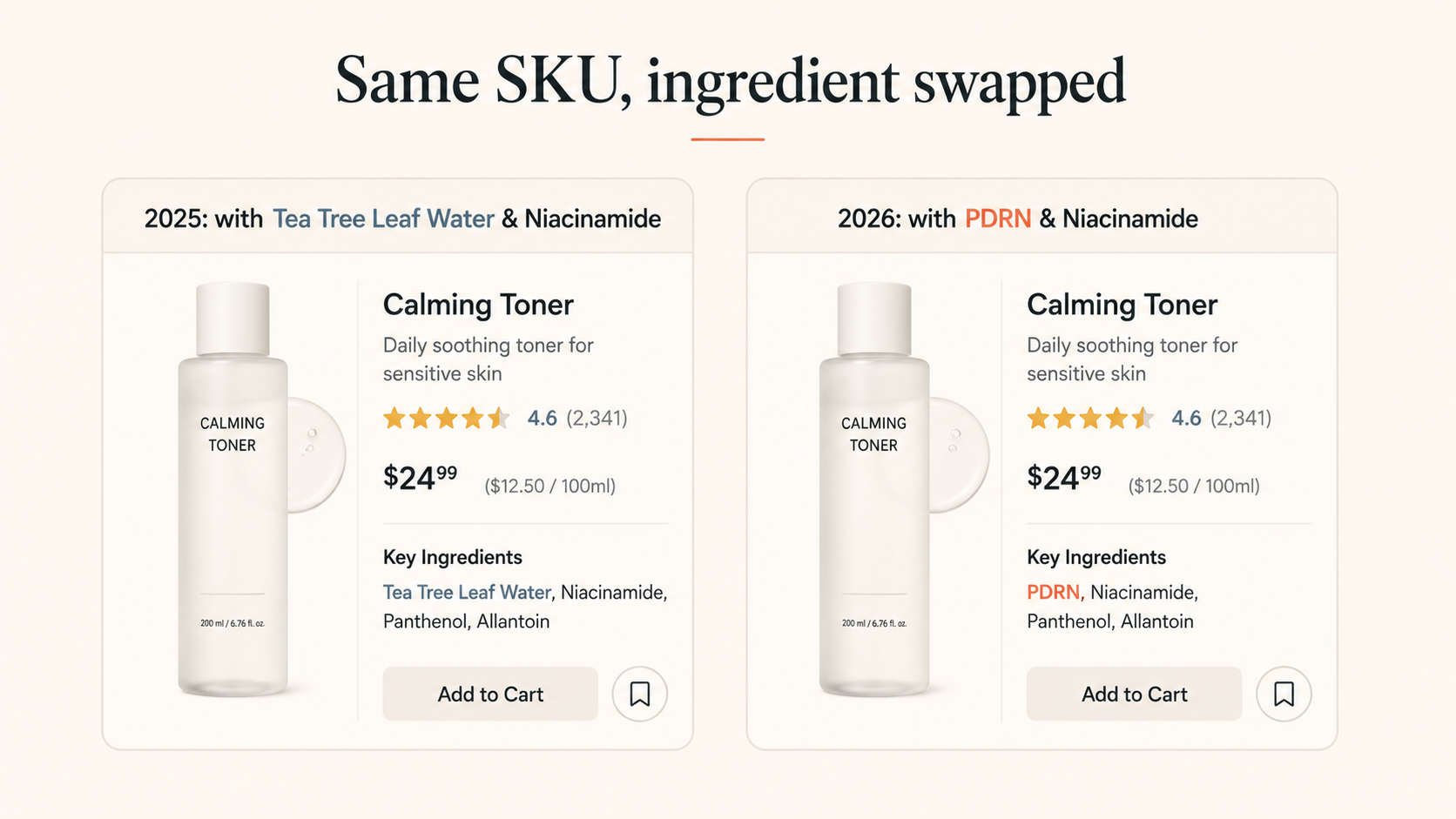
They literally swapped the headline ingredient in their hero product to ride the PDRN wave. Brand-name search nearly doubled along with it — the “dr althea” rank moved from 13,846 to 7,570.
The wider PDRN picture across the group:
- Searches for “anua pdrn” went from rank 36,623 in 2025 to 3,273 in 2026 — roughly a 10x jump in real demand.
- “medicube pdrn”: 3,690 → 2,326.
- The plain “pdrn” search in 2026 has all-Korean top three (VT Cosmetics, medicube, Anua), with a popularity rank of ~5,100 — roughly where the most-searched snail-mucin terms sat two years ago.
These brands aren't betting on PDRN. They're already positioned on it, with hero products on shelves, while a lot of US shoppers are still Googling what it is.
What This Means for Non-Korean Operators
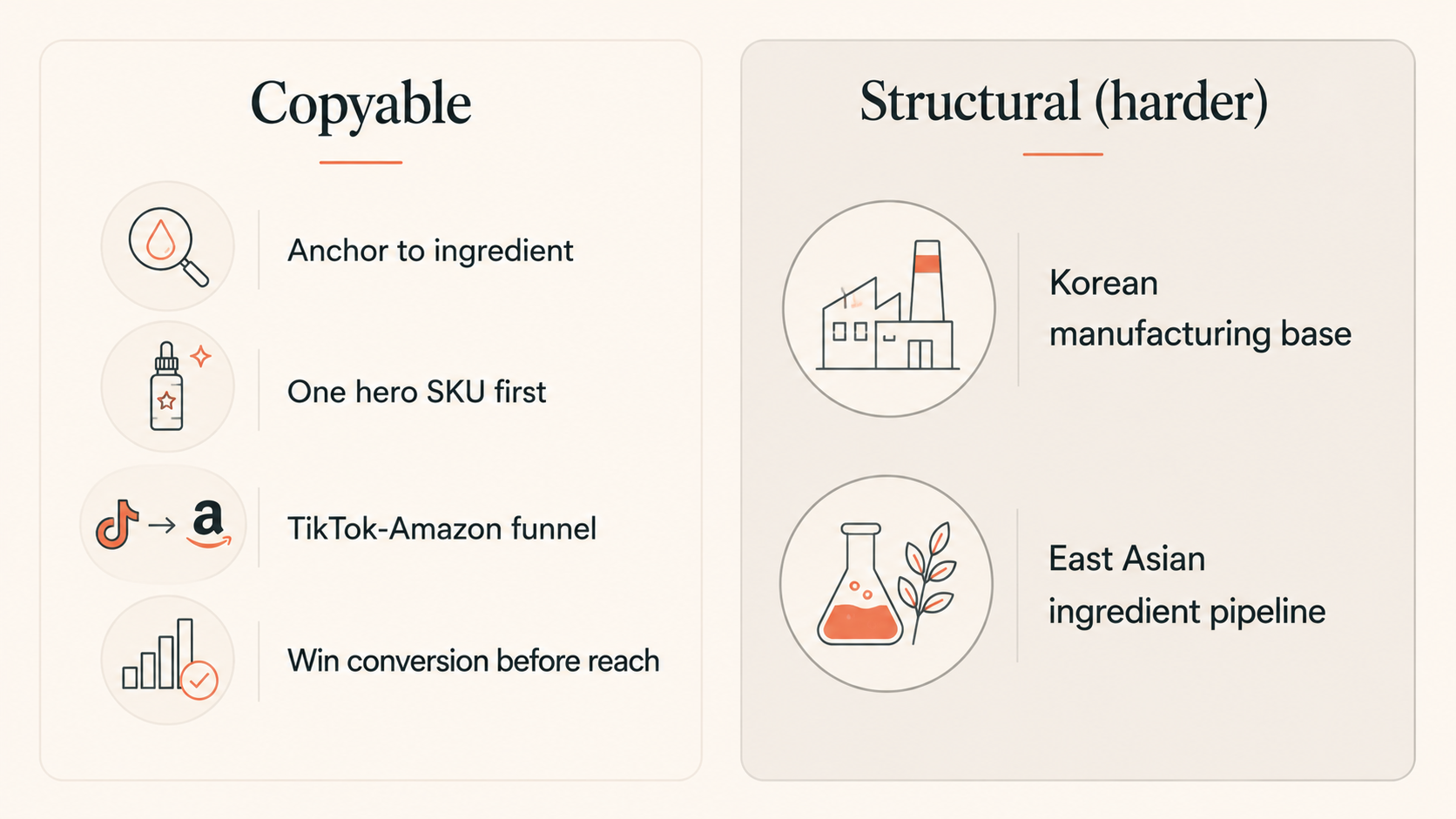
Parts of this playbook are copyable. Parts are structural.
The copyable parts:
- Pick an ingredient with a real, checkable story and build the brand around it. Not just a trendy one — one with an actual mechanism, some history, and enough creator content already out there that you can ride a wave instead of trying to start one yourself.
- Launch one hero SKU and stay focused on it. Don't ship a full catalog day one. Stack sales, reviews, and conversion data on one product until it owns its ingredient search, and then expand outward.
- Treat TikTok and Amazon as one path, not two channels. Make sure the discovery content exists, and that the SKU title and description match what people are saying about the product. A shopper who's already heard of the product converts at way higher rates than one who hasn't.
- Win conversion before chasing impressions. Hitting more than 70% conversion on your own brand-name search is what trains Amazon to start handing you ingredient and generic searches too.
The harder parts — the deep Korean manufacturing base, and the cultural pipeline that keeps moving new ingredients from East Asian clinics into Western skincare every few years — aren't easily copied. But they aren't fully closed off either.
Some US brands already use Korean contract manufacturers. Some are partnering with creators inside the K-beauty content ecosystem to pre-warm their Amazon launches.
These brands' edge isn't magic. It's a system. The system is visible in the search data, and so is the next wave.