Amazon GWD vs AWD: Fees, Eligibility, and Trade-offs Sellers Need to Know in 2026

On April 9, 2026, Amazon launched Global Warehousing and Distribution, or GWD for short. The pitch is simple: store your FBA inventory at one warehouse in Shenzhen, China, and let Amazon handle the cross-border shipping to US fulfilment centers through Amazon Global Logistics.
Amazon says storage costs run up to 45% lower than US-based Amazon Warehousing and Distribution, and delivery runs up to seven days faster when you pair GWD with AGL. But here's the thing: both numbers come from Amazon, no one else has verified them, and that “up to” language is doing a lot of heavy lifting. So take the marketing with a grain of salt, and let's actually look at what you're signing up for.
What follows is the practical breakdown of what GWD is, what you pay, what you give up in exchange, and which sellers should consider signing up. Everything here pulls from Amazon's own Seller Central documentation and fee schedules current as of January 2026.
How GWD Works
GWD links four parts of Amazon's logistics system into one sequential process.
Your products start at the GWD warehouse in Shenzhen, where they sit in storage until your US inventory needs a top-up. When stock in the US drops below a certain level, Amazon uses Amazon Global Logistics (AGL) to ship your products by ocean freight from Shenzhen to the United States. Once the shipment clears customs and arrives in the US, it moves into AWD, Amazon's bulk storage network, where it waits until individual fulfillment centers need stock. From there, FBA takes over, picking, packing, and delivering orders directly to your customers.
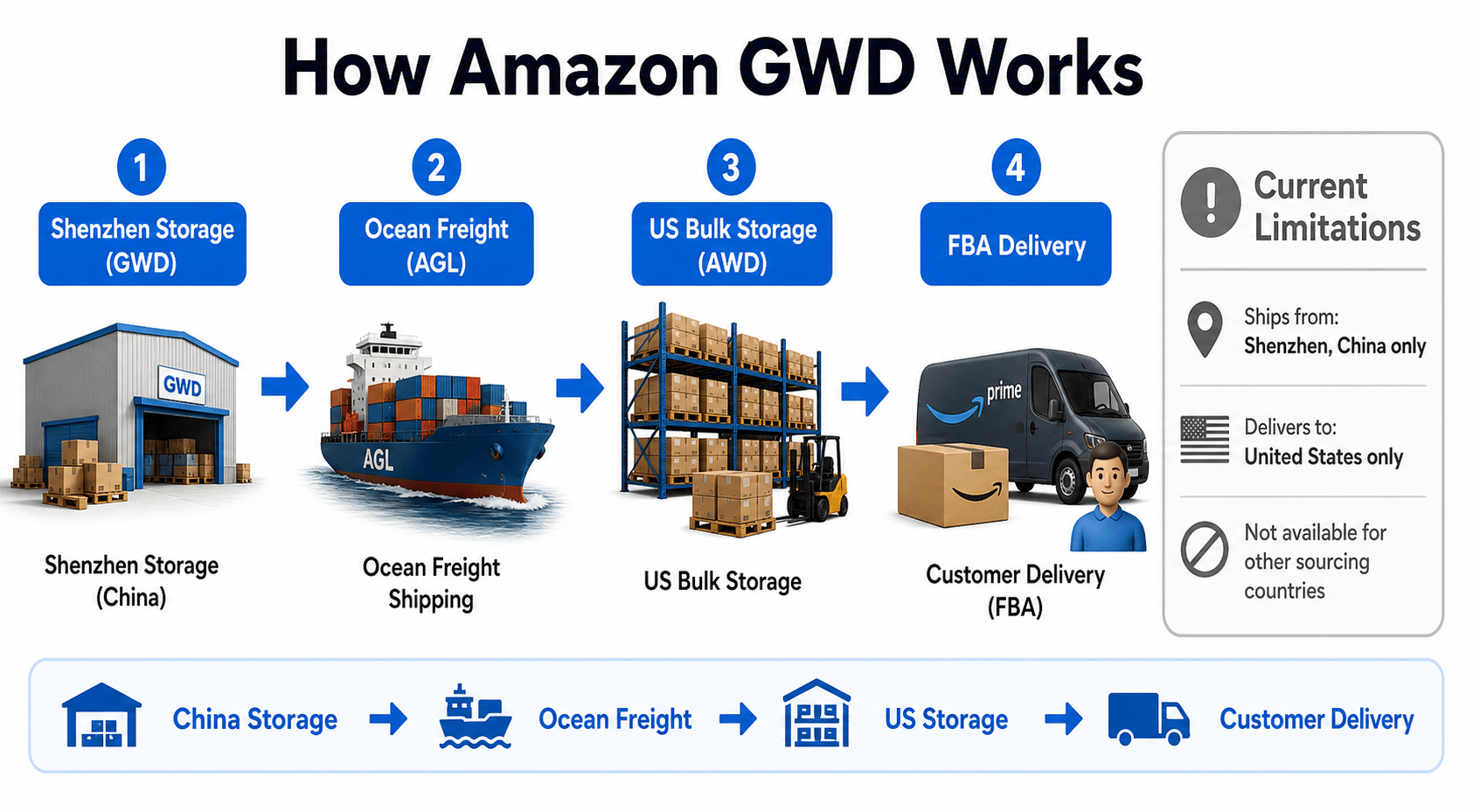
In short, the chain runs like this: Shenzhen storage, then ocean freight, then US bulk storage, then customer delivery.
You manage every stage of that chain through a single workflow inside Seller Central, instead of coordinating separate vendors for freight, customs, storage, and fulfillment.
What “Global” Actually Means Right Now
The name overstates the program's current reach. As of today, GWD operates with one warehouse location in Shenzhen and ships to one destination market, the United States. Amazon has mentioned plans to expand, but has not named specific countries or set public timelines.
So if your products come from other regions (like Shanghai or Shandong), GWD might not be the best option for you right now. (Moreso if you're shipping from other countries like Vietnam, Bangladesh, India, or anywhere other than mainland China.
Can You Really Save 45% on Storage with Amazon GWD?
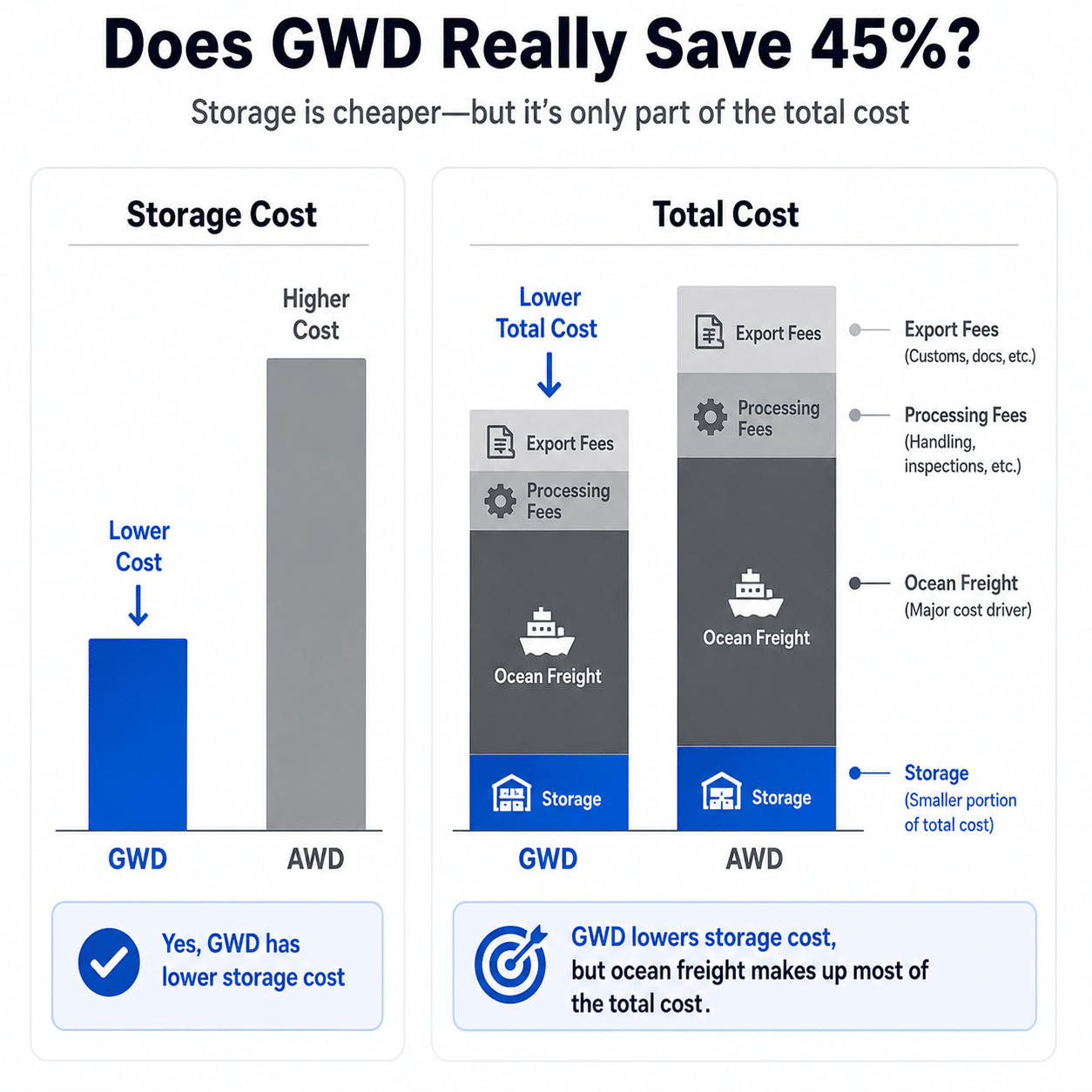
Amazon's headline number compares GWD's storage rate against AWD's storage rate, and the math checks out at that one line. The catch is that storage is one piece of your total cost, not the whole picture.
Other costs that factor into your total landed cost include:
- Inbound and outbound processing fees
- Export declaration fees
- AGL ocean freight charges
- FBA fulfillment fees once inventory reaches the US
Whether your total drops by 45%, by 10%, or by nothing at all depends on your specific products, your shipment volumes, and how often your inventory replenishes.
The seven-day speed claim deserves the same skepticism. Amazon's own AGL transit time tables tell a clearer story than the marketing does:
| Shipping mode | Origin to US destination | Transit time |
|---|---|---|
| Fast Ocean FCL | China to West Coast | 35-45 days |
| Fast Ocean LCL | China to West Coast | 38-48 days |
| Standard FCL | China to West Coast | 45-55 days |
| Standard FCL | China to East Coast | 55-65 days |
| Standard LCL | China to West Coast | 54-64 days |
Pure ocean transit from a Chinese port to a US port runs 12 to 22 days depending on the route. Shanghai to Los Angeles, for example, is usually 14 to 18 days on the water under normal conditions.
That's the number you'll see quoted in shipping circles, but it only covers the boat ride. Your inventory doesn't become sellable the moment the boat docks. The full door-to-door timeline includes:
- Cargo drop-off or pickup at origin in China
- Origin handling, consolidation, and loading at the Chinese port
- Ocean transit (the 12 to 22 day part)
- US port arrival, customs clearance, and unloading
- Inland transportation to the cross-dock or fulfillment center
- Final delivery and check-in at Amazon
Amazon's published AGL transit times put the full chain at 35 to 65 days depending on your shipping mode and US destination. That's the number to plan your inventory cycles around, not the ocean-only figure.
None of those windows changes whether you're using GWD, AWD, or shipping straight to FBA. The water is the water.
Whatever speed gains exist come from faster customs clearance and better consolidation, not from ships moving any quicker.
Amazon's documentation also includes a quiet caveat: transit time reliability is “subject to volume and external market conditions.” So the published numbers are best-case estimates. Port congestion, customs delays, and peak season volume all push the actual time higher than the table suggests.
What does hold up is the simplification benefit. Replacing three or four vendor relationships with one Seller Central workflow is a real operational win. The cost of that simplicity is deeper reliance on Amazon, and that's a trade-off only you can weigh.
The FBA Capacity Bypass
There's one benefit of GWD that Amazon underplays, though it comes with more strings attached than the marketing suggests.
Auto-replenishment shipments from GWD bypass your FBA storage limits. For sellers who lose Q4 sales every year because FBA caps reject their shipments, this matters. The catch is that the bypass only applies to auto-replenishment, not manual shipments. So if you want it, you have to let Amazon decide how much inventory moves and when, with no minimum or maximum unit controls.
There's also a setup hurdle. Auto-replenishment requires complete ProCheck data for each SKU, and without it, your SKU defaults to manual replenishment regardless of preference. The bypass isn't a checkbox. You earn it by getting your customs and trade data in order first.
GWD vs AWD: Cost Comparison
GWD wins on rate cards, but the savings narrow once you factor in AWD's discount programs. Here's how the two stack up on storage:
| Program | Rate per cubic meter / month |
|---|---|
| GWD Shenzhen | $8.79 |
| AWD West Coast (base) | $20.13 |
| AWD East Coast (base) | $16.95 |
| AWD West Coast (Smart Storage, 10% off) | $18.12 |
| AWD East Coast (Smart Storage, 10% off) | $15.26 |
| AWD West Coast (Amazon Managed, 20% off) | $16.10 |
| AWD East Coast (Amazon Managed, 20% off) | $13.56 |
GWD beats every AWD rate on paper, but a disciplined seller running Amazon Managed at AWD East Coast is paying closer to $13.56 per cubic meter, which closes the gap considerably. Storage is where the 45% claim comes from, and you can see how much that depends on which AWD comparison you pick.
Processing fees tell a different story. GWD wins clearly here:
| Fee type | GWD | AWD |
|---|---|---|
| Inbound processing | $0.20 per carton | $1.40 per box |
| Outbound processing | $0.30 per carton | $1.40 per box |
How much that difference adds up to depends on your monthly carton volume, but the percentage gap is much wider than the storage gap.
On transportation, the comparison gets messy. GWD has no separate transportation line item because AGL bills ocean freight independently. AWD charges $1.40 per cubic foot for transportation, with a 10% discount available under Amazon Managed. The frustrating part is that AGL hides its rate cards behind enrollment, so you cannot calculate your true total cost before committing to the program.
Two AWD discount programs widen the gap further in AWD's favor for the right sellers. Smart Storage offers 10% off AWD storage for sellers who maintain a 70% auto-replenishment ratio and at least 70 combined days of supply.
Amazon Managed offers 20% off AWD storage for SKUs enrolled in that service.
Neither applies to GWD, which means your GWD storage rate stays at $8.79 per cubic meter no matter how clean your operation looks.
One more difference worth flagging: GWD enforces a 6-month storage limit in Shenzhen, with an optional 6-month extension you request through a separate process. AWD follows standard FBA storage timelines.
If your inventory hits the 12-month combined limit and still hasn't moved, you have a problem. Bonded warehouse rules prevent the goods from going back into China, so your only options are pushing the inventory into FBA or accepting losses.
Plan your storage timeline around two questions:
- How fast does this SKU sell through your existing FBA inventory?
- How much of the 12-month window do you actually need before everything has to move?
If the answer to the first question is “slowly” and the answer to the second question is “most of it,” GWD is probably not the right fit for that SKU.
Full GWD Fee Schedule
Amazon's published rates for GWD effective January 1, 2026 break down across five lines.
| Fee | Rate |
|---|---|
| Storage | $8.79 per cubic meter / month |
| Inbound processing | $0.20 per carton |
| Outbound processing | $0.30 per carton |
| Inbound Export Declaration | $50 per shipment |
| Outbound Export Declaration | $0.10 per carton |
To make those numbers concrete, here are three scenarios using Amazon's own examples.
| Scenario | GWD cost |
|---|---|
| 15 cubic meters stored for one month | $131.85 |
| 100-box inbound shipment | $70.00 |
| 50-box outbound shipment | $20.00 |
The 100-box inbound figure breaks down as $20 in processing plus $50 in declaration. The 50-box outbound figure breaks down as $15 in processing plus $5 in declaration. Straightforward enough.
What's missing from those numbers is everything else. AGL ocean freight, FBA fulfillment fees, and customs broker charges all land on separate invoices. You only see AGL rates after enrolling, which means you cannot complete a full cost comparison before you commit to the program. That's worth sitting with for a moment, because it's the kind of structural detail that changes the calculation.
Product Eligibility
GWD accepts most of the bread-and-butter FBA categories. Apparel, baby products, beauty, books, home and garden, office products, pet supplies, sports equipment, tools, toys and games, and video games are all eligible. If your business runs in any of those, you're in the clear on category.
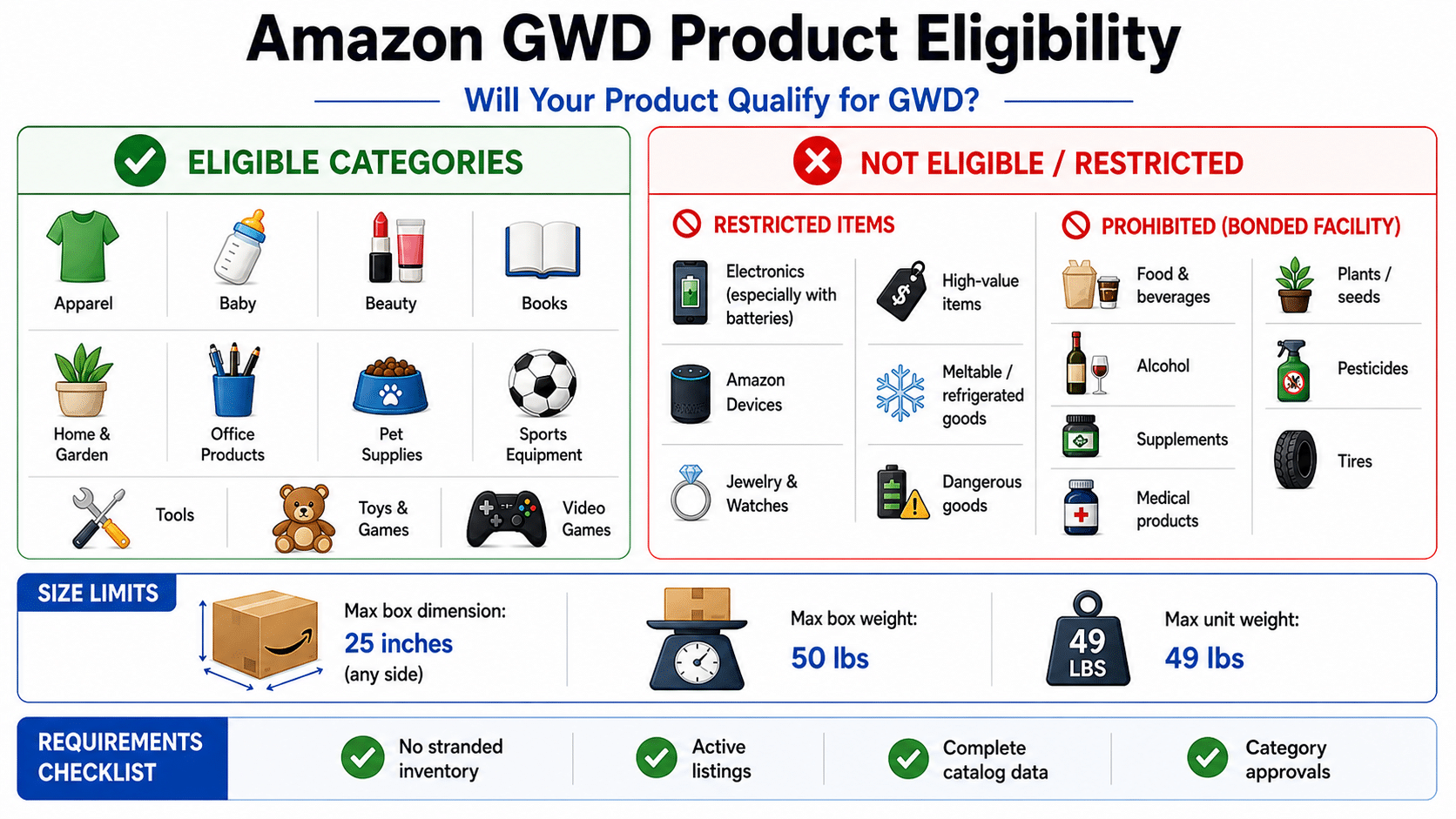
The ineligible list is more selective. Amazon devices, consumer electronics, gift cards, high-value products, jewelry, watches, meltable items, refrigerated goods, and dangerous goods including lithium batteries are all excluded. So if you sell anything with a battery in the box, GWD is not for you yet.
A separate prohibited list covers products that simply cannot enter a bonded facility. Alcohol, vehicle tires, food and beverages, agricultural products, plants, seeds, supplements, medical devices, drugs, and pesticides all fall into this category. Most of these were never going to work in cross-border bonded storage anyway, but check the list before you spend an afternoon on the workflow.
Physical specs are tight. Here are the ceilings:
| Limit | Maximum |
|---|---|
| Box dimensions | 25 inches on any single side |
| Box weight | 50 pounds |
| Unit weight | 49 pounds |
Anything bigger or heavier gets bounced.
Before you ship, your account needs to clear a few prerequisites. None of these are unique to GWD, but the workflow won't let you skip them either.
- No stranded inventory in your account
- Active and valid product listings in the destination store
- Complete catalog attributes for all SKUs you plan to send
- Category pre-approvals where required
If any of these are open, fix them before you start the shipment workflow. The system will block your inbound request otherwise.
Setting Up Your Account
Getting into GWD takes more time than the announcement suggests, and most of that time goes to AGL onboarding rather than GWD itself. There are four hurdles to clear before your first shipment.
1. Account standing. Performance issues block the entire program, not specific shipments. Clear any open warnings before you move forward.
2. AGL enrollment. This is mandatory, and setting it up involves four steps:
- Pick a payment method
- Register an Importer of Record
- Secure an active US customs bond
- File a Power of Attorney
If you've never been the importer of record on your own freight before, this is unfamiliar territory. The customs bond especially has its own approval timeline through a third party, and Amazon doesn't control how long that takes. Build in a buffer of a few weeks.
3. ProCheck setup. The Amazon Customs and Trade ProCheck product library stores HTS codes, cargo descriptions, and country of origin data for each of your SKUs. Without ProCheck data populated, your SKUs default to manual replenishment, which means you lose access to auto-replenishment, the feature Amazon is most excited about. Plan to spend real time getting this right before your first shipment.
4. User permissions. Configure these inside Seller Central before any team members beyond the primary account holder reach the workflow. Permission levels run None, View only, and View and edit, applied separately to inventory pages and the Inventory Ledger report.
How a Shipment Actually Moves
Once you're set up, sending a shipment runs four steps inside Seller Central.
1. Select your inventory. Set your ship-from address, pick Shenzhen as the destination, and add inventory by SKU list or file upload. A few rules to keep in mind:
- File uploads accept a maximum of 150 rows per shipment
- Each box can hold a maximum of 150 units, all from the same SKU
- Mixed-SKU boxes are not allowed
- You can save up to three packing templates per SKU
2. Confirm shipping details. This step covers five pieces of information:
- Shipping mode (you arrange your own carrier to deliver into the Shenzhen warehouse, since Amazon doesn't offer pickup service in China)
- Planned delivery date
- Contact details for shipper, consignee, primary booking contact, notify party, IOR, and exporter
- Incoterms agreed with your supplier
- Payment currency for AGL transportation and customs clearance fees, which has to be USD through the Shipper Central Disbursement account
3. Print and apply labels. This is where new sellers most often trip up. Each box requires a Serialized Ship Container Code (SSCC) label printed in A4, thermal, or US letter format.
Your label shows a US fulfillment center as the destination even though the shipment is going to China. Amazon explains this as a placeholder, and the actual destination fulfillment center gets assigned later at replenishment time.
Mislabeled shipments face delays, rejection, and potential blocking of future shipments. Amazon takes no responsibility for losses caused by label errors, so triple-check the work.
A few rules to keep in mind when applying SSCC labels:
- Each box must have exactly one SSCC label with a unique identification number
- Don't photocopy, reuse, or modify labels for use on additional boxes
- The label on the box must match the FNSKUs placed inside
- Place labels on a flat surface so the barcode doesn't fold over edges or corners
- Keep the label uncovered so it stays scannable
You can add additional labels to the box if you need to, but the SSCC label has to remain completely visible.
4. Book the delivery appointment. Amazon sends instructions within one business day of your inbound request. Bonded or supervised facilities require an Exports Declaration, which typically means preparing these documents:
- Customs Clearance form
- Advanced Shipping Notice
- Commercial Invoice
- Packing List
- Sales contract
You have one business day from receiving the broker's email to complete the templates and submit them. Customs may request additional documentation for special goods like dangerous materials. Amazon also takes no responsibility for costs if your inventory gets rejected for missing your scheduled appointment (which is on-brand).
How Replenishment Works
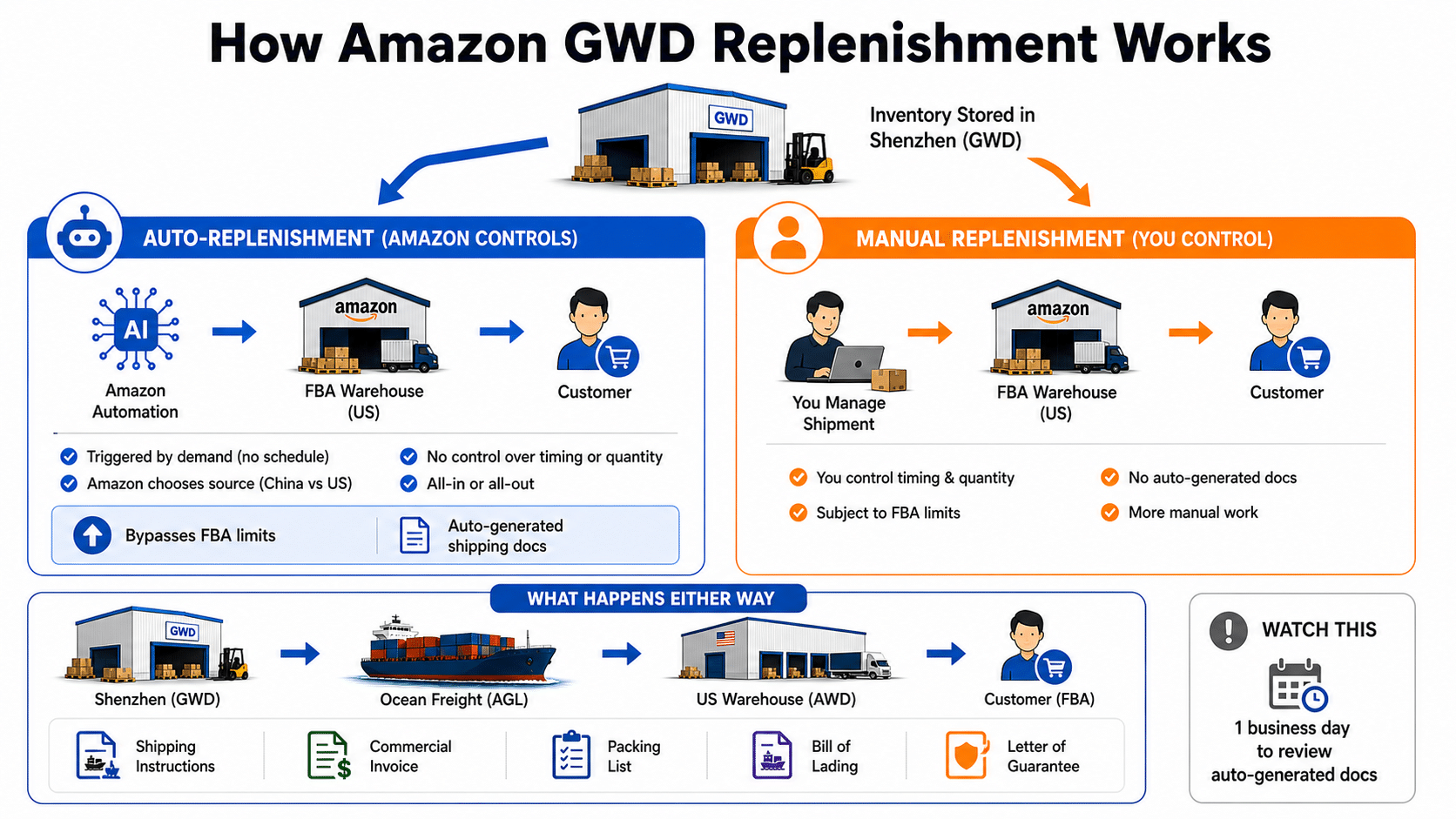
Once your inventory is sitting in Shenzhen, replenishment runs in one of two modes:
Auto-replenishment mode. Amazon decides how much inventory to pull and when, based on demand signals from your FBA sales. The system fires when projected demand will outpace your current FBA stock, considering both on-hand units and inventory already in transit. A few things to know about how this works:
- The trigger isn't on a fixed schedule, so you can't plan around it
- Amazon's science model picks between GWD China and AWD US as the source, based on transit time
- If you stock the same SKU in both locations, Amazon decides which one gets used, not you
- You can only opt in or opt out, with no middle ground
Manual replenishment mode. You control the quantities and timing, but you give up two things in exchange:
- The FBA capacity bypass, since manual shipments stay subject to standard FBA storage limits
- Auto-generated shipping documents, which means more paperwork on your end
Either way, AGL handles the actual cross-border transportation, and you handle the documentation. Required documents include:
- Shipping Instructions
- Commercial Invoice
- Packing List
- Bill of Lading
- Letter of Guarantee
For auto-replenishment, Amazon generates the Shipping Instructions for you using data from your inbound order, the inventory received at the warehouse, and your ProCheck library. You get one business day to review, which isn't a lot of time when you're running a real business.
The Risks Worth Knowing About
Before you commit, there are a few structural risks worth sitting with.
Vendor lock-in. GWD requires AGL enrollment, and switching costs grow as you stow more inventory. Once you have a thousand cartons in Shenzhen, walking away gets expensive.
Inventory recoverability. This is the one that surprises sellers. Bonded warehouse rules at GWD prevent inventory from moving back into China after exports declaration, which means once your goods are stowed and declared, the only direction they go is forward to FBA in the US. If a SKU dies on the shelf, your options shrink fast. The rule comes from Chinese customs, not Amazon, but the effect on your business is the same.
Pricing changes. Amazon adjusted AWD rates effective January 15, 2026, and GWD rates are current as of January 1, 2026. Amazon retains the right to change either schedule, and history says they will.
Single-facility dependency. One Shenzhen warehouse handles all GWD volume right now, which means a disruption from local conditions, customs changes, or capacity constraints affects every GWD seller at the same time. Concentration risk is real.
Documentation burden. Tight one-business-day windows apply to several documents, and penalties for missed deadlines include cargo holds and disposal. If your operation is one person with a spreadsheet, this part gets stressful fast.
So…Should You Use GWD?
GWD makes sense for a specific kind of seller. If you do high volume, source primarily from China, regularly hit FBA capacity limits, and have stable demand on the SKUs you would store at origin, the math probably works in your favor. If you're low volume, your demand swings, your return rates run high, or you source from anywhere other than China, you're better off sitting this round out.
Before you enroll, walk through four questions:
- What does your landed cost look like with GWD versus your current setup, including AGL freight rates you can't see until you sign up?
- Are you comfortable with bonded warehouse rules and what happens if a SKU stops selling?
- Can you absorb the documentation burden?
- And how much do you trust Amazon's auto-replenishment to make good decisions for your SKUs?
The program is new, and independent seller data will accumulate over the next year. For sellers with the volume and risk tolerance to test it, the savings are real money. For everyone else, waiting six months to see how the early adopters fare is a perfectly defensible move.