Sellers Are Sharing Screenshots of Amazon Asking for Star Ratings Mid-Return

What started as a single seller's account is now backed by visual evidence from a second, independent source. A screenshot circulating in the Million Dollar Sellers community shows Amazon's return flow asking a customer to rate a product with a 5-star widget, positioned directly above the Continue button, after the customer has already selected “Defective” as their return reason and answered an AI-generated follow-up question about what specifically went wrong. Eugene Khayman first raised the issue on X on August 20, and this screenshot, shared separately, shows the exact mechanic he described.
What the Screenshot Actually Shows
The flow works in sequence. A customer selects a return reason, in this case “Defective.” Amazon's AI-powered return assistant then asks a specific, contextual follow-up question based on that product category, in the screenshot, asking whether an eye mask's silk was torn, the stitching was loose, or the light-blocking design was insufficient. After the customer answers, the flow presents a 5-star rating widget with the text: “Thanks. To help other shoppers, how would you rate this item? (optional)”
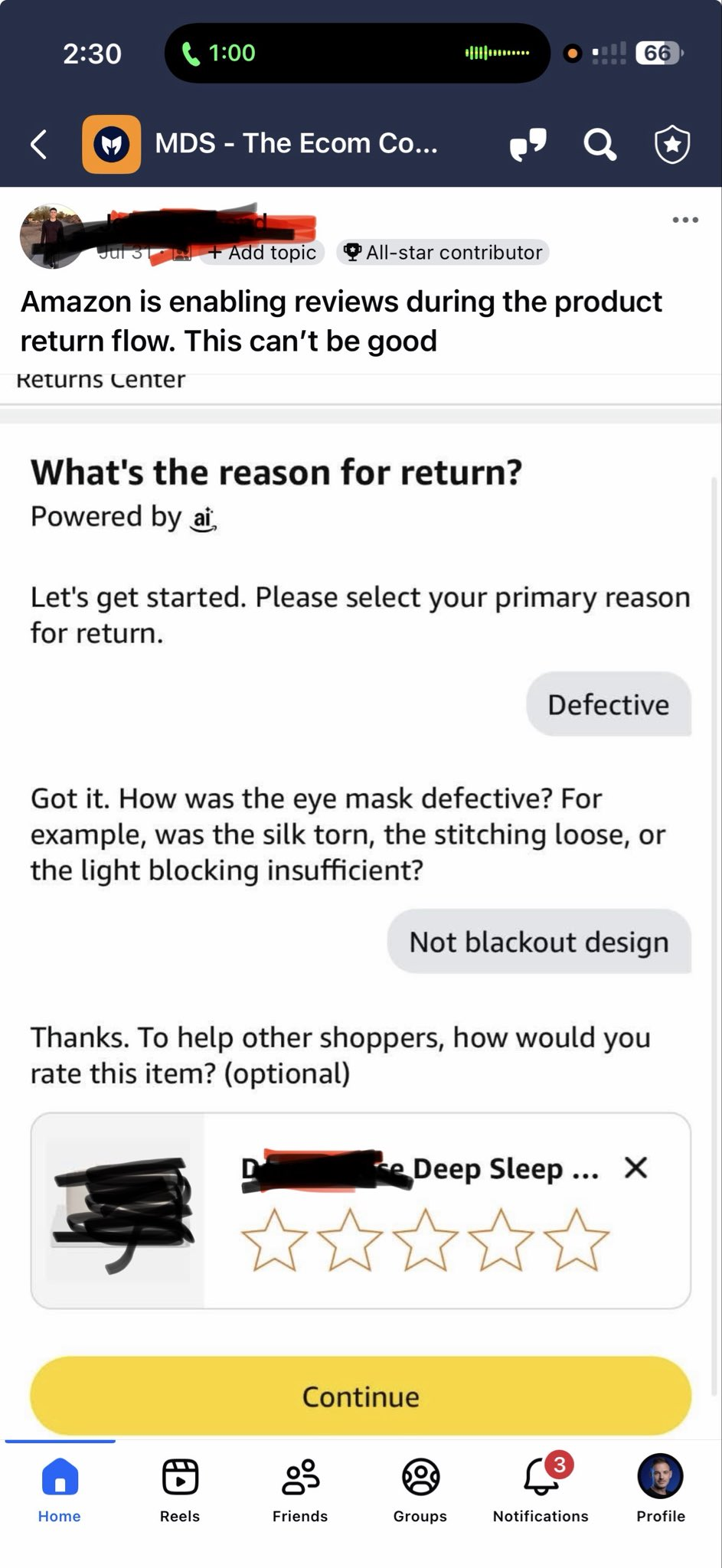
Two details here are worth being precise about. First, the rating request is explicitly marked optional, something the original report didn't specify. Second, this specific example follows a “Defective” selection, meaning the customer has already articulated a problem with the product before being asked to rate it, arguably a more pointed illustration of the selection-bias concern than a generic return prompt would be.
Why Two Independent Reports Change the Verification Picture
I flagged the original claim as unconfirmed because it traced to a single X post with no independent corroboration beyond reply comments. This screenshot comes from a different platform, a different community, and appears to be a separate seller's own account interaction, not a repost of the original claim. Two independently sourced accounts of the same specific mechanic, one described in detail and one now visually documented, is meaningfully stronger evidence than either alone.
That said, the caveat from before still holds in one respect: Amazon has not issued any public statement confirming this feature, and no mainstream trade press has reported on it independently as of this writing. What's changed is the strength of the seller-community evidence, not Amazon's official position.
Why the AI-Generated Follow-Up Question Matters
The “Powered by ai” labeling on the reason-for-return flow adds a layer worth understanding on its own. This isn't a static return form. It's a system generating contextual, product-specific questions based on the return reason selected, then routing directly into a rating request once that context-gathering is complete. If this is accurate and consistent across product categories, it suggests the rating prompt is a deliberate, integrated step in Amazon's newer AI-assisted returns experience, not an isolated UI experiment bolted onto an existing flow.
That framing matters for how you think about Khayman's original concern. A rating request appearing as the natural final step of an AI conversation that just walked a customer through articulating a product defect is a more structurally embedded design choice than a simple pop-up, and potentially harder for Amazon to walk back quickly if seller pushback continues, despite Khayman's original point that removing it wouldn't require significant infrastructure change.
What You Should Actually Do Right Now
If you're seeing unusual negative rating activity clustering around your own return volume, this is now documented and specific enough to reference directly when you escalate to Seller Support or when discussing the pattern with other sellers, rather than relying on a general sense that something changed. Note the reason-for-return category tied to any suspicious rating spikes, since this mechanic appears to trigger specifically after a defect-related reason is selected, which may make certain categories more exposed than others.
Continue treating this as an actively developing situation rather than settled fact. Two corroborating accounts is a meaningfully stronger evidence base than one, but it's still short of Amazon confirmation or independent press verification. Watch official Seller Central announcements and established seller-news outlets over the coming days, since a mechanic this visible and this documented tends to either get confirmed or clarified by Amazon fairly quickly once enough sellers start asking about it directly through official channels.