Meta Ends Credit Card Payments for DTC Ad Accounts—Amazon Next?

Meta began notifying advertising accounts on February 26, 2026, that credit card payments will no longer be accepted. Starting March 2, affected accounts must transition to monthly invoicing by March 31. The change was confirmed in an official email from Meta account representatives, which acknowledged the sensitivity of the shift and cited predictable billing and fewer payment interruptions as reasons for the move.
David Herrmann, an independent media buyer, posted about it on X the same day emails went out, where the thread accumulated over 135,000 views and drew responses from brand operators, agency executives, and media buyers. For anyone still wondering whether this is real, the answer is yes.
What the Change Actually Means
Under the new billing structure, affected accounts move from credit card threshold billing to monthly invoicing, where Meta extends a credit line based on account history, and brands have 30 days to pay after receiving their invoice. Meta framed the benefits as predictable monthly billing, fewer invoices to reconcile, and the elimination of spending limits that stop ads mid-campaign.
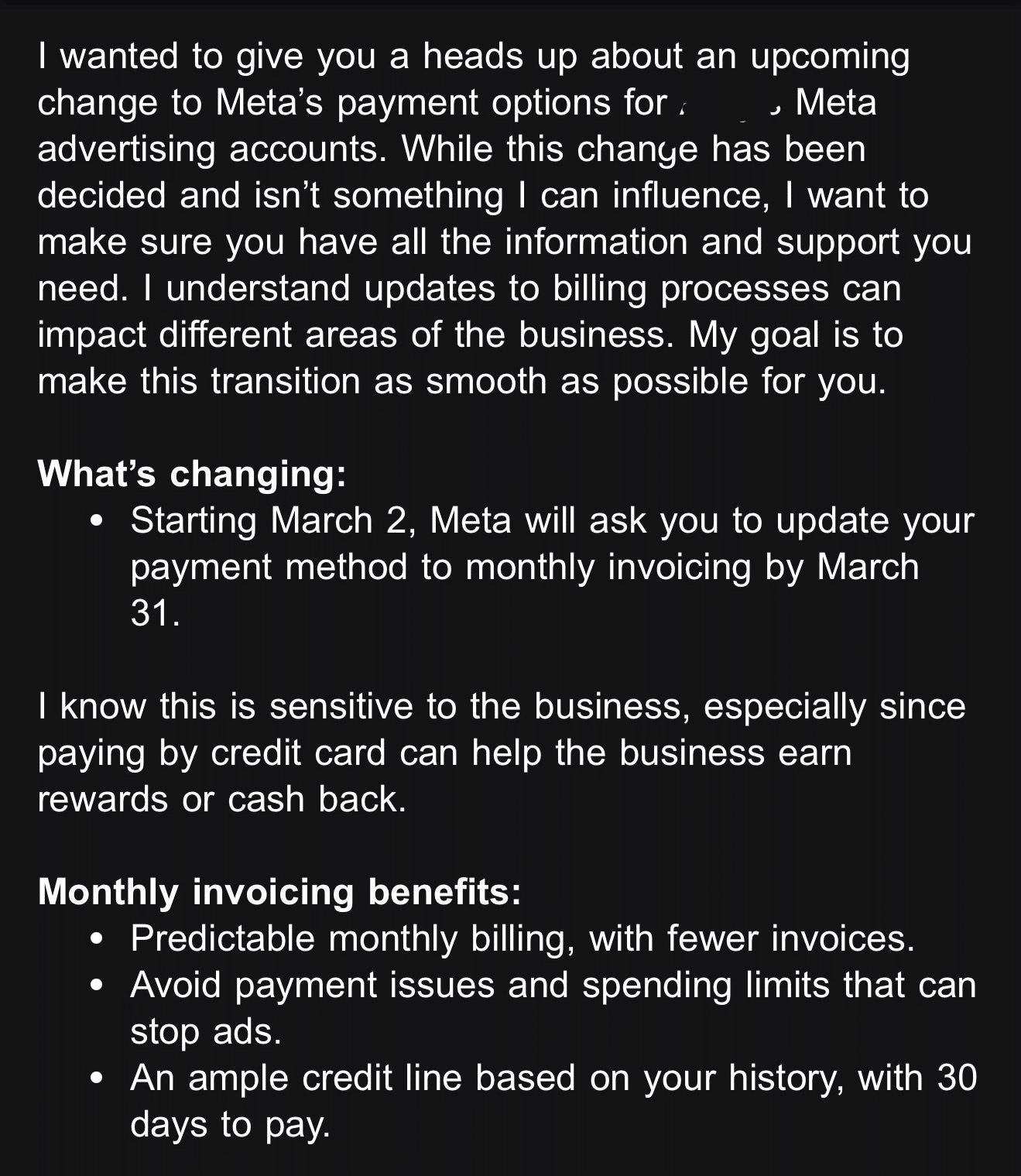
What Meta did not address directly in the email is the part brands are most upset about: the loss of credit card rewards and cash back. For brands spending $50,000 or more per month on Meta ads, a 2% to 3% cash back rate on a business credit card represents real money.
At $50,000 per month, that is $1,000 to $1,500 back every month, or $12,000 to $18,000 per year. At $200,000 per month in ad spend, the math becomes significantly more impactful. Some advertisers in the thread reported pipeline strategies that stacked rewards cards to reach 4% to 4.5% effective cash back on ad spend.
The Cash Flow Problem Is Separate From the Rewards Problem
Beyond the lost rewards, the billing structure shift creates a cash flow timing issue that hits ecommerce brands differently than it hits agencies. Credit card payments typically come with a 21 to 30 day float before the statement closes, effectively extending how long brands hold cash before paying for ads. Monthly invoicing with a 30-day pay window sounds similar on paper, but the timing depends on when Meta issues the invoice and how quickly the payment clears.
For brands that run heavy ad spend in Q4 against inventory purchased months in advance, tighter or less predictable billing cycles add financial pressure at exactly the wrong time. Losing that buffer forces brands to hold more cash or rely on other financing options to cover the gap.
This Is Not the First Time a Major Ad Platform Has Done This

Meta is not the first major ad platform to make this move. Google did the same for high-spend advertisers, requiring accounts above certain monthly thresholds to transition off credit cards and onto monthly invoicing or direct debit. That change drew similar pushback from the DTC community, and the policy held regardless.
As ad platforms scale and billing volumes grow, the cost of processing credit card interchange fees becomes a meaningful line item. Platforms benefit financially from moving advertisers to direct bank-based payments, and they frame the transition as a service improvement while the financial incentive runs in the opposite direction for brands.
Which raises a question the ecommerce industry is already asking: Is Amazon next?
Amazon Ads has grown into one of the largest digital advertising platforms in the world, and many FBA and DTC brands now run significant monthly budgets through Sponsored Products, Sponsored Brands, and DSP campaigns.
Amazon currently accepts credit cards for ad payments across most account types. If Google and Meta have both determined that high-spend advertisers belong on invoicing rather than cards, Amazon has every structural reason to reach the same conclusion.
There has been no announcement from Amazon suggesting this change is coming, but the direction of travel across the industry is consistent enough that sellers should not assume the current setup is permanent.
What to Do Before March 31
The Meta change has been decided and is not subject to negotiation at the platform level. Contact your Meta account representative to confirm your invoicing terms, specifically the credit line amount and billing cycle timing. Model out what the cash flow change means for your Q2 and Q3 before you hit Q4 planning.
If your business relied on credit card rewards as a meaningful line item in your unit economics, adjust that assumption now. And if a significant portion of your ad budget runs through Amazon, it is worth building a billing contingency into your financial planning before an announcement forces the conversation.