Iran’s Devastating Attacks Paralyze Amazon Shipments and AWS

Drone strikes on Jebel Ali port and three Amazon data centres have frozen fulfilment across the region, leaving thousands of third-party sellers unable to ship, sell, or even log in to their stores.
The escalating military conflict in the Middle East has delivered a swift and compounding blow to Amazon's regional e-commerce operations, disrupting both its physical logistics network and cloud computing infrastructure simultaneously, with hundreds of thousands of third-party sellers caught squarely in the crossfire.
Joint U.S. and Israeli strikes against Iran in late February rapidly broadened into a wider regional conflict, triggering the closure of the Strait of Hormuz, a suspension of Suez Canal transits, and sweeping airspace restrictions across Gulf states. For Amazon, the fallout has played out on two distinct but equally damaging fronts: on the ground and in the cloud.
The Logistics Freeze
The sea-lane consequences have been severe and immediate. Container shipping giants, including Maersk, MSC, Hapag-Lloyd, and CMA CGM, have all suspended operations through the Strait of Hormuz and begun rerouting vessels around the Cape of Good Hope. The Strait handles a critical share of global seaborne oil and a vast volume of containerised cargo linked to Dubai's Jebel Ali hub.
Jebel Ali Port itself — the largest container terminal in the Middle East and a key supply node for Amazon's regional FBA warehouses — sustained direct damage. A plume of smoke rose from the port following a reported Iranian strike on March 1, and berth operations have since been suspended. For sellers relying on Jebel Ali to clear customs, unload goods, and replenish FBA inventory, the closure amounts to a complete logistical standstill.
The impact on delivery windows has been swift across all major e-commerce platforms. Major platforms have warned of longer delivery times to the Middle East after the U.S.-led strikes disrupted key air and sea routes, threatening supplies to one of the industry's fastest-growing markets. According to the logistics data platform 17Track, the changes break down as follows:
| Platform | Previous Estimate | Current Estimate | Change |
|---|---|---|---|
| Amazon | ~25–35 days | 35–45 days | +10 days |
| Temu | ~15 days | ~20 days | +5 days |
| SHEIN | 5–8 days | 8–10 days | +2–3 days |
For sellers with goods already in transit, the options are grim. Shipments are either being held at ports or rerouted around the Cape of Good Hope — a detour that adds roughly 10 to 20 days to voyage times while pushing freight costs sharply higher. Even in the best-case scenario where goods eventually reach their destination, significantly eroded margins are the likely outcome.
“The risk of geopolitics has shown its ugly face with higher frequency and more severity over the past years than ever before.”
— Peter Sand, Chief Analyst, Xeneta, via CNBC
The hardest-hit sellers are those who had planned to stock up in March for the Ramadan sales peak — traditionally one of the region's biggest retail events. Inventory pipelines built months in advance have been rendered useless by the abrupt closure of sea routes and the suspension of ground operations.
Abu Dhabi Fulfilment Centre Closed, Deliveries Suspended
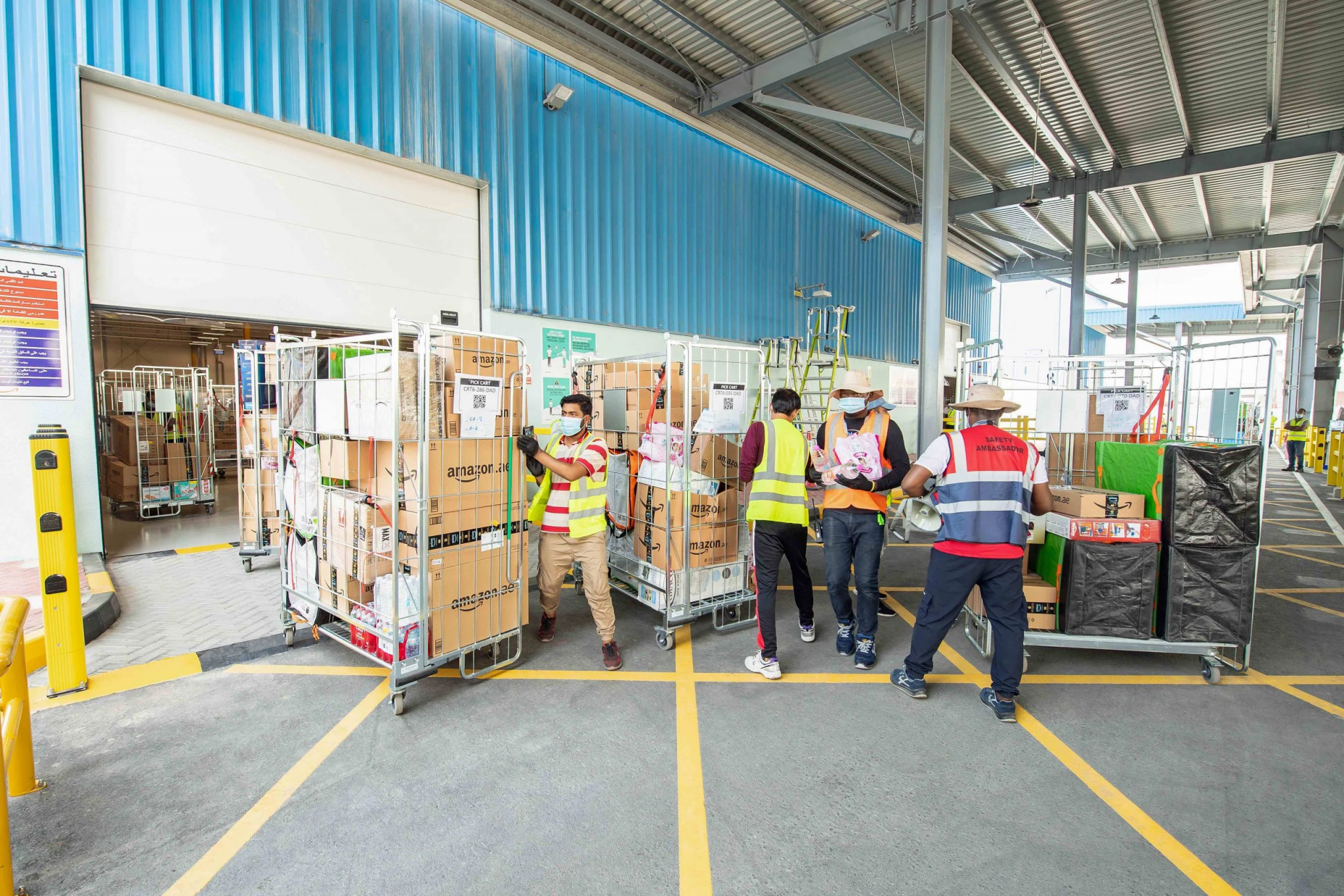
Beyond the port disruptions, Amazon has taken direct operational action of its own. Amazon warned customers of delivery delays in the Middle East as Iran targeted the region with missiles and drones, subsequently closing its Abu Dhabi fulfilment centre — a cornerstone of its UAE, Saudi Arabia, Egypt, and Turkey operations — and suspending all delivery services in the area.
The implications for sellers are stark: even those who had managed to pre-position inventory in the region before the crisis cannot fulfil existing orders. Orders are being cancelled and lost, with sellers having no mechanism to intervene. Industry insiders say freight forwarders and shipping companies have largely adopted a wait-and-see stance, with no clear timetable for a resumption of services. Amazon has stated that the broader operating environment in the Middle East “remains unpredictable” and has instructed all corporate employees in the region to work remotely.
AWS Data Centres Take Direct Hits
Compounding the logistics freeze, Amazon's cloud infrastructure in the region has also sustained physical damage. Amazon Web Services warned of prolonged disruptions after drone strikes damaged three of its data centres — two in the UAE and one in Bahrain. AWS confirmed that two UAE facilities were directly struck, while the Bahrain centre was damaged by a strike in proximity to the building.
The service impact was immediate and broad. Consumer apps, including Careem, Alaan, and Hubpay reported outages, while banking providers ADCB and Emirates NBD, alongside enterprise platforms like Snowflake, saw disruptions cascade from the downed AWS infrastructure. For cross-border sellers, the consequences were direct: store back-ends, order management systems, inventory dashboards, advertising consoles, fund settlement tools, and ERP integrations all run on cloud services. Sellers on Amazon's UAE site reported widespread app inaccessibility, checkout failures, and stalled order data updates.
AWS warned that instability is likely to continue and advised customers to consider backing up data or migrating critical workloads to other AWS regions. Given the nature of the physical damage involved, a rapid return to full service is considered unlikely.
A Broader Supply Chain Shock
The disruption to Amazon's operations sits within a wider supply chain shock rippling across global markets. Asian liquefied natural gas prices surged to their highest level since 2023 after the conflict forced a shutdown at Qatar's major export plant and halted shipping through the Strait of Hormuz, with spot prices reportedly more than doubling in a matter of days.
The confluence of closures — a major port, a critical shipping strait, and foundational cloud infrastructure — has led analysts to compare the current situation to the severity of the 2021 Suez Canal blockage, though the geopolitical dimensions of the present crisis make a rapid resolution considerably less certain.
What Sellers Should Do Now
With no clear timeline for recovery across either logistics or cloud services, the practical guidance from industry observers is consistent. Sellers with significant exposure to the Middle East are advised to act quickly to protect their positions.
Recommended Actions for Affected Sellers
- Contact freight forwarders immediately to verify the status and location of in-transit goods
- Confirm inventory positions and payment security with Amazon Seller Central and third-party logistics providers
- Pause new inbound shipments from China to the Middle East until conditions stabilise
- Scale back advertising spend in the region, where impressions and conversions are heavily disrupted
- Explore alternative fulfilment routes if goods are already en route, including Cape of Good Hope diversions
- Monitor AWS service health dashboards and consider migrating critical workloads to alternative regions as AWS has advised
When Amazon's Abu Dhabi distribution centre will reopen, when AWS servers will return to stable operation, and when shipping lanes through the Strait of Hormuz will be declared safe — these questions remain unanswered for the foreseeable future. For sellers who built their Middle East strategy around the region's strong recent growth trajectory, the conflict is a stark reminder that geopolitical risk is now as integral a planning variable as seasonal demand cycles.