Mother’s Day Outspends Father’s Day by Billions—Here’s Why

Every year, consumers show up for Mother’s Day with bigger budgets, broader participation, and more emotional urgency than they do for Father’s Day.
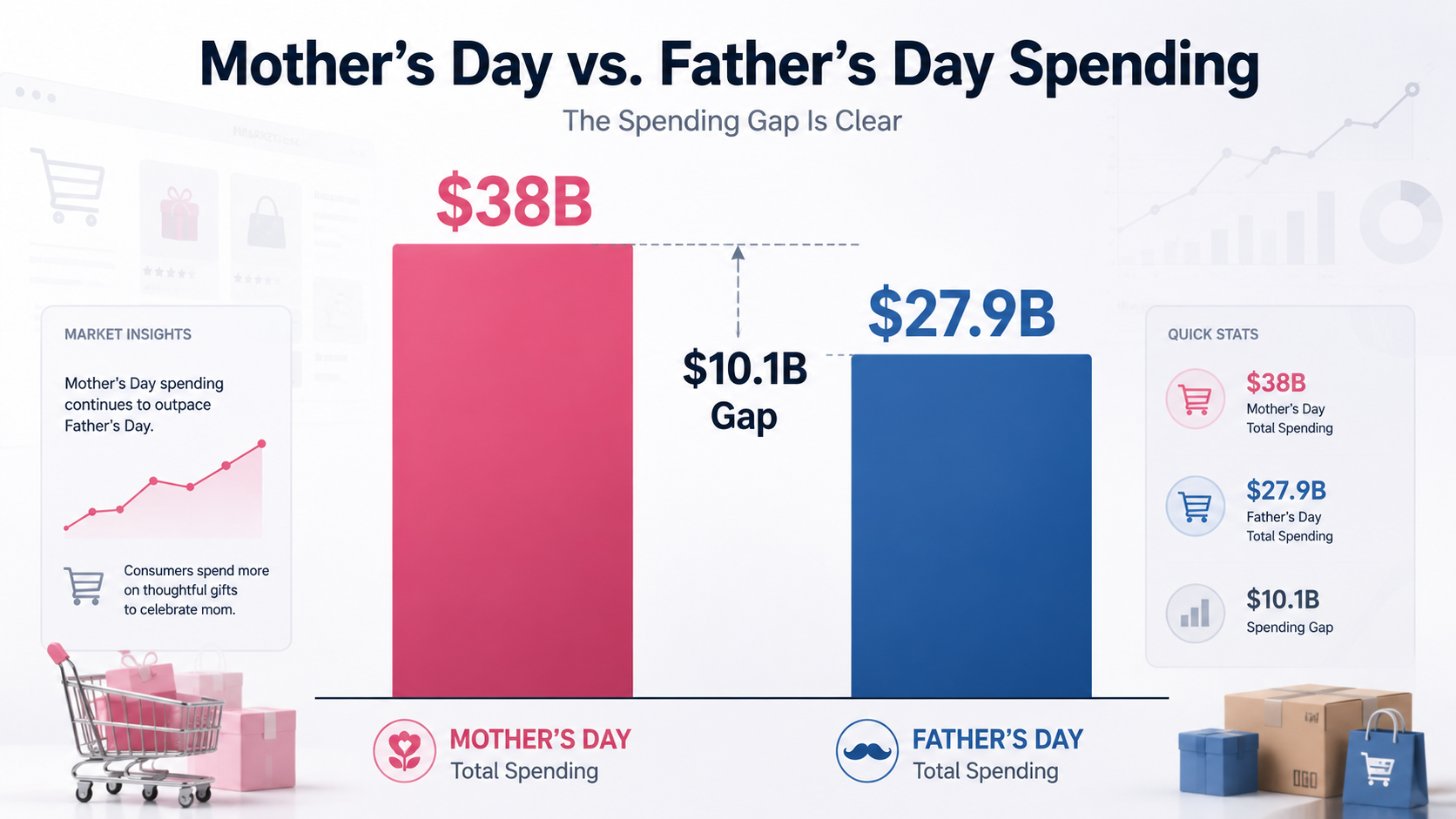
In 2026, shoppers were expected to spend a record $38 billion on Mother’s Day, according to the National Retail Federation’s latest Mother’s Day survey. For Father’s Day, spending was also projected to hit a record high, but at a much lower total: $27.9 billion, based on NRF’s Father’s Day spending data.
That is still a massive holiday. But it also means Mother’s Day outspends Father’s Day by roughly $10.1 billion.
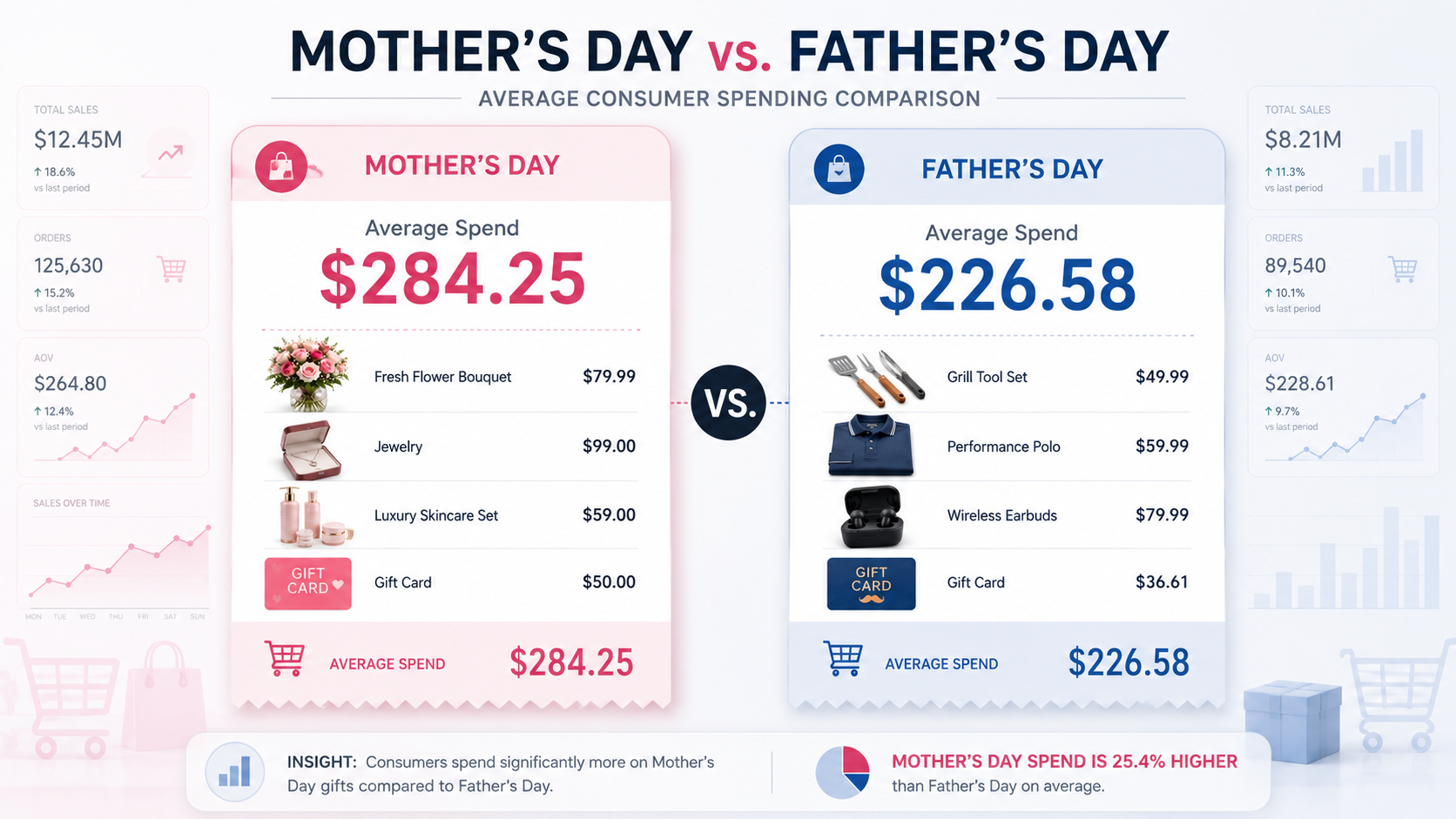
On a per-person basis, the gap is just as clear. Consumers planned to spend $284.25 on Mother’s Day gifts in 2026, compared with $226.58 on Father’s Day. Participation is higher too: 84% of U.S. adults planned to celebrate Mother’s Day, while 77% planned to celebrate Father’s Day.
For ecommerce sellers, this is more than a fun retail trivia question. It is a useful look at how emotional buying behavior, holiday timing, product category, and advertising strategy can shape demand.
If you sell on Amazon, Shopify, Walmart, or any other marketplace, the lesson is obvious: not all gifting holidays behave the same.
The Spending Gap Is Smaller Than Before, But Still Huge
The Mother’s Day vs. Father’s Day gap has narrowed in 2026 because Father’s Day spending jumped meaningfully from the previous record of $24 billion in 2025 to $27.9 billion in 2026. Dad is not exactly getting ignored anymore.
But Mother’s Day is still the larger retail event by a comfortable margin.
The simplest explanation is that Mother’s Day combines three things ecommerce brands love: more shoppers, higher spend per shopper, and stronger emotional purchasing intent.
Mother’s Day shoppers are not just buying a card because the calendar told them to. They are often buying flowers, jewelry, special outings, gift cards, clothing, beauty items, electronics, and “something unique.” NRF reported that 75% of Mother’s Day shoppers planned to buy flowers, while jewelry led total category spending at $7.5 billion.
Father’s Day shoppers are also spending more than ever, but the category mix looks different. NRF’s 2026 data shows greeting cards, clothing, special outings, and gift cards leading the list. Those are valuable categories, but the emotional and premium-gifting ceiling still tends to be lower.
That is where ecommerce brands should pay attention. The gap is not just about moms and dads. It is about how consumers assign emotional value to a purchase.
Mother’s Day Had a 58-Year Commercial Head Start
One reason Mother’s Day has a deeper retail footprint is simple: it became official much earlier.
Mother’s Day was made a national observance in the United States in 1914, when President Woodrow Wilson proclaimed the second Sunday in May as the holiday. Father’s Day, despite being celebrated in some form earlier, did not become a national holiday until 1972.
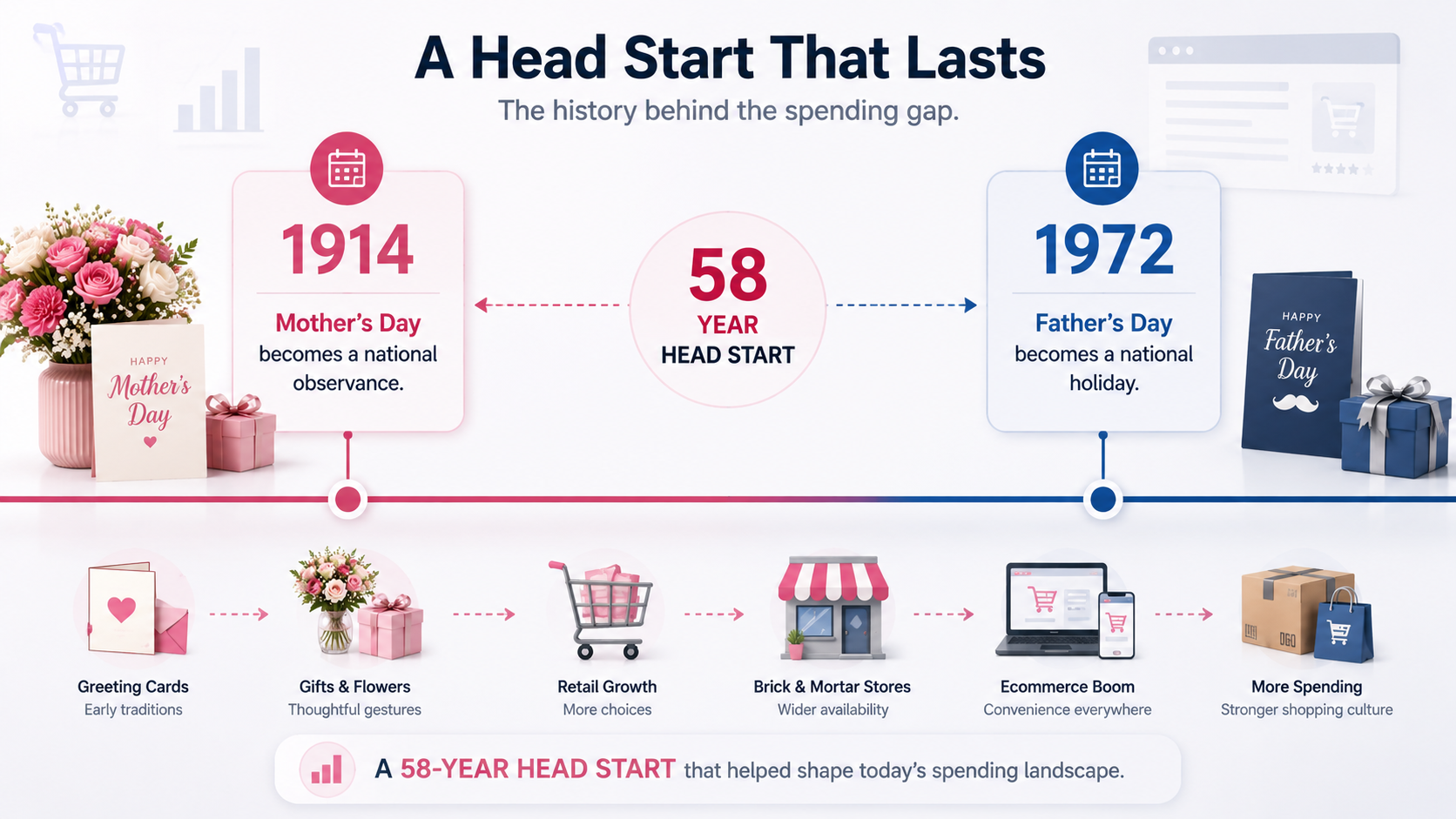
That gave Mother’s Day a 58-year head start in building traditions around flowers, cards, restaurants, jewelry, and gifting rituals.
That kind of head start matters in retail. Commercial habits compound. Once families get used to buying flowers, booking brunch, sending cards, and spending extra on mom every year, those behaviors do not vanish just because another holiday gets added to the calendar.
Retailers also had decades longer to train shoppers around Mother’s Day promotions. Florists, jewelers, restaurants, department stores, and eventually ecommerce brands all built campaigns around the idea that Mother’s Day is a major gift-giving moment.
Father’s Day has grown, especially in categories like apparel, electronics, grilling, tools, personal care, subscription boxes, and experiences. But it is still catching up to a holiday with more than a century of commercial muscle behind it.
Mother’s Day Marketing Is More Emotional
Look at the average Mother’s Day ad and the message is usually serious, sentimental, and appreciation-heavy.
Mom sacrificed. Mom showed up. Mom deserves something special.
Now look at a lot of Father’s Day marketing.
Dad likes grilling. Dad needs socks. Dad wants a gadget. Dad makes bad jokes. Dad will be fine.
This is not exactly subtle. Mother’s Day campaigns often push shoppers toward emotionally loaded, higher-consideration gifts. Father’s Day campaigns often lean into humor, practicality, and last-minute convenience.
That difference affects spending behavior. If a customer feels that the purchase is tied to gratitude, sacrifice, and emotional recognition, they are often more willing to spend more. If the purchase feels like a practical token, the ceiling is lower.
For sellers, this is where product positioning matters. A garden statue, necklace, spa set, framed photo, or personalized keepsake can become a “meaningful gift for Mom” with the right creative. A grill basket, multitool, or polo shirt can absolutely work for Father’s Day, but the messaging usually has to fight harder to create the same emotional premium.
That does not mean Father’s Day creative should suddenly become melodramatic. Please do not make Dad cry over a wrench unless you really know what you are doing. But it does mean sellers should stop treating Father’s Day as the generic “male gift guide” holiday.
Mother’s Day Buyers Give Sellers a Longer Runway
Timing is one of the biggest practical differences between the two holidays.
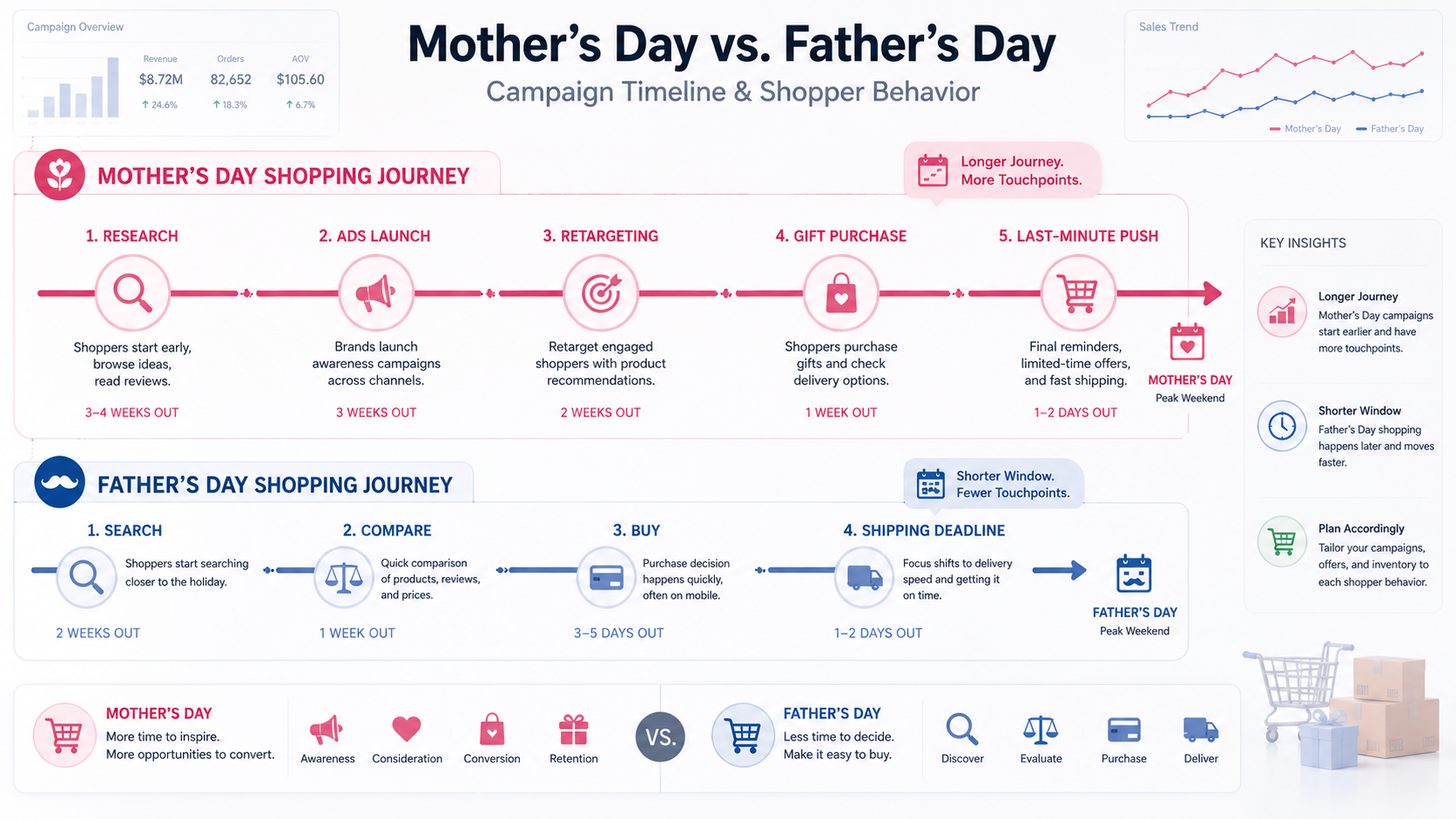
Mother’s Day tends to support a longer campaign window. Shoppers plan earlier, compare gift options, and often look for items that feel thoughtful. That gives ecommerce sellers more room to test creatives, build retargeting audiences, optimize listings, and scale ads before the final rush.
Amazon’s own guidance on holiday advertising strategy recommends planning around key retail events early and building campaigns around dates that are relevant to your products. That advice matters even more for holidays like Mother’s Day, where demand can build weeks before the actual date.
Father’s Day is often more compressed. Shoppers still spend billions, but the behavior skews more practical and more last-minute. That can still be profitable, especially if your category fits the holiday well, but the campaign strategy should be different.
For Mother’s Day, sellers can usually justify earlier ad testing, broader keyword coverage, gift-guide positioning, and premium bundles. For Father’s Day, the playbook may need to focus more on fast shipping, clear use cases, sharp pricing, and urgency-driven creative.
If you are running Amazon campaigns, this is also where your budget pacing matters. A seller who needs a refresher on campaign structure can start with EcomCrew’s Amazon PPC strategy guide before throwing money at seasonal keywords and hoping Bezos personally blesses the ACoS.
What the Spending Gap Means for Inventory Planning
For ecommerce sellers, holiday demand is not just an advertising problem. It is an inventory problem.
Mother’s Day’s larger market size and longer buying window mean sellers need to start planning earlier if their products naturally fit the holiday. That is especially true for private label sellers importing inventory from overseas, where production, freight, check-in delays, and FBA receiving times can wreck a seasonal campaign before it even starts.
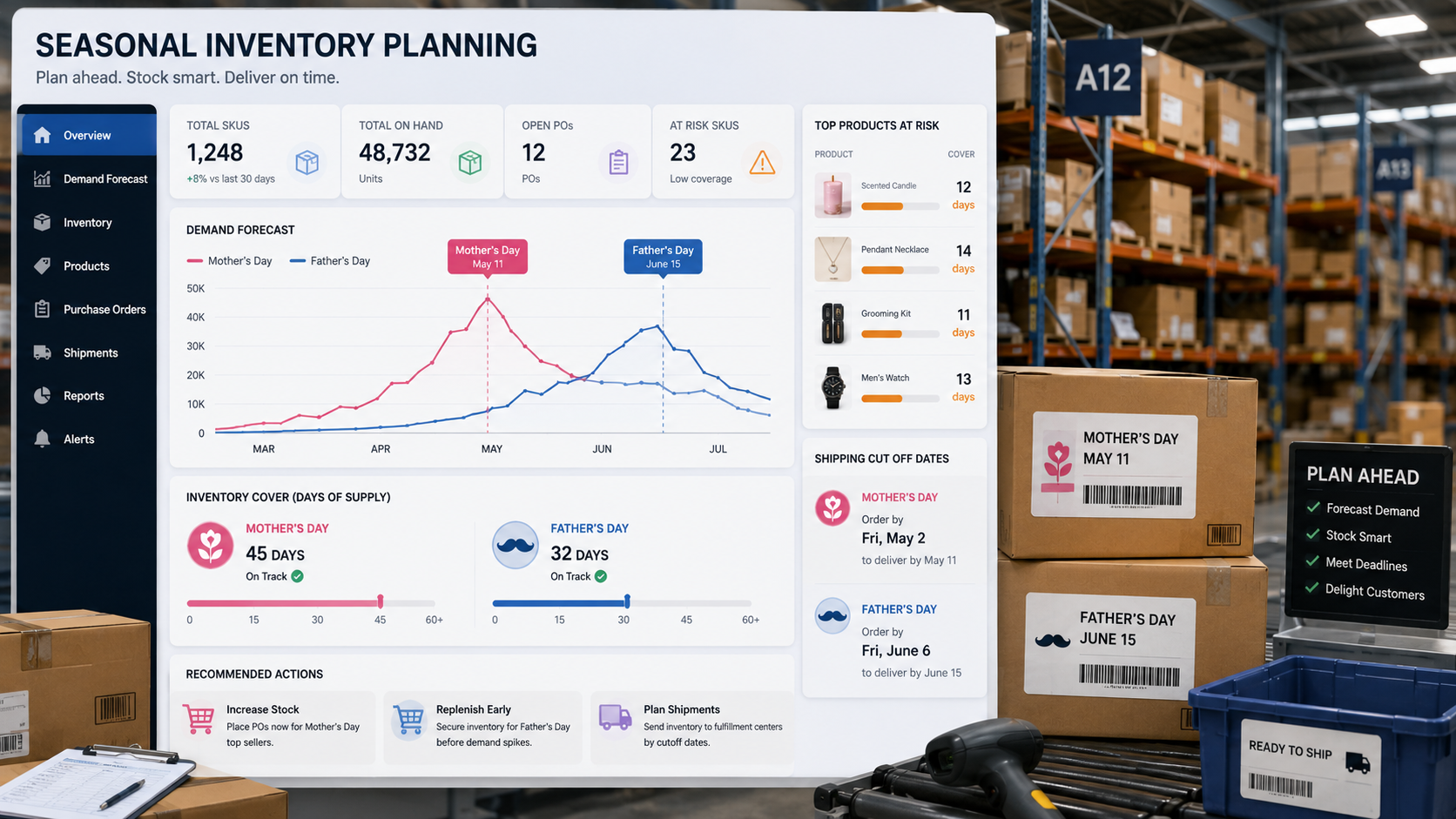
If your product is giftable for Mother’s Day, you should not be thinking about inventory in late April. By then, you are already playing chicken with Amazon’s receiving system, and Amazon is very comfortable letting you lose that game.
For Mother’s Day, sellers should look at:
- Prior year sales by SKU
- Keyword trends from the previous holiday cycle
- Current inventory cover
- FBA check-in times
- Seasonal bundle opportunities
- Giftable packaging or inserts
- Coupons and promotions planned around the holiday
Father’s Day needs inventory planning too, but sellers should be more careful about over-ordering. Because the campaign window is often shorter and more category-dependent, it is easier to overestimate demand if you are looking only at broad holiday spending numbers.
A grill accessory brand may want to stock up aggressively for Father’s Day. A generic home decor brand probably should not.
The goal is not to buy inventory because a holiday exists. The goal is to buy inventory because your product has a believable reason to convert during that holiday.
Product Category Matters More Than the Holiday Itself
It would be a mistake to conclude that Mother’s Day is always better than Father’s Day for every seller.
The better question is: does your product naturally fit the way people shop for that holiday?
Mother’s Day is especially strong for categories tied to beauty, jewelry, flowers, home decor, sentimental gifts, clothing, electronics, and experiences. Father’s Day can be excellent for grilling products, tools, outdoor gear, electronics, apparel, personal care, hobby products, and subscription boxes.
If you sell a premium skincare set, Mother’s Day may be your Super Bowl. If you sell grill accessories, Father’s Day may outperform Mother’s Day by a mile. If you sell generic home organization products, neither holiday may be a perfect fit unless you create a convincing gift angle.
This is why sellers should look beyond broad retail spending totals and analyze category-level demand. Amazon has been giving sellers more tools for this over time, including Product Opportunity Explorer, which we covered in our guide on how to use Product Opportunity Explorer to find competitor ASIN keyword and sales data.
The big spending holiday is not always the best holiday for your product. The best holiday is the one where your product matches the buyer’s intent.
How Sellers Can Reposition Products for Each Holiday
One of the easiest mistakes ecommerce sellers make is assuming a product either is or is not a holiday product.
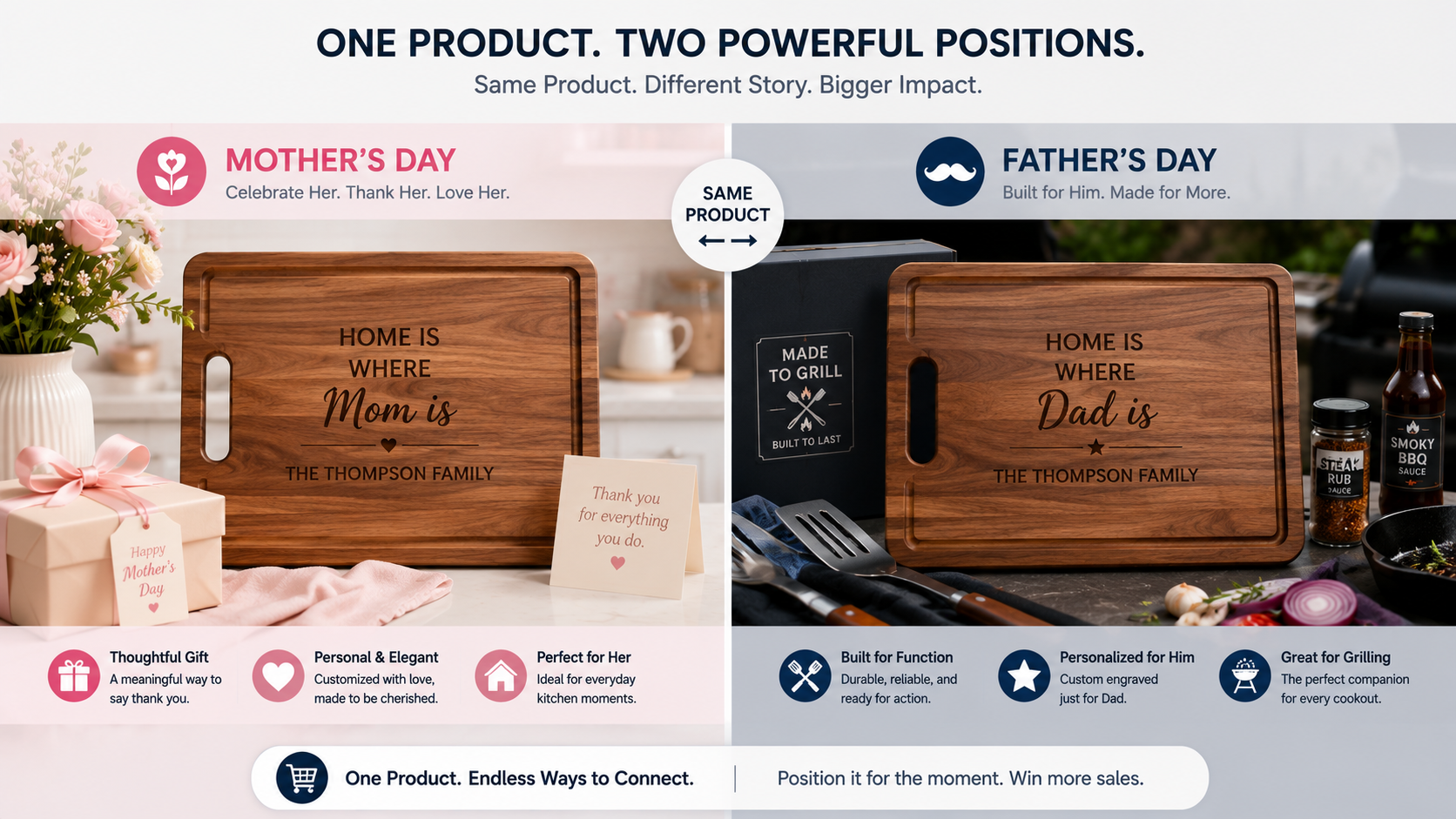
In reality, many products can become seasonal if the positioning is believable.
A regular product can become giftable when the listing, images, copy, and ads frame it around the buyer’s intent.
For example:
- Garden decor can become a Mother’s Day garden gift.
- A tea sampler can become a relaxing gift for Mom.
- A robe or blanket can become a self-care gift.
- A personalized cutting board can work for either Mother’s Day or Father’s Day depending on the creative.
- A grill basket can become a Father’s Day BBQ gift.
- A multitool can become a practical gift for Dad.
- A massage gun can become a recovery gift for dads who golf, run, or pretend their knees are still 25.
- A coffee subscription can become a gift for either parent if the messaging changes.
The product does not always need to change. The context does.
That said, sellers should not force it. Slapping “Mother’s Day Gift” or “Father’s Day Gift” onto a product with no real gifting angle is not a strategy. It is a keyword bandage.
If the connection feels fake, shoppers can tell. Worse, Amazon’s algorithm may reward the click but punish the poor conversion rate. That is how sellers end up paying for traffic that was never going to buy.
Amazon Search Behavior Rewards Seasonal Relevance
On Amazon, seasonal relevance can turn ordinary products into holiday gifts.
A garden ornament is not inherently a Mother’s Day product. A grill basket is not inherently a Father’s Day product. But with the right title, images, listing copy, and ad targeting, both can become giftable in the eyes of shoppers.
That is why sellers often inject seasonal keywords into listings and campaigns around holidays. The goal is not to pretend the product only exists for one day a year. The goal is to catch the temporary wave of high-intent search behavior.
The tricky part is knowing which keywords actually have demand and which ones only look good in a keyword tool. We have written before about whether sellers can really trust Amazon keyword tool estimates, and seasonal holidays are exactly where this gets messy. Search volume can spike quickly, drop quickly, and distort averages.
For Mother’s Day, demand often stretches across multiple related searches: “gifts for mom,” “Mother’s Day gifts,” “gifts for wife,” “personalized gifts for mom,” and category-specific gift terms.
For Father’s Day, searches can be more utilitarian: “Father’s Day gifts,” “gifts for dad,” “grill gifts,” “golf gifts,” “tools for dad,” and similar terms.
The strategy is not just to bid on “Mother’s Day gifts” or “Father’s Day gifts” and call it a day. Those terms can get expensive and broad. A smarter approach is to layer holiday keywords with product-specific intent.
For example:
- “Mother’s Day garden gift”
- “personalized necklace for mom”
- “spa gift set for wife”
- “Father’s Day grill accessories”
- “gifts for dad who likes fishing”
- “men’s personal care gift set”
Specificity usually beats lazy broad-match chaos. Amazon already has enough chaos. No need to contribute to the ecosystem.
How Amazon Sellers Should Adjust PPC for Mother’s Day and Father’s Day
Mother’s Day and Father’s Day should not have identical Amazon PPC campaigns.
The buyer behavior is different, the timing is different, and the emotional intent is different. If your ad structure treats them the same, your campaign is probably leaving money somewhere it should not.
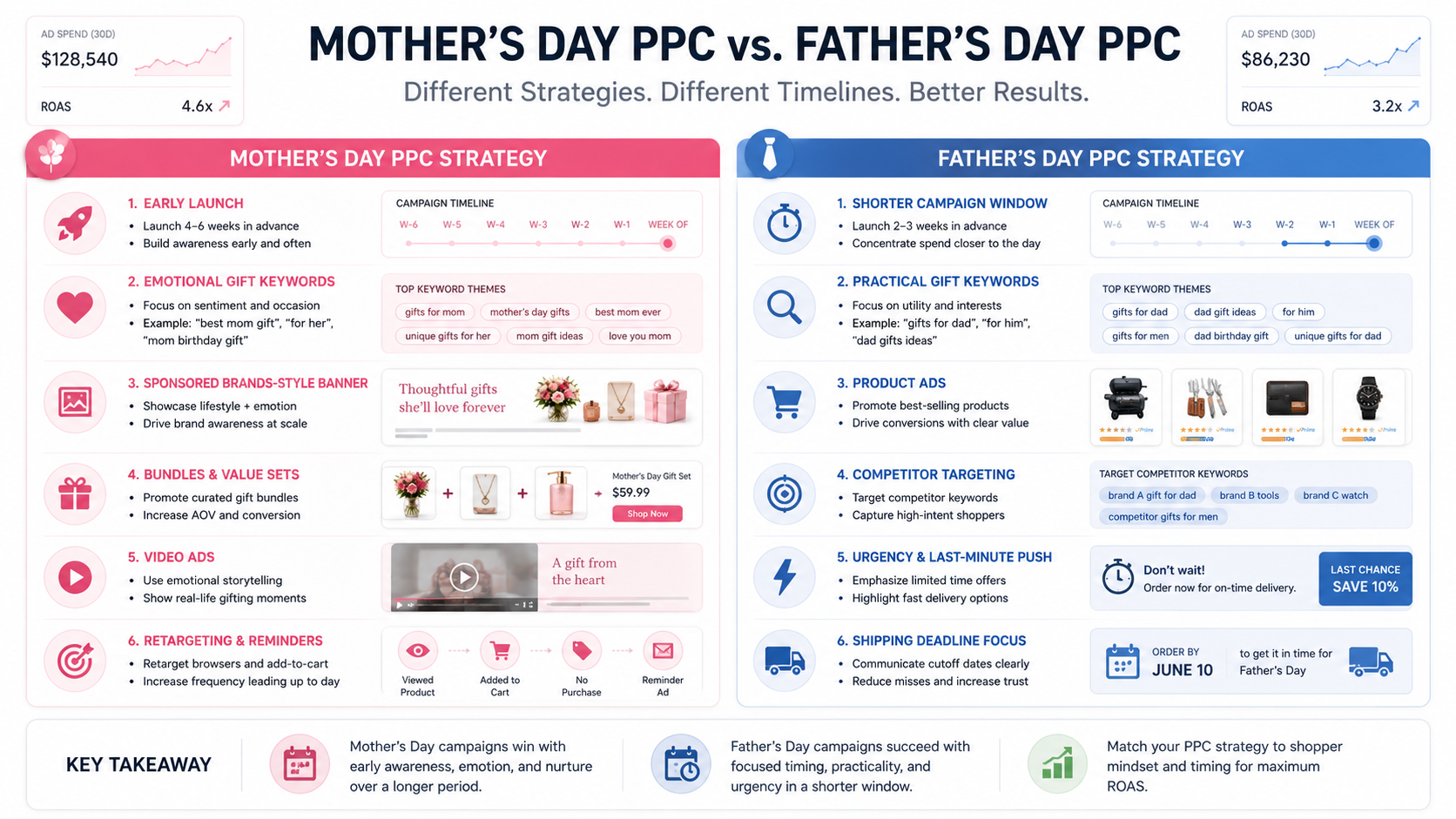
For Mother’s Day, sellers can usually afford to start earlier and test more angles. The holiday supports broader gift discovery, especially for products in jewelry, beauty, decor, apparel, kitchen, self-care, personalized gifts, and experience-adjacent categories.
A Mother’s Day PPC structure might include:
- Separate campaigns for holiday keywords
- Product-specific gift keywords
- Sponsored Brands campaigns for gift bundles
- Sponsored Brands Video for visually giftable products
- Retargeting campaigns for shoppers who viewed but did not buy
- Coupon-backed campaigns closer to the holiday
- Long-tail keywords such as “gift for mom who gardens” or “relaxing gifts for mom”
Father’s Day campaigns should usually be tighter. The window is shorter, and shoppers are often looking for practical gifts or fast solutions.
A Father’s Day PPC structure might include:
- Product-specific holiday campaigns
- Long-tail practical gift keywords
- Sponsored Products campaigns focused on high-converting ASINs
- Competitor targeting for similar giftable products
- Budget increases closer to the shipping deadline
- Copy that emphasizes utility, delivery speed, and gift readiness
For both holidays, sellers should separate seasonal campaigns from evergreen campaigns. Otherwise, it becomes harder to tell whether a keyword actually works year-round or only converted because shoppers were panic-buying gifts before a deadline.
The big mistake is letting seasonal campaigns pollute your evergreen data. Holiday clicks can look great in the moment and completely distort your normal keyword strategy afterward.
Holiday Listing Checklist for Amazon Sellers
Before spending heavily on Mother’s Day or Father’s Day traffic, sellers should make sure the listing is ready to convert.
Seasonal demand will not save a weak listing. It will just send more expensive traffic to a page that still does not close the sale.
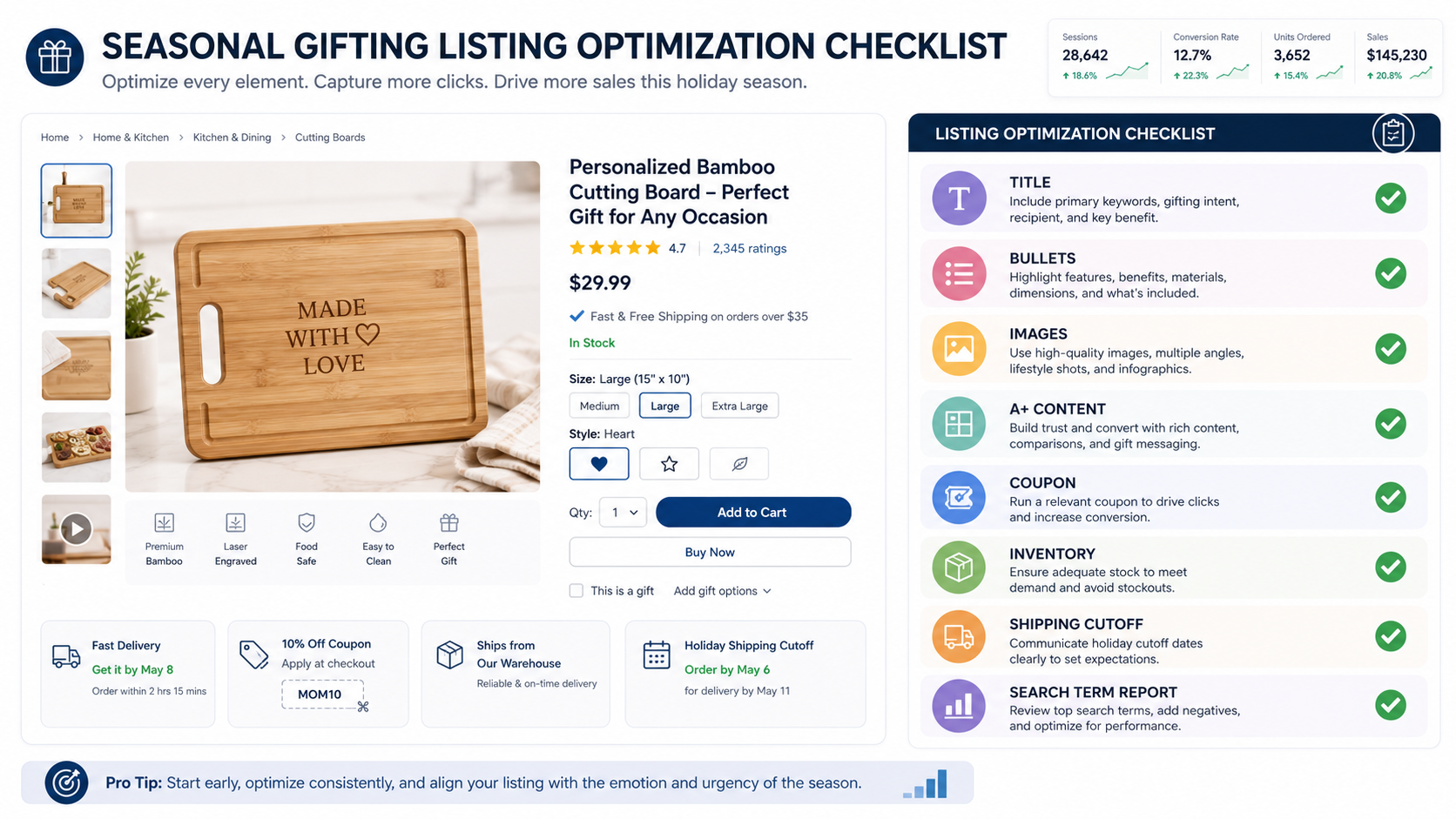
Here is a practical checklist:
- Add relevant seasonal keywords where they fit naturally.
- Do not keyword-stuff the title until it reads like it was written by a malfunctioning vending machine.
- Update bullet points to include gift use cases.
- Add a gift-focused image if it complies with Amazon’s image guidelines.
- Consider seasonal A+ Content if the product is a strong holiday fit.
- Highlight bundles, personalization, packaging, or gift-ready features.
- Use coupons or promotions strategically, especially near the final buying window.
- Check FBA inventory levels before scaling PPC.
- Confirm shipping cutoff dates.
- Monitor conversion rate, not just clicks.
- Separate holiday campaigns from evergreen campaigns.
- Review search term reports after the holiday for reusable keywords.
A good holiday campaign starts before the shopper sees the ad. If the listing does not communicate why the product makes sense as a gift, the click is already fighting uphill.
For sellers still working on organic visibility, our guide on how to rank items and keywords well on Amazon is a good foundation before layering seasonal campaigns on top.
Why the Mother’s Day Premium Exists
The Mother’s Day premium comes down to perceived emotional value.
Consumers are not only buying the object. They are buying the message attached to the object.
A $40 gift basket is not just snacks and packaging. It is “I appreciate you.” A $75 necklace is not just metal and stones. It is “You matter.” A $150 spa day is not just a service. It is “You deserve rest.”
That emotional layer gives brands room to increase average order value through bundling, personalization, gift packaging, handwritten notes, premium positioning, and curated gift guides.
Father’s Day can support the same strategy, but sellers often underuse it. Instead of positioning products as meaningful, many Father’s Day campaigns default to “Dad likes meat, tools, beer, and sitting down.” Inspiring stuff.
The brands that win Father’s Day are the ones that understand the actual customer behind the gift. Is the buyer a daughter looking for something thoughtful? A spouse buying from the kids? An adult child who wants something useful but not boring? The sharper the customer angle, the better the creative.
Common Mistakes Sellers Make During Gifting Holidays
Holiday traffic can be profitable, but it also makes sellers do strange things.
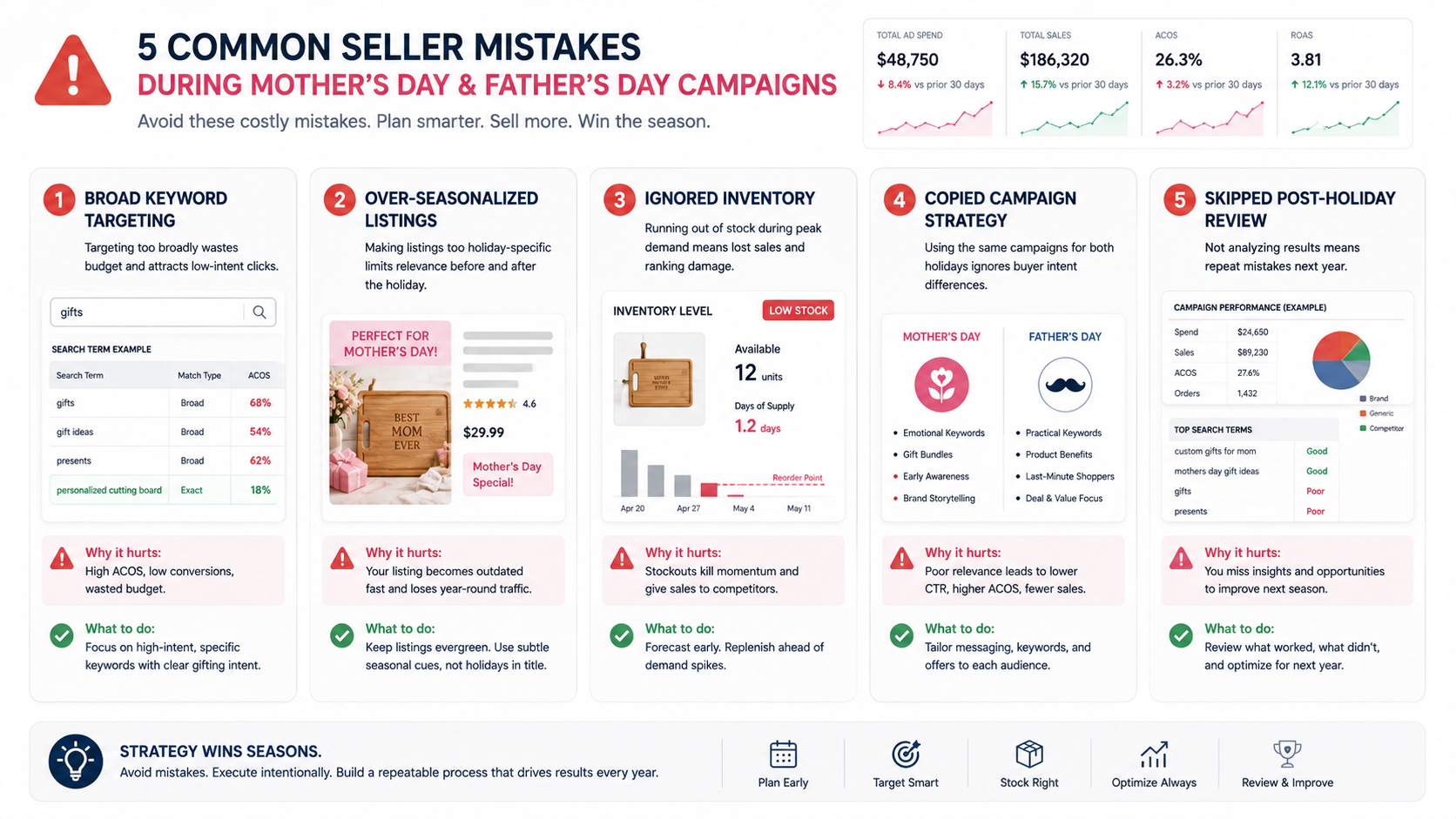
Mistake #1
The first mistake is targeting overly broad keywords with no plan. “Mother’s Day gifts” and “Father’s Day gifts” may have plenty of volume, but they can also be expensive, vague, and brutally competitive. If your product is not a strong fit, broad holiday keywords can burn through budget quickly.
Mistake #2
The second mistake is changing the listing too aggressively. Seasonal optimization is useful, but sellers should avoid making the listing so holiday-specific that it damages evergreen relevance. If a product sells year-round, do not turn the entire listing into a one-week greeting card.
Mistake #3
The third mistake is ignoring inventory. A strong PPC campaign is not helpful if the product stocks out right before the highest-converting days. Running out of inventory during a seasonal spike can hurt momentum, rankings, and profitability.
Mistake #4
The fourth mistake is copying the same strategy across both holidays. Mother’s Day and Father’s Day may both be gifting holidays, but they are not the same buyer journey.
Mistake #5
The fifth mistake is skipping the post-holiday review. Once the campaign ends, sellers should look at which keywords converted, which ASINs performed, what bundles moved, which creatives worked, and whether the traffic created any halo effect for evergreen sales.
Holiday campaigns are not just about short-term revenue. They are also data-gathering opportunities.
What Ecommerce Sellers Should Do Differently
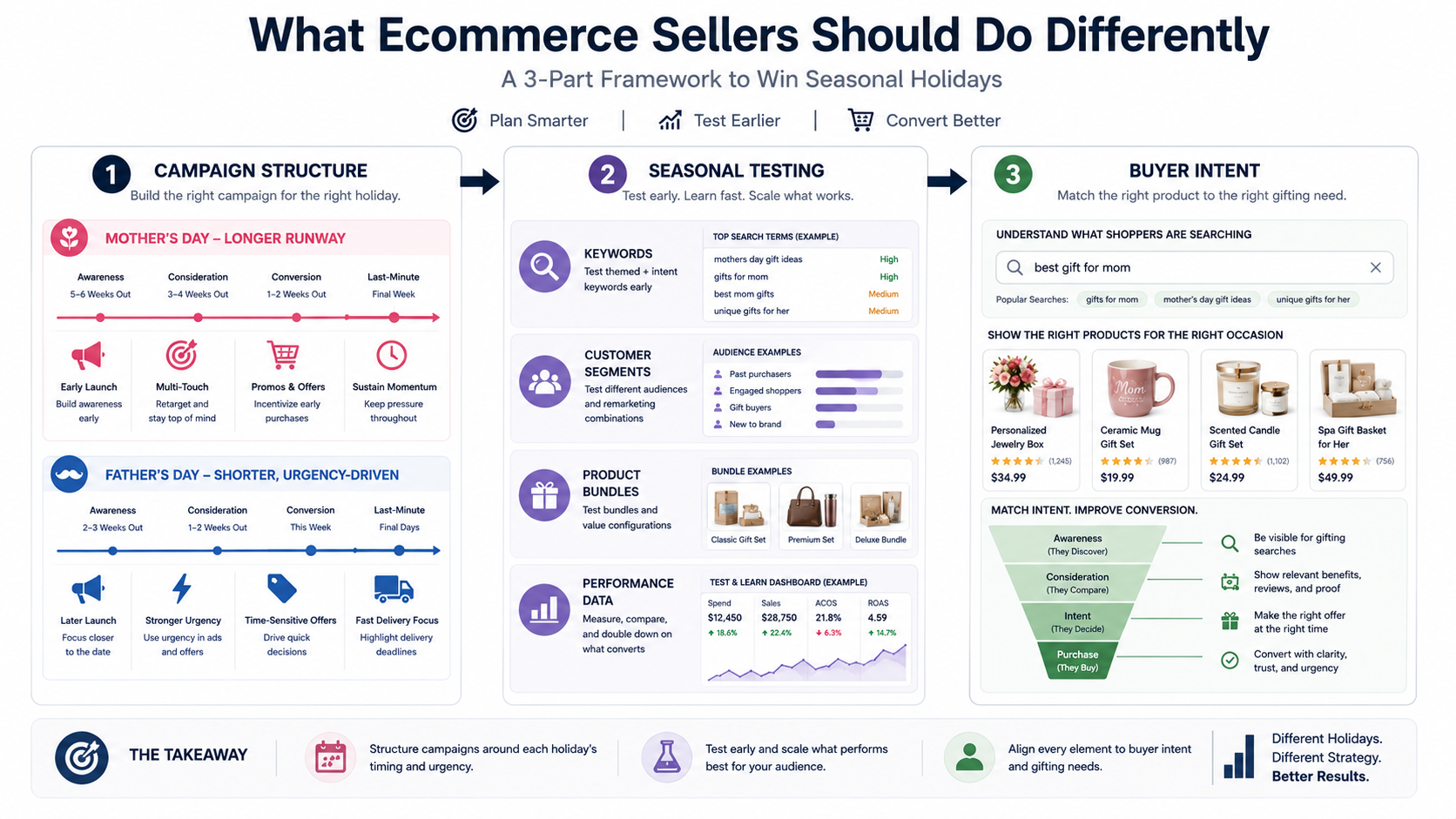
Tip #1: Do not use the same campaign structure for both holidays.
Mother’s Day deserves a longer runway. Start researching keywords and preparing creatives several weeks out. Test gift-focused images, emotional hooks, premium bundles, and category-specific landing pages. If you sell on Amazon, separate holiday campaigns from evergreen campaigns so you can track performance cleanly.
Father’s Day should be tighter and more urgency-driven. Focus on products with obvious fit, fast delivery, and clear gift use cases. Use copy that makes the buying decision easy. A shopper searching “Father’s Day gift for dad who grills” does not need poetry. They need to know whether the product is useful, giftable, and going to arrive on time.
Tip #2: Treat seasonal traffic as a testing ground.
Holiday periods can reveal new customer segments, new keywords, and new product bundles that may work beyond the holiday itself.
Tip #3: Build your campaign around buyer intent, not just the holiday name.
If your product solves a gifting problem, make that obvious. If it does not, forcing it into a holiday campaign may only waste ad spend.
This is where a good Amazon SEO foundation helps. If your listing is already weak, seasonal traffic will not magically fix it.
Mother’s Day vs. Father’s Day: The Ecommerce Takeaway
Mother’s Day outspends Father’s Day because it has more participation, higher average spend, deeper commercial traditions, and stronger emotional buying behavior.
Father’s Day is growing, and 2026’s record $27.9 billion projection proves it is not some tiny throwaway retail event. But Mother’s Day remains the bigger ecommerce opportunity overall, especially for sellers in giftable, emotional, premium, and experience-driven categories.
For Amazon sellers, the lesson is not “ignore Father’s Day.” That would be leaving money on the table, which is generally frowned upon by people who enjoy having money.
The real lesson is to treat each holiday according to how shoppers actually behave.
Mother’s Day is a longer, more emotional, higher-spend campaign window.
Father’s Day is a shorter, more practical, more category-dependent opportunity.
Both can be profitable. But if you run the same creative, the same bids, the same bundles, and the same timing for both, you are not running a strategy. You are just decorating your PPC account with seasonal keywords and hoping for the best.
And hope, unfortunately, is still not an Amazon advertising strategy.
FAQ
How much more do consumers spend on Mother’s Day than Father’s Day?
In 2026, U.S. consumers were expected to spend $38 billion on Mother’s Day and $27.9 billion on Father’s Day, a difference of about $10.1 billion.
What is the average spend for Mother’s Day vs. Father’s Day?
According to NRF data, consumers planned to spend an average of $284.25 for Mother’s Day in 2026 and $226.58 for Father’s Day.
Why is Mother’s Day bigger for ecommerce?
Mother’s Day benefits from higher participation, stronger emotional buying intent, more premium gift categories, and longer-established commercial traditions.
Is Father’s Day still worth targeting for ecommerce sellers?
Yes. Father’s Day spending reached a record projected $27.9 billion in 2026. It can be especially valuable for sellers in categories like grilling, tools, apparel, electronics, outdoor gear, hobby products, personal care, and subscription boxes.
When should sellers start advertising for Mother’s Day and Father’s Day?
Mother’s Day campaigns generally deserve a longer runway, often several weeks before the holiday. Father’s Day campaigns can be more compressed and should emphasize urgency, clear gift fit, and delivery timing.
Should Amazon sellers create separate campaigns for Mother’s Day and Father’s Day?
Yes. Sellers should usually separate seasonal campaigns from evergreen campaigns so holiday performance does not distort normal keyword, bid, and conversion data.
What should sellers do after a holiday campaign ends?
Review search term reports, conversion rates, CPCs, inventory impact, bundle performance, and any keywords that may be useful for evergreen campaigns. The post-holiday review is where sellers turn a seasonal spike into long-term learning.