Temu’s Explosive Growth: From Zero to 24% Global Dominance

Temu launched in September 2022 with no Western customer base. Within two years, it reached 700 million monthly visits globally and became the most downloaded shopping app worldwide in 2024. By 2025, it had captured 24% of global cross-border e-commerce — essentially matching Amazon's 25% share in that segment.
That growth story changed dramatically in early 2025. U.S. tariffs on Chinese goods reached 145%, and the de minimis exemption — which allowed duty-free imports under $800 — was eliminated in May 2025. Temu's U.S. daily active users fell 48% between March and May 2025, and the company pulled all Google Shopping ads in the U.S. by mid-April. Its App Store ranking dropped from #3 to #58 in three days.
But Temu quickly shifted strategy. By Q3 2025, Europe had overtaken North America as Temu's largest revenue source. The platform now runs 27,000 ads across Meta platforms in Europe and the U.K., compared to near-zero in the U.S. In Poland, Temu holds an estimated 30–40% market share. In France, penetration is pushing 40%. In Germany, 16 million monthly users make it a top-five marketplace.
Temu's U.S. dominance may have stalled, but its global model is very much alive. This guide explains how that model works, where it's still competitive, and what sellers need to know.
Temu's Business Strategy
Temu's rapid growth was built on three structural advantages that traditional retailers couldn't match. Understanding these fundamentals explains both why Temu succeeded and where its vulnerabilities now lie.
How Temu Keeps Prices So Low
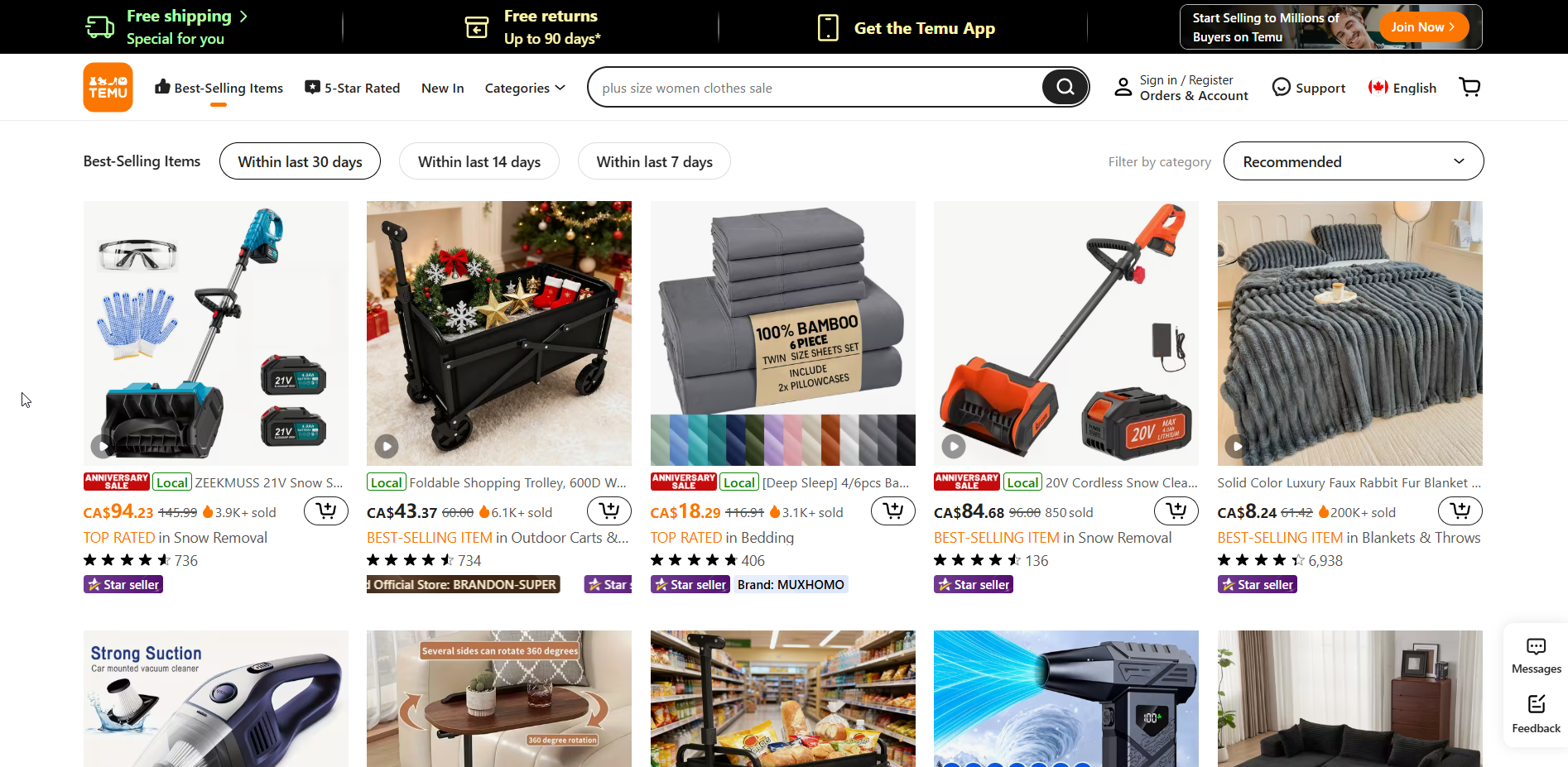
Temu's pricing advantage came from reshaping the entire supply chain, forcing supplier competition, and exploiting a tax loophole that has since closed.
The Consumer-to-Manufacturer (C2M) Model
Traditional retail: factory → wholesaler → distributor → retailer → customer. Each step adds markup. Temu's C2M model removes nearly all of those steps. Factories list directly on Temu and ship straight to consumers. No wholesaler, no distributor, no retail overhead. This structure alone cuts costs by 30–50% compared to traditional supply chains.
Price Competition Between Suppliers
Temu operates a continuous-auction system in which suppliers bid against one another for listing placement. The factory that can produce at the lowest cost gets the listing. This creates constant downward pressure on prices — great for shoppers, brutal for sellers competing on cost.
The De Minimis Loophole: What It Was and Why It Mattered
The de minimis exemption was the structural advantage that powered Temu's U.S. growth from 2022 to early 2025. Under U.S. customs law, any package valued at $800 or less could enter the country completely duty-free—no import taxes, no customs fees, no tariffs.
Since most Temu orders fell well under that threshold, Temu shipped nearly every package tax-free.
Meanwhile, American companies importing goods in bulk — even the same goods from the same factories — paid tariffs on everything. By 2023, the U.S. was processing nearly 4 million de minimis packages per day. A large share came from China, and much of that volume flowed through Temu and Shein.
De Minimis Tax Advantage: Temu vs. Traditional U.S. Importer
Cost breakdown for a $10 product from Chinese factory (2022-2024)

Source: Industry estimates based on 20% average tariff rate on consumer goods
Key Insight: Temu saved $1.50 per unit (11% cost advantage) by shipping direct and avoiding tariffs through de minimis exemption
The cost advantage was enormous. A $10 product from a Chinese factory could land in a U.S. customer's hands with no added duty. That same product, if imported by a U.S. company in a bulk shipment, would carry tariffs ranging from 7.5% to 25%, depending on the product category. For low-margin goods, that gap made competing on price nearly impossible.
The End of De Minimis — And What Happened Next
In May 2025, the Trump administration eliminated the de minimis exemption for Chinese imports. By August 2025, the exemption was removed globally. Tariffs on Chinese goods shipped via USPS reached 120% or a flat $100 per package. Goods shipped via UPS and other carriers faced a 145% tariff.
Both Temu and Shein announced price increases starting April 25, 2025. Temu posted a notice on its site: “Due to recent changes in global trade rules and tariffs, our operating expenses have gone up. To keep offering the products you love without compromising on quality, we will be making price adjustments.”
The impact was immediate. Temu's U.S. daily active users dropped approximately 48% between March and May 2025. Credit card transaction data showed Temu and Shein sales plummeting in the U.S. market. The structural price advantage that had powered three years of hypergrowth vanished in a matter of weeks.
Temu U.S. Daily Active Users
March 2025 – May 2025 | 48% decline after de minimis elimination
Source: Sensor Tower, Smarter Ecommerce, CNBC (April-May 2025)
Data represents estimated U.S. daily active users. De minimis exemption for Chinese imports was eliminated May 14, 2025.
For Western e-commerce sellers, this was the most significant structural shift in years. The playing field became more level overnight. Temu's cost advantage — which had seemed insurmountable — was no longer structural law. It became operational execution, and execution is something sellers can compete on.
Marketing and Psychology
Temu didn't just undercut competitors on price. It rebuilt the shopping experience to maximize engagement and turn users into recruiters.
How Temu Makes Shopping Addictive
Temu's app borrows heavily from gaming and casino design to keep users engaged far longer than traditional e-commerce platforms.
Gamification
Temu's app design borrows heavily from gaming and casino psychology. Users encounter spinning prize wheels, countdown timers, mystery gift boxes, daily check-in bonuses, and layered discount mechanics. Every visit feels like an opportunity to win something.

The engagement metrics prove it works. Data from SimilarWeb shows users spend approximately 18–23 minutes per session in the Temu app. On Amazon, the average is closer to 11 minutes. That additional 10+ minutes of browsing time translates directly into higher purchase frequency, especially for impulse buys.
Referral Mechanics
Temu's referral programs turn users into recruiters.
- Invite a friend: unlock free items.
- Complete a friend's first purchase: earn cash credits.
- Share links: get more spins.
These mechanics drove explosive early growth. Temu grew from 5.8 million U.S. users in October 2022 to over 100 million active users by early 2023.
The $2 Psychological Threshold
At $2, most people don't deliberate. They just click. Low prices remove the mental friction that normally delays a purchase. Interestingly, nearly half of Temu's revenue comes from households earning over $190,000 per year. Temu appeals broadly across income levels, not just budget shoppers.
Temu's Advertising Strategy: $3 Billion Spent, Then Zero
Temu's marketing approach was as aggressive as its pricing. The company didn't grow organically—it bought its way to dominance, then pulled back almost overnight when economics changed.
Temu spent an estimated $3 billion on advertising in 2023. Approximately $1.2 billion went to Meta (Facebook and Instagram) alone. Goldman Sachs analysts reported that Temu ran around 8,900 ads on Meta platforms in a single month at peak spend.
At its height, 90% of retailers running Google Shopping ads saw Temu appearing in their Auction Insights reports. Temu was bidding on the same keywords as nearly every other online retailer. Research from Tinuiti found that Google retail search ad costs rose approximately 20% in one year, driven largely by Temu's spending.
Temu's $3 Billion Ad Blitz vs. Typical Retailers
Annual advertising spend, 2023
Source: Goldman Sachs analysis, Meta ad library data, 2023
Key Insight: Temu outspent most retailers 10x-100x, inflating ad costs across Google Shopping and Meta platforms
In February 2024, Temu ran three 30-second Super Bowl ads at an estimated cost of $21 million in airtime. “Shop Like a Billionaire” became one of the most recognized shopping slogans of the year.
The April 2025 Advertising Collapse
Then, almost overnight, Temu's U.S. advertising stopped. On April 9, 2025, Temu ceased all Google Shopping ads in the United States. By April 12, its impression share had dropped from approximately 20% to zero. Daily Google ad placements fell from 30,000–60,000 to just 14.
Meta ads collapsed similarly. Temu went from running tens of thousands of daily ads on Facebook and Instagram to just four active ads by mid-April 2025. Temu's App Store ranking dropped from #3 to #58 in three days.
According to Sensor Tower, Temu's U.S. ad spending on Meta fell 31% between March 31 and April 13, 2025. Paid traffic to Temu.com — visits driven by search, display, and social ads — dropped 77% after April 11.
Temu Google Shopping Impression Share
March 2025 – May 2025 | From dominant to zero in 3 days
Source: Smarter Ecommerce (Mike Ryan), Google Ads Transparency Centre (April 2025)
Impression share represents percentage of total Google Shopping ad impressions. On April 9, 2025, Temu ceased all U.S. Google Shopping advertising.
For competing sellers, this created a real but brief window of lower ad costs. Meta CPMs fell approximately 6% in Q1 2025. Some of that decrease was attributable to broader market volatility, but Temu's absence was a contributing factor.
Where the Ads Went: Europe
Temu didn't shut down its advertising — it redirected it. As of mid-2025, Temu is running approximately 27,000 ads across Meta platforms globally, heavily concentrated in Europe and the U.K. Ad spending in European markets remains aggressive, with Germany, France, Poland, Italy, and Spain all seeing significant Temu ad presence.
How TikTok Built Temu's Brand
While paid ads drove traffic, organic social content built trust. Temu leveraged “haul culture” on TikTok and YouTube to turn a completely unknown brand into a household name.

Thousands of creators posted unboxing videos showing real products and real prices. That social proof built trust faster than traditional advertising. The platform drove 42 million app downloads from users aged 18–24 in the first 10 months of 2024 alone.
Temu's Global Position in 2025
The tariff changes devastated Temu's U.S. business but revealed something important: the company's model still works in markets without those regulatory barriers. Europe became the new proving ground.
U.S. Market: Stalled but Not Dead
The de minimis elimination hit Temu's U.S. operations hard, but the platform maintained a foothold even after losing nearly half its user base.
Temu's U.S. growth has stalled significantly. Daily active users fell 48% between March and May 2025. But the platform hasn't disappeared. As of late 2025, approximately 16% of U.S. consumers still shop on Amazon Haul (Amazon's Temu competitor), while 28% shop on Temu at least monthly, according to Omnisend survey data.
By April 2024, before the tariff changes, Temu held an estimated 17% share of the U.S. discount retail market. That share has declined, but Temu still represents a real alternative for price-driven shoppers in commodity categories.
Europe: The New Battleground
While U.S. growth stalled, Temu's European expansion accelerated. The platform now holds market positions in several European countries that rival or exceed Amazon's presence.
By Q3 2025, Europe overtook North America as Temu's largest revenue source. The company's cross-border e-commerce market share globally reached 24% in 2025 — essentially matching Amazon's 25%. That's an increase from less than 1% in 2022.
In Europe specifically, Temu's penetration is staggering:
- Poland: 30–40% estimated market share (Amazon holds less than 10%)
- France: Approaching 40% penetration among online shoppers
- Germany: 16 million monthly active users, making Temu a top-five marketplace
- Portugal: 38% of internet users have used Temu
- Overall EU: 93.7 million monthly active users by mid-2025
Temu's European Dominance (2025)
Market penetration by country
Source: Lengow Blog, MarketMaze, Digital Commerce 360, IPC (2025)
Key Insight: Temu matches Amazon at 24-25% global cross-border e-commerce share. In Eastern Europe, Temu often exceeds Amazon's presence.
Amazon still dominates in Western Europe. Two-thirds of German shoppers use Amazon. More than half of French shoppers do. In Italy, it's close to 70%. But in Eastern Europe — where Amazon never established deep roots — Temu is filling the void. In December 2025, Amazon announced commission cuts on low-cost fashion and accessories for European sellers, openly acknowledging pressure from Temu and Shein.
How Amazon Responded
Amazon doesn't typically imitate competitors, which makes its response to Temu particularly telling. The company launched two separate initiatives directly targeting Temu's low-price model.
Amazon launched Amazon Haul in November 2024 — a budget section with items under $10 and a $20 price cap. In early 2025, it launched Amazon Bazaar, extending the low-price model to 14 additional countries.
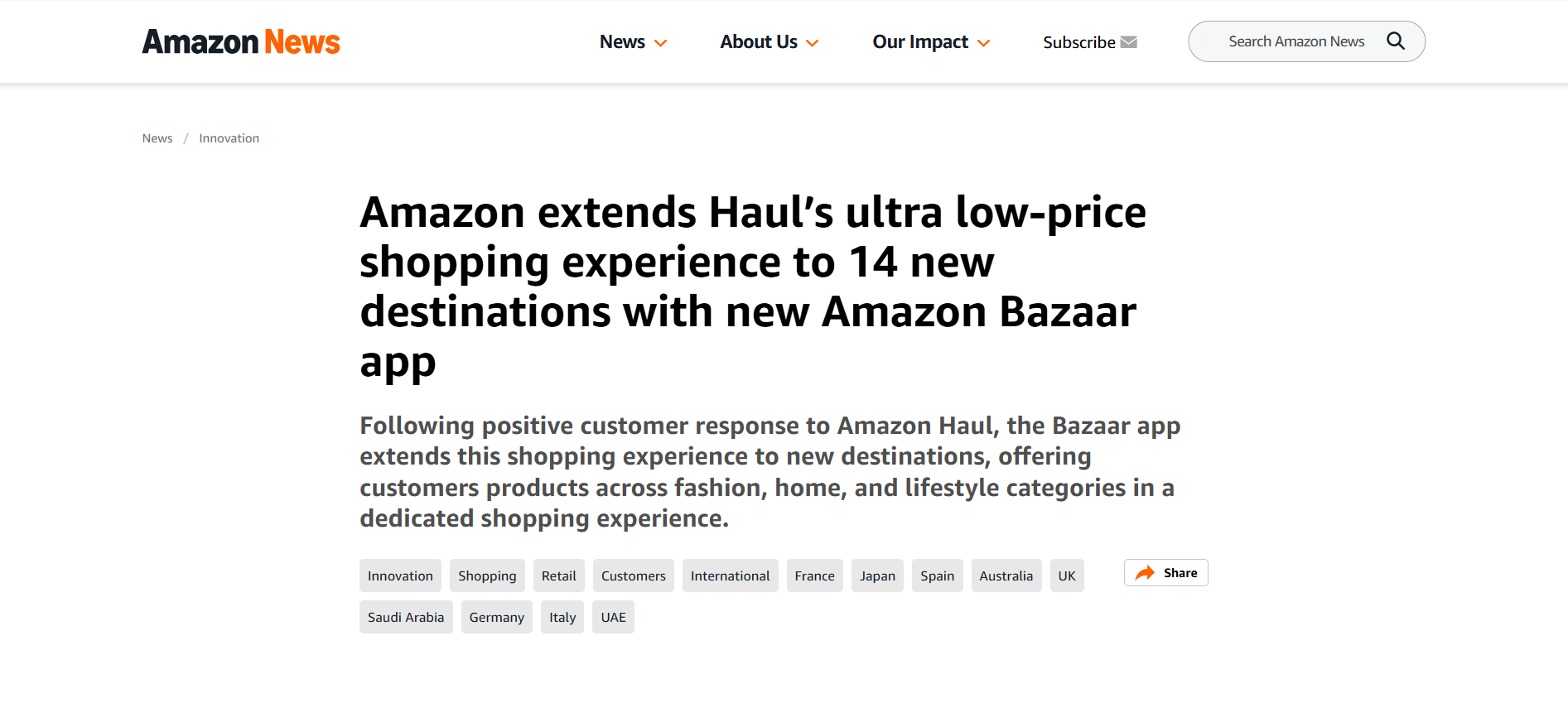
Early results show Amazon Haul is gaining traction but remains behind Temu. A 2025 Omnisend survey found 28% of U.S. consumers shop on Temu monthly, versus 16% for Amazon Haul. The fact that the world's largest e-commerce company built a direct imitation signals how seriously it's taking the threat.
The Profitability Question
Temu's growth came at a steep financial cost, subsidized by a profitable parent company that could afford to lose money for market share. The 2025 tariff changes made that strategy unsustainable.
Reports suggest Temu lost an average of $30 per order at its peak, totaling $588 million to $954 million in annual losses. The model was subsidized by parent company PDD Holdings, which reported $34.8 billion in revenue and $21.8 billion in profit in 2023. Temu's losses were a deliberate investment in market share — until tariffs made that math unsustainable.
Where Temu Can't Compete: Trust
Despite massive scale, Temu faces a trust deficit it hasn't overcome. For purchases where quality and reliability matter, most shoppers still default to established platforms.
Amazon product listings average around 50,000 reviews. Temu averages around 1,500. For high-stakes purchases — electronics, baby products, car parts — most shoppers still default to Amazon. Temu has also faced European Commission investigations for allegedly failing to prevent illegal product listings. These regulatory and trust issues are real structural weaknesses.
Lessons for E-Commerce Sellers
Temu's rise and subsequent challenges offer concrete lessons for sellers on any platform. The key is understanding where you can't compete with Temu—and where you don't have to.
Test Before You Scale
One of Temu's smartest operational practices is also one sellers can adopt: validate demand before committing capital.
Temu's suppliers test products with small batches, measure demand, then scale what works. Compare this to the traditional private label playbook: order 1,000–5,000 units and hope they sell. Smaller initial orders with clear go/no-go thresholds reduce capital risk significantly.
Use TikTok as a Trend Signal
Temu monitors TikTok for trending products and lists them quickly. Sellers can do the same. TikTok's Creative Center and trending hashtags show what's gaining momentum before it hits bestseller lists. Early entry into trending categories is more valuable than competing in saturated ones.
Build Brand Loyalty
Price competition with Temu—even post-tariff—is a losing strategy for most sellers. The alternative is building something Temu can't replicate: customer relationships. A customer who follows your brand on social media, trusts your quality, and has bought from you before isn't cross-shopping on Temu. Price gaps become irrelevant when trust is established.
Use Speed as a Competitive Advantage
Fulfillment speed is one area where Temu still can't consistently match established platforms. Sellers with access to fast fulfillment networks have a real edge.
Temu's shipping has improved, but it still can't consistently match two-day delivery from fulfillment services like Amazon FBA or Walmart WFS. Sellers using these services can offer guaranteed speed that Temu can't. For time-sensitive purchases — gifts, replacements, anything needed immediately — speed beats price.
Focus on Quality and Service
Temu's model optimizes for cost, which inherently limits quality and after-sales support. This creates an opening for sellers willing to invest in both.
Sellers who back products with real warranties and easy returns compete in the territory Temu doesn't occupy. A customer who buys cheaply on Temu, has a bad experience, then finds a reliable alternative, is a customer you can keep.
Should You Sell on Temu?
For some sellers, the right move might be selling on Temu itself. The platform introduced a model for U.S. sellers in 2024, but it's not the right fit for everyone.
In 2024, Temu introduced a Semi-Managed Model for U.S.-based sellers with domestic warehouses. Unlike the fully managed model, semi-managed sellers list on Temu and fulfill from their own inventory. PopMarket, a novelty company, reported that Temu became its fastest-growing channel after joining in late 2024.
Before pursuing Temu, clarify:
- Is your product high-volume, low-margin? Temu's audience is price-driven.
- Are you comfortable ceding pricing control to the platform?
- Will Temu pricing undercut your other listings or brand positioning?
- Do you have domestic inventory and logistics to fulfill quickly?
Branded or premium products are generally a poor fit. For generic, fast-moving consumer goods with tight margins, it's worth evaluating.