Trump Launches Section 301 Trade Probes Against 18 Economies

The Trump administration has opened new trade investigations against 18 economies, including China, Mexico, and the European Union, using a legal tool that predates the tariffs the Supreme Court struck down last month. The move signals the administration's intent to rebuild its trade policy on firmer legal ground, with Treasury Secretary Scott Bessent predicting tariffs will return to their previous levels by August.
Why the Administration Is Turning to Section 301
On February 20, the Supreme Court ruled 6-3 that President Trump did not have the authority to impose tariffs under the International Emergency Economic Powers Act, or IEEPA. That decision invalidated the reciprocal tariffs Trump had levied against most of the world's nations last year without congressional authorization.
Within hours of the ruling, Trump signed an executive order imposing a 10% global tariff under Section 122 of the Trade Act. Section 122 tariffs are a temporary fix, expiring within 150 days. The new Section 301 investigations are the administration's longer-term strategy to put equivalent tariffs back in place through a legal framework that has survived more than 4,000 court challenges.
U.S. Trade Representative Jamieson Greer confirmed the investigations during a call with reporters on March 11. “The president's trade policy remains the same,” Greer said. “Protect American jobs and to make sure we have fair trade with our trading partners.”
What Section 301 Actually Does
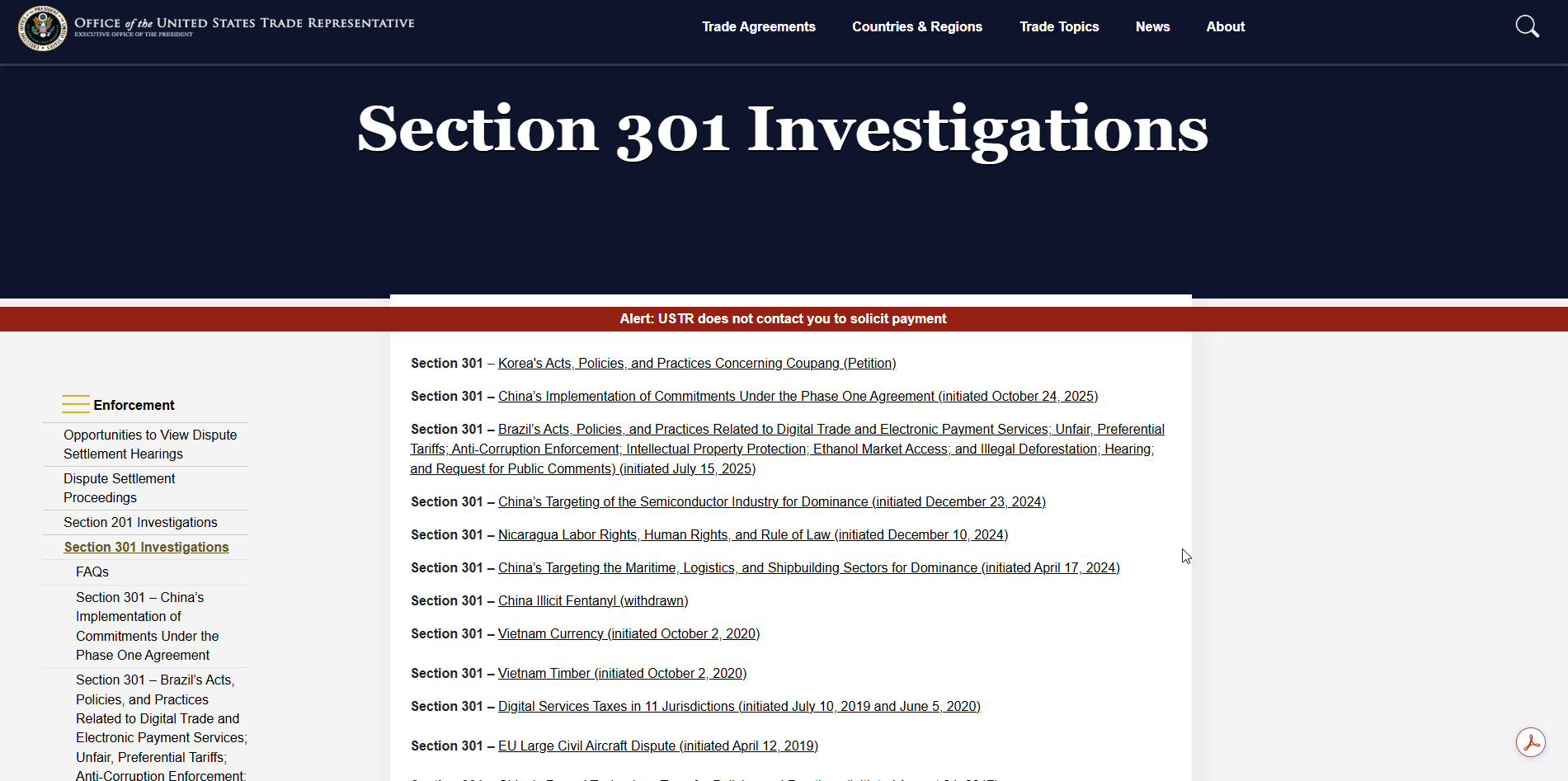
Section 301 comes from Title III of the Trade Act of 1974. It gives the Office of the U.S. Trade Representative authority to investigate foreign trade practices and impose tariffs or other restrictions on countries found to have engaged in unfair trade behavior.
Unlike IEEPA, Section 301 has a well-established legal record. The Trump administration used it during its first term to impose tariffs ranging from 7.5% to 25% on roughly $370 billion worth of Chinese imports, and those tariffs have remained in place through multiple administrations and legal challenges.
The law divides potential actions into two categories. If USTR finds a trade agreement violation or an “unjustifiable” practice that burdens U.S. commerce, action is mandatory. If the practice is deemed “unreasonable or discriminatory,” action is discretionary. In either case, USTR must prioritize tariffs if it opts for import restrictions.
Which Economies Are Being Investigated
Greer said the probes will focus on “acts, policies, and practices of certain economies relating to structural excess capacity and production in manufacturing sectors.” The 18 economies currently under investigation are China, Mexico, the European Union, Japan, India, Taiwan, Vietnam, South Korea, Singapore, Switzerland, Norway, Indonesia, Malaysia, Cambodia, Bangladesh, and Thailand. Greer added that the list will likely expand.
“We do expect that there will be other Section 301 investigations on a country-specific basis, or maybe other tools or investigations that may come up,” he said.
How the Investigation Process Works
Section 301 investigations follow a structured process that takes time. Here is what happens at each stage:
1. Initiation
USTR self-initiated these probes, which it is permitted to do after consulting with public and private stakeholders. USTR must determine whether to initiate an investigation within 45 days of receiving a petition, though in this case the administration moved on its own.
2. Consultations
Once an investigation begins, USTR is required to request consultations with the governments under scrutiny. Greer confirmed this will happen. “We'll also be consulting with our trading partners who are subject to this investigation,” he said.
3. Public comment and hearings
USTR will accept written comments and hold public hearings as part of the process. Sellers, importers, and industry groups have the opportunity to submit input at this stage.
4. Determination and action.
After consultations and hearings, USTR makes a formal determination and proposes a response. Greer outlined the range of options available:
- Tariffs on imported goods
- Fees on services
- Withdrawal or suspension of trade agreement concessions
- A binding agreement with the foreign government to change the practice in question
In most cases, USTR makes its determination within 12 months of opening an investigation.
What This Means for Tariff Levels
Bessent has been direct about the administration's timeline and goals. Speaking to CNBC last week, he said tariffs will return to the levels that existed before the Supreme Court ruling by August.
“It's my strong belief that the tariff rates will be back to their old rate within five months, and those are very fulsome authorities,” Bessent said. “They have survived more than 4,000 legal challenges. They are more slow-moving, but they are more robust.”
The 10% global tariff currently in place under Section 122 serves as a bridge while the Section 301 process plays out. If the investigations result in affirmative findings, new tariffs imposed under Section 301 would replace the temporary Section 122 measure on a country-by-country or sector-by-sector basis.
Political Reaction
Not everyone supports the approach. Senator Ron Wyden of Oregon, the ranking member of the Senate Finance Committee, criticized the probes as an attempt to revive tariffs through a different legal path rather than address genuine trade concerns.
“Donald Trump is scrambling to replace his illegal trade taxes with a different tariff scheme to hike prices for Americans,” Wyden said. “Trump isn't interested in solving real trade problems or stopping China and other trade cheats from undercutting U.S. workers and businesses. He's trying to put his tariffs back in place any way he can.”
What Sellers and Importers Should Watch
For cross-border sellers and importers, the Section 301 process introduces a period of uncertainty. The 10% global tariff under Section 122 stays in place for now, and the administration has signaled clearly that it intends to restore previous tariff levels before that measure expires.
The Section 301 investigations now underway are likely to run for months. Sellers importing from any of the 18 economies on the current list should monitor USTR's public comment process closely. Submitting input during the comment period is one of the few direct ways businesses have to put their concerns on the record before USTR finalizes its findings and proposes specific actions.