What Happened to Pharmapacks? The Full Story of Its Bankruptcy and Quiet Second Life

For years, Pharmapacks looked like one of Amazon’s greatest third-party seller success stories.
The company grew from a small health and beauty retailer into one of the largest third-party sellers on Amazon. It generated hundreds of millions of dollars in annual revenue, shipped tens of thousands of orders each day and prepared to go public at a valuation of more than $1.5 billion.
Less than a year after announcing that deal, Pharmapacks was laying off employees, liquidating inventory and filing for Chapter 11 bankruptcy.
The failed public listing accelerated its downfall, but it did not create the company’s problems. Pharmapacks had been losing money for years, and each new stage of growth required more inventory, more fulfillment capacity and more outside funding.
When the next major round of capital failed to arrive, the business had no profitable core to fall back on.
TL;DR
Pharmapacks was founded in 2010 and became one of Amazon’s largest third-party sellers by reselling health, beauty, household and personal-care products from established brands.
Its revenue grew from approximately $202 million in 2018 to a projected $456.2 million in 2021. However, its operating losses also grew from approximately $25 million to $112.5 million over the same period.
Packable, the parent company of Pharmapacks, planned to go public through a SPAC merger expected to add approximately $434 million in cash to its balance sheet. While waiting for the transaction to close, the company hired employees, invested in technology, rebranded and began developing a new California fulfillment center.
The merger was abandoned in March 2022. By then, Packable owed more than $42 million to vendors and depended on emergency financing to continue operating.
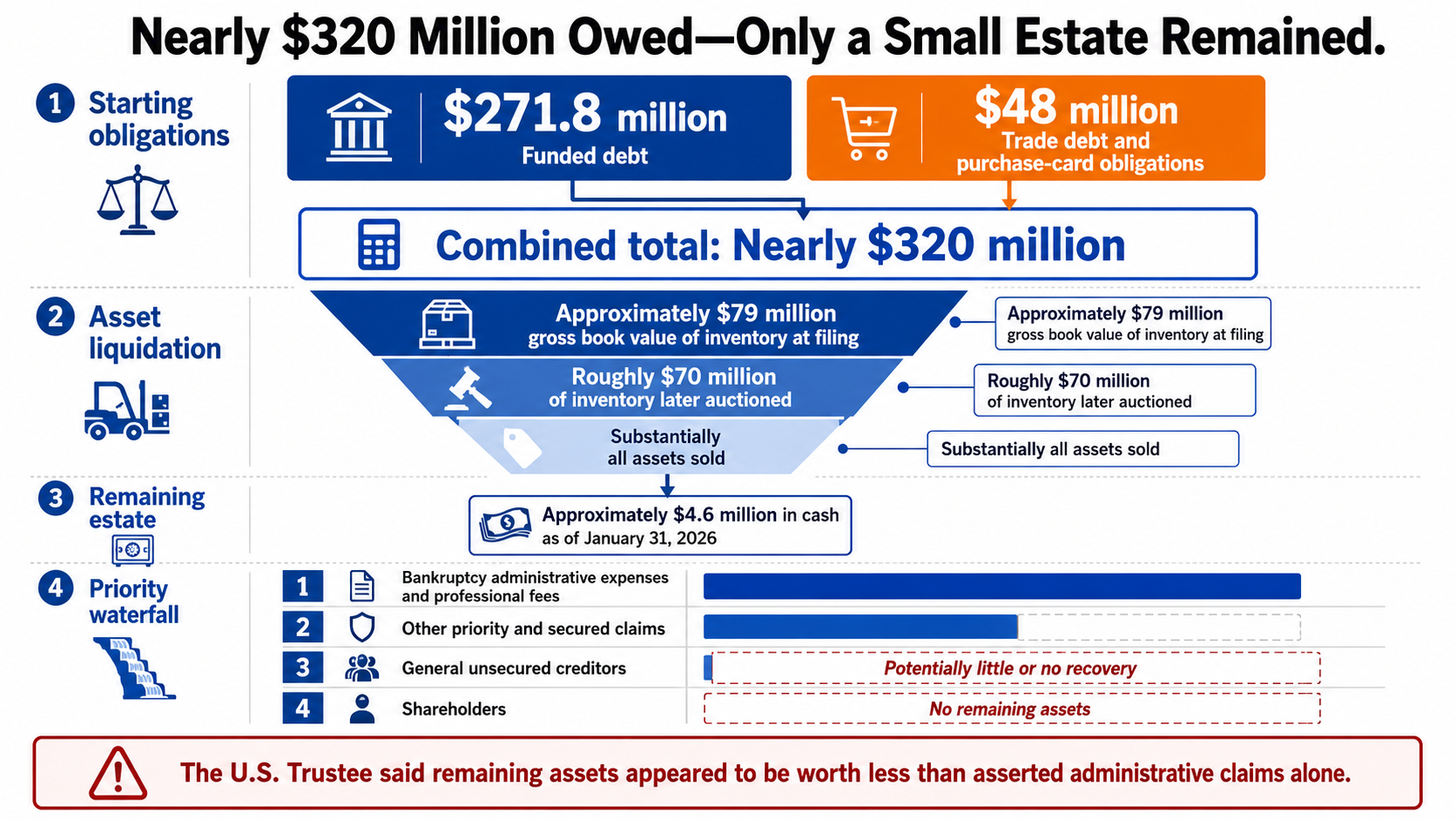
Packable and its subsidiaries filed for Chapter 11 bankruptcy on August 28, 2022, with approximately $271.8 million in funded debt and another $48 million in trade and purchase-card obligations.
Substantially all of its assets were sold beginning in 2022, but the legal bankruptcy process continued into 2026. The estate had approximately $4.6 million in cash as of January 2026, while the U.S. Trustee said its remaining assets appeared to be worth less than its administrative claims alone. This left ordinary unsecured creditors facing the possibility of little or no recovery.
A much smaller Amazon account continues selling under the Pharmapacks name. The account, the current Packable business and the former bankrupt entities share several connections, but public records do not fully explain how the marketplace account, technology and other assets reached their current owners.
How Pharmapacks Built a $500 Million Amazon Business
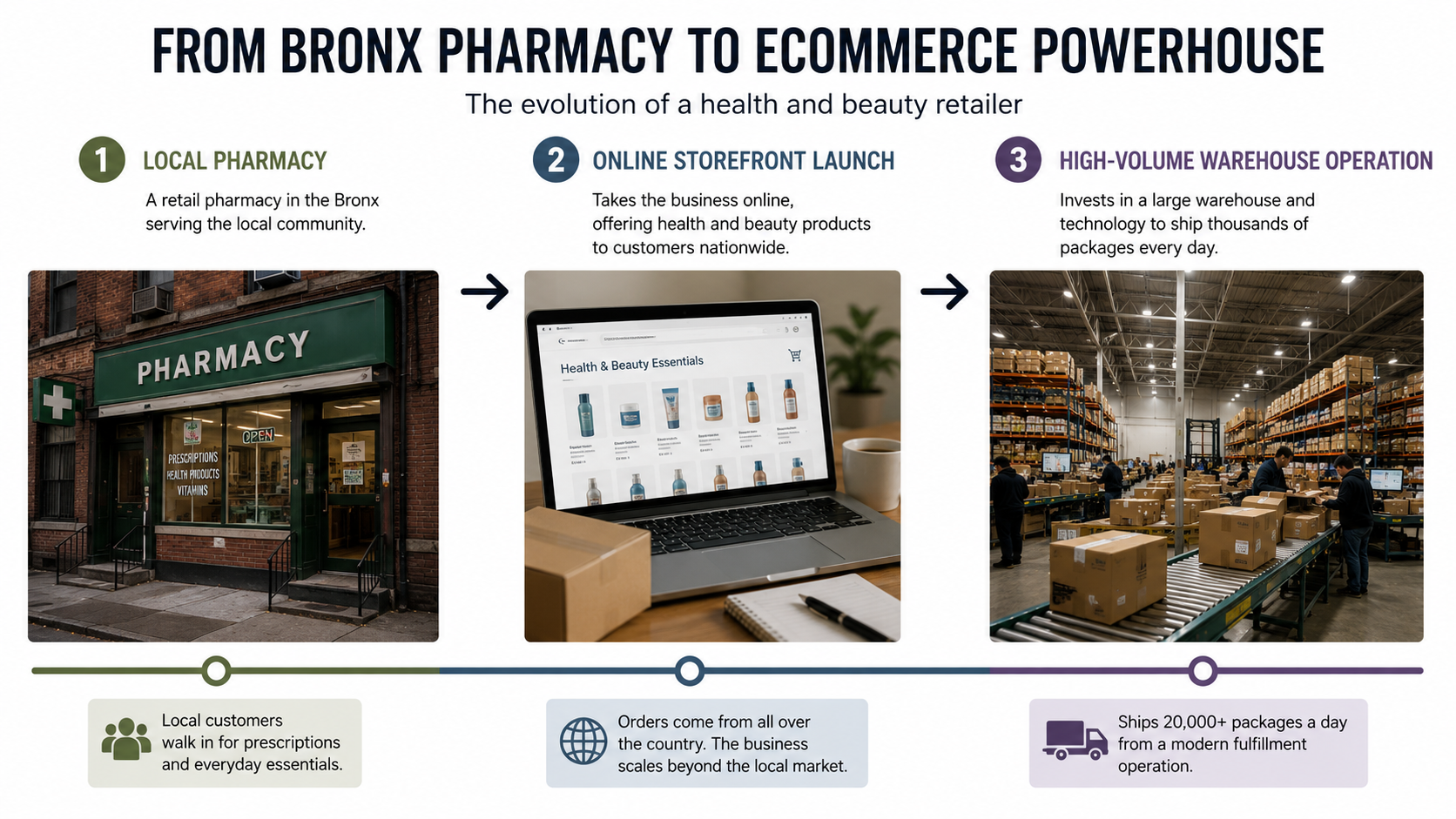
Andrew Vagenas had previously owned and operated a retail pharmacy in the Bronx. Around 2010, he and several business partners launched Pharmapacks as an online health and beauty retailer operating from a warehouse in Queens.
In a 2016 ABC News profile, Vagenas said the founders knew relatively little about ecommerce when they started. What they did understand was the health and personal-care industry.
Pharmapacks purchased recognizable products from brands and distributors, listed them across major online marketplaces and used software to manage prices, inventory and fulfillment at a scale most individual resellers could not match.
Its early growth was rapid. Revenue increased from approximately $17.5 million in 2013 to $31 million in 2014 and $66.6 million in 2015, according to a later Delaware bankruptcy court opinion.
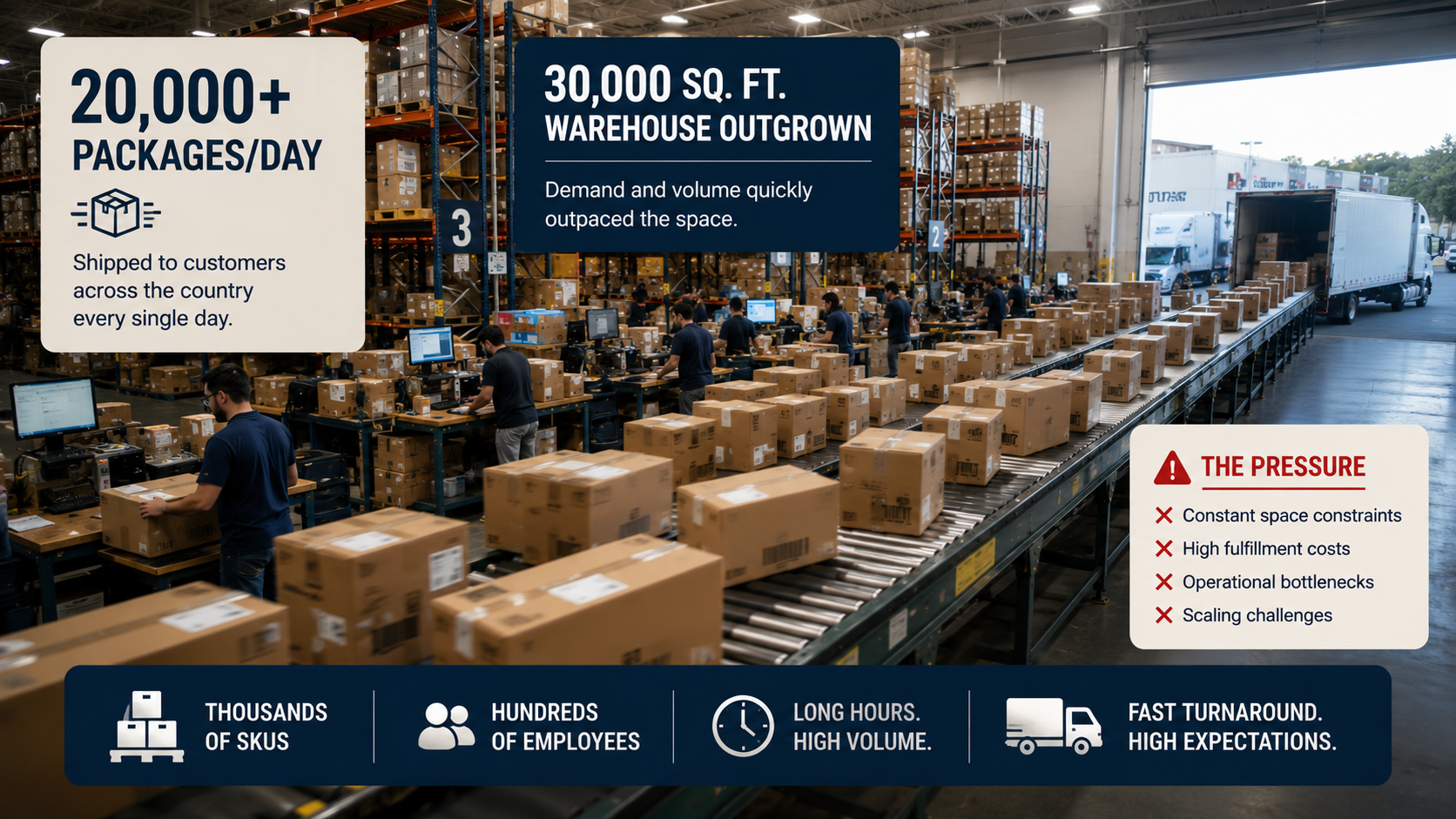
By 2016, Pharmapacks was shipping more than 20,000 packages per day and had outgrown its 30,000-square-foot warehouse. By 2020, annual revenue had reached approximately $373.3 million.
At its peak, Packable carried more than 31,000 SKUs and processed over 1.8 million monthly orders. It sold through Amazon, Walmart, eBay, Target and Kroger, along with direct-to-consumer websites it managed for brand partners.
The company worked with brands including Johnson & Johnson, Unilever, Bayer, Revlon, Bausch + Lomb, L’Oréal and Reckitt, according to its first-day bankruptcy declaration.
Pharmapacks also developed software that monitored marketplace listings and adjusted prices roughly every 45 minutes. This helped the company compete for the Amazon Buy Box, where most purchases on shared product listings take place.
From the outside, the strategy appeared to work. Sales were rising, major brands were supplying the company and investors were willing to provide increasingly large amounts of capital.
The problem became obvious one level below revenue.
Why Pharmapacks’ Growth Did Not Produce Profit
Pharmapacks did not have almost no gross margin, as an earlier version of this article stated. Its gross margin generally ranged from 43% to 47%, which sounds fairly healthy on its own.
The real issue was how much of that gross profit disappeared through selling, distribution, warehousing and administrative expenses.
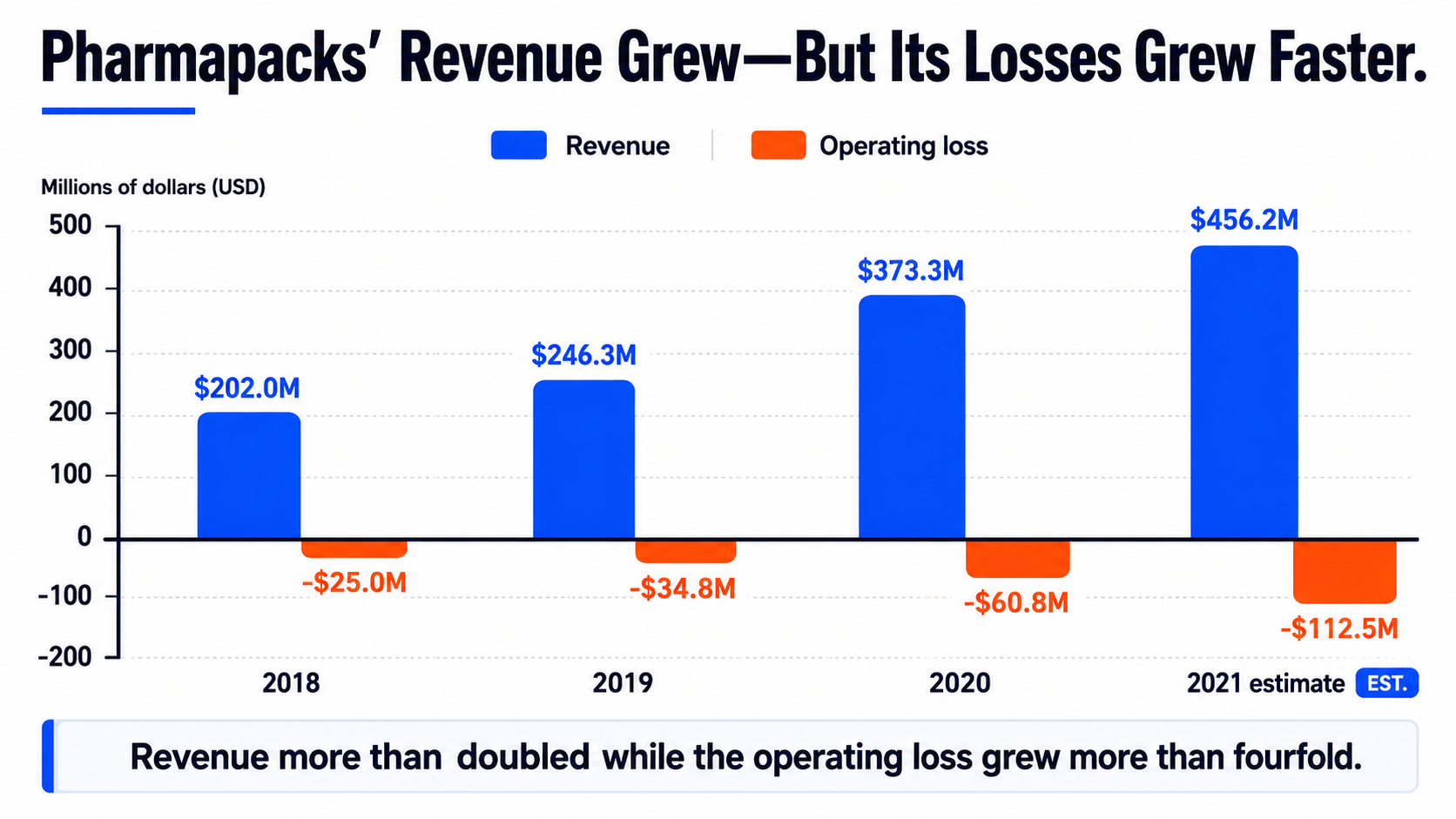
Packable’s SEC-filed financial projections showed the following:
| Year | Revenue | Gross Margin | Selling and Distribution | Warehouse and G&A | Operating Income |
|---|---|---|---|---|---|
| 2018 | $202.0M | 43.0% | 43.2% | 12.2% | -$25.0M |
| 2019 | $246.3M | 45.6% | 47.6% | 12.0% | -$34.8M |
| 2020 | $373.3M | 47.3% | 50.3% | 13.3% | -$60.8M |
| 2021 estimate | $456.2M | 45.3% | 49.8% | 20.2% | -$112.5M |
The 2018 and 2019 figures were unaudited management numbers. The 2020 figures were based on audited financial statements, while the 2021 numbers were estimates when the company prepared its investor presentation.
The direction was still difficult to ignore. Revenue more than doubled between 2018 and 2021, but the projected operating loss grew more than four times larger.
Selling and distribution expenses alone matched or exceeded the company’s entire gross margin each year. Warehouse and administrative costs then pushed the operation further into the red.
Packable estimated that its blended contribution margin was only around 4% in 2021. That was the portion of each order left after direct product costs, fulfillment expenses and marketplace commissions.
Only a small amount remained to cover technology, offices, executives, corporate employees, warehouse infrastructure and other fixed costs.
Selling identical products limited its pricing power
Pharmapacks mainly sold products manufactured by other companies.
That gave it access to items consumers already recognized, but it also meant competing against Amazon, Walmart and other sellers offering the exact same products.
When multiple sellers share one Amazon listing, there is little room to explain why one seller’s bottle of shampoo is better than another seller’s identical bottle. Price, availability, account performance and delivery speed become the main areas of competition.
Pharmapacks could improve its software, negotiate purchasing terms and make fulfillment more efficient. It could not redesign most of its products or raise prices freely without risking the Buy Box.
A company that develops its own private-label products has more control over pricing, packaging, product improvements and customer loyalty. A reseller has fewer ways to protect its margin when costs rise.
Its fulfillment network created a large fixed-cost burden
Pharmapacks used a mixture of fulfillment methods. It operated its own facilities and participated in Amazon’s Seller Fulfilled Prime program, while also using services such as Fulfillment by Amazon and Walmart Fulfillment Services for some inventory.
Under Fulfilled by Merchant, the seller or its logistics partner stores inventory, packs orders, ships products and handles the operational requirements itself. Seller Fulfilled Prime allows qualifying merchant-fulfilled products to carry the Prime badge.
Running fulfillment internally can provide more control and may become cheaper at sufficient scale. However, it also creates long-term obligations.
Warehouse leases, equipment, software, managers and employees must still be paid when sales slow or a facility operates below capacity.
Packable operated several leased locations in New York and began developing a fulfillment center in Perris, California. The new facility was intended to reduce West Coast shipping times and costs, but the project was abandoned as the company tried to conserve cash.
Fulfillment by Amazon does not absorb the seller’s shipping and warehousing costs. Sellers still pay storage, fulfillment and other Amazon fees. The advantage is that much of the expense is tied to the inventory stored and orders shipped rather than an entire warehouse operation.
A seller can also use a third-party logistics provider, which offers a middle ground between FBA and operating a full fulfillment network internally.
Pharmapacks chose a more operationally demanding model. That gave it greater control, but it also made the company more difficult to shrink when growth and financing slowed.
Amazon produced most of its sales
Amazon accounted for approximately 80% of Packable’s sales in 2020, according to CNBC’s reporting on the company’s shutdown.
That concentration helped Pharmapacks build enormous scale on one channel. It also meant that Amazon’s commissions, fulfillment requirements, pricing environment and seller policies were built directly into the company’s economics.
Packable sold through several other marketplaces, but none matched Amazon’s importance. If its performance declined on Amazon, the company did not have another channel large enough to replace the lost sales quickly.
These operating problems did not immediately destroy Pharmapacks because investors and lenders continued supplying cash.
Outside Capital Kept Pharmapacks Growing
Pharmapacks had depended on outside funding long before the SPAC transaction.
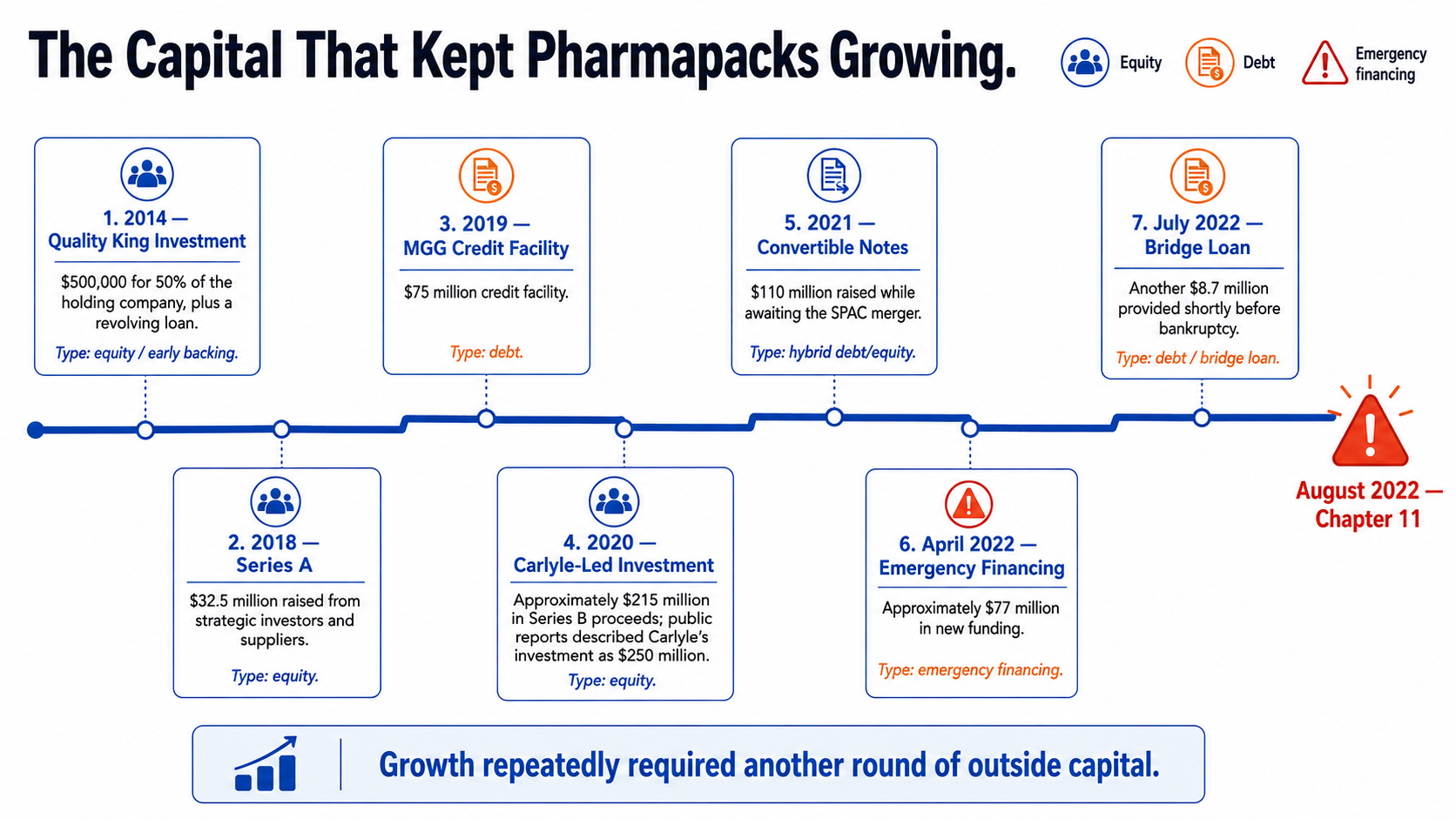
In 2014, Jonathan Webb, Adam Berkowitz and Quality King collectively paid $500,000 for 50% of the holding company that later became Packable Holdings. Quality King also provided a revolving loan of up to $9 million.
The loan balance continued growing and reached approximately $33 million by the end of 2018, according to the later bankruptcy court opinion.
Pharmapacks raised another $32.5 million through a Series A investment involving companies such as Reckitt, McKesson, Sealed Air and Emerson. Part of that funding was used to reduce the Quality King loan.
In 2019, the company obtained a $75 million credit facility from MGG Investment Group and used the proceeds to repay the remaining Quality King debt. Quality King retained an ownership interest, while its CEO, Glenn Nussdorf, remained on Packable’s board.
Carlyle then led a large preferred-equity investment in November 2020. Contemporary reporting described Carlyle’s investment as $250 million and valued Packable at approximately $1.1 billion.
A later court opinion described approximately $215 million in Series B proceeds. Some of the money was used to buy out earlier investors, including more than $27 million paid to Quality King for its equity.
Quality King was therefore more than an ordinary supplier. At different points, it had been a supplier, lender, shareholder, board-level participant and, eventually, a secured creditor and purchaser of inventory from the bankruptcy estate.
By 2021, Packable had proven that it could grow revenue. It had not proven that the business could fund that growth using the cash it generated itself.
The $1.55 Billion SPAC Gamble
In September 2021, Packable announced that it would merge with Highland Transcend Partners I Corp., a special purpose acquisition company.
A SPAC is a publicly traded shell company created to merge with a private business. The merger allows the private company to enter the public markets without completing a traditional initial public offering.
The proposed transaction gave Packable a pro forma enterprise value of approximately $1.55 billion and an equity value of about $1.9 billion.
Packable expected the deal to add approximately $434 million in cash to its balance sheet after fees, assuming SPAC shareholders did not withdraw large amounts of their money.
The company also issued $110 million in convertible notes to provide funding while it waited for the merger to close.
That expected cash was central to Packable’s plans. Its projections showed revenue increasing to approximately $707 million in 2022, more than $1 billion in 2023 and $1.34 billion in 2024.
Management expected the company to approach operating break-even in 2023 and produce approximately $58.5 million in operating income in 2024.
Packable began spending in preparation for that future. It increased headcount, invested in technology, launched a company rebrand, expanded its brand services and began developing the California fulfillment center.
The company was building for the business it expected to become after the transaction. When the merger failed, the larger cost structure remained.
The Deal Collapsed as Pharmapacks Ran Out of Cash
Investor interest in SPAC transactions weakened sharply during late 2021 and early 2022.
Packable was also dealing with higher product costs, labor shortages, supply shortages, reduced shipping capacity, inflation and fuel surcharges. These pressures increased its cash burn just as it was investing heavily in expansion.
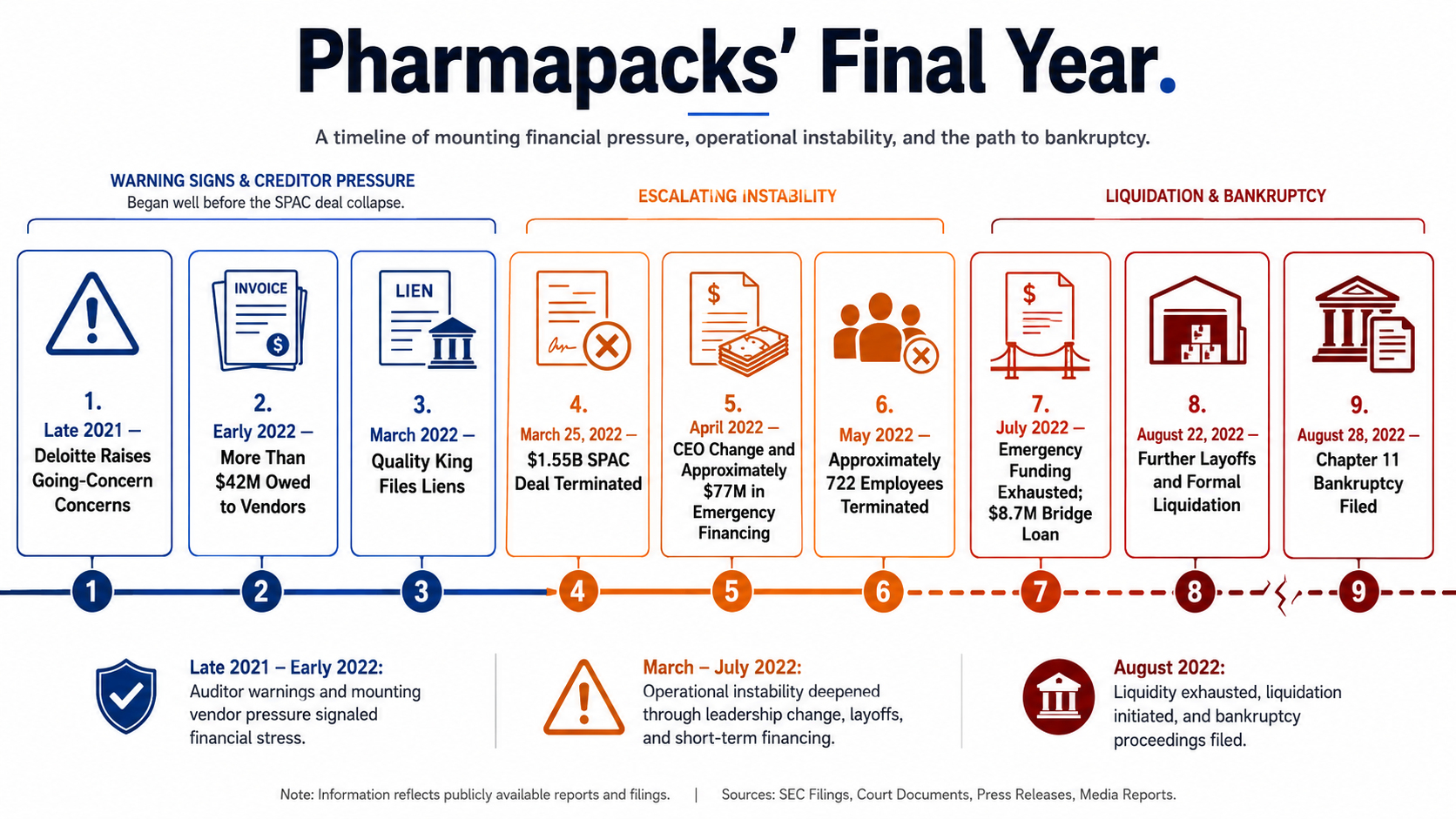
By late 2021, Deloitte had raised concerns about whether Packable could continue operating without additional financing. A later court opinion said the company’s liabilities exceeded the value of its assets by the end of the year.
On March 25, 2022, Packable and Highland Transcend terminated the merger, citing unfavorable market conditions.
The expected $434 million never arrived. The $110 million in convertible notes remained outstanding.
- Late 2021: Deloitte raised going-concern concerns because of negative cash flow and possible problems with Packable’s debt covenants.
- Early 2022: Packable owed more than $42 million to vendors for products that had already been delivered. Some suppliers stopped shipping additional inventory until their outstanding bills were paid.
- March 2022: Quality King filed three liens against Packable’s assets. The SPAC merger was terminated, and a later court opinion said Packable paid a $10 million breakup fee.
- April 2022: Andrew Vagenas stepped down as CEO and was succeeded by Daniel Myers, a Carlyle operating executive. Packable also obtained approximately $77 million in new funding from a lender group that included existing investors, suppliers and Quality King.
- May 2022: Packable terminated approximately 722 employees as part of a turnaround and cost-cutting effort.
- July 2022: The April financing had already been exhausted. The lender group supplied another $8.7 million bridge loan, but Packable was unable to secure a committed rescue investment.
- August 22, 2022: The company terminated another approximately 138 employees and moved into formal liquidation.
- August 28, 2022: Packable Holdings and its subsidiaries, including Pharmapacks LLC, filed for Chapter 11 bankruptcy in Delaware.
At its peak, Packable employed approximately 1,284 full-time employees and 22 part-time employees.
Only about 372 remained at the time of the bankruptcy filing. Most were retained temporarily to control inventory, fulfill remaining orders and assist with the sale of the company’s assets.
EcomCrew covered Pharmapacks’ shutdown in 2022, when the company was still one of the largest Amazon resellers in the United States.
How Much Did Pharmapacks Owe?
Packable reported approximately $271.8 million in funded debt when it filed for bankruptcy.
| Debt Category | Approximate Amount |
|---|---|
| Asset-based lending facility | $53.1 million |
| Term-loan facilities | $95.4 million |
| Convertible notes | $110 million |
| Equipment and capital financing | $12.1 million |
| PPP and joint-venture financing | $1.2 million |
| Total funded debt | $271.8 million |
The company also reported approximately $48 million in trade debt and purchase-card obligations.
Together, those categories totaled nearly $320 million before other bankruptcy claims, professional expenses and administrative costs were considered.
Revenue had made Pharmapacks look enormous. Its debt and continuing losses showed how little room remained beneath that revenue.
Pharmapacks Sold Its Assets, but the Bankruptcy Continued
Chapter 11 does not always mean a company will shut down. Some businesses use the process to reduce debt and continue operating.
That was not Packable’s plan.
The company entered bankruptcy to sell its assets and complete an orderly wind-down. Its remaining employees were kept mainly to manage inventory, complete outstanding orders and support the liquidation.
At the time of filing, Packable reported inventory with a gross book value of approximately $79 million. It also owned proprietary technology, investments in more than 20 brands, majority interests in several businesses, joint-venture interests, intellectual property, leasehold interests, furniture and equipment.
The debtors first requested permission to sell inventory, furniture, fixtures and equipment shortly after filing for bankruptcy. They later sought approval to sell substantially all remaining assets, including intellectual property, intangible assets and lease-related interests.
Inventory valued at roughly $70 million was eventually sold through an auction. A 2025 bankruptcy court opinion states that Quality King purchased a substantial portion of it.
The court authorized a broader sale of substantially all remaining assets in December 2022. Smaller asset sales continued into 2023.
However, the public documents reviewed do not provide one clear list showing the buyer and purchase price for every asset Pharmapacks once controlled.
The records do not conclusively identify:
- Who acquired Packable’s proprietary technology
- What happened to each of its brand investments and joint ventures
- Whether Webb Enterprises purchased particular assets from the bankruptcy estate
- Whether the Amazon seller account was sold as part of the bankruptcy
- What was paid for the Pharmapacks marketplace history or related intellectual property
That missing information matters because businesses connected to the former company continue operating under the Packable and Pharmapacks names.
The evidence supports the conclusion that the original operating business was liquidated. It does not provide a complete public trail showing how every surviving asset reached its current owner.
What did creditors recover?
Packable entered bankruptcy with nearly $320 million in funded debt, trade debt and purchase-card obligations.
The estate recovered money by selling inventory and other assets, collecting receivables and pursuing legal claims. Some individual claims were also paid, settled, reduced or withdrawn during the case.
However, those recoveries did not create enough money to repay everyone.
According to the U.S. Trustee’s March 2026 motion, the debtors had approximately $4.6 million in cash as of January 31, 2026.
The U.S. Trustee said the remaining estate assets appeared to be worth less than the asserted Chapter 11 administrative-expense claims alone.
Administrative claims include certain costs incurred after bankruptcy, such as professional fees and expenses required to administer the case. These generally must be addressed before ordinary unsecured creditors receive distributions.
That means suppliers, noteholders and other unsecured creditors were behind administrative claimants in line for a limited pool of money.
The remaining cash balance also continued declining. The estate reported a loss of approximately $1.9 million in January 2026 and cumulative losses of more than $162 million during the bankruptcy.
A proposed liquidation plan was filed in March 2026, shortly after the U.S. Trustee asked the court to convert the cases to Chapter 7 or dismiss them. However, the plan had not reached a final confirmed outcome in the public filings reviewed for this article.
As a result, there was no reliable, court-approved recovery percentage that could be stated for general unsecured creditors.
Based on the U.S. Trustee’s description of the estate, those creditors faced the possibility of a very small recovery or no recovery at all after higher-priority claims and the continuing costs of the case were addressed.
Shareholders would generally rank behind creditors and therefore were unlikely to recover anything unless all higher-priority claims were paid first.
The creditors’ lawsuit
In September 2023, the official committee representing unsecured creditors filed a lawsuit connected to the bankruptcy.
The complaint challenged transactions involving Quality King and related parties, including payments, liens, loans, releases and transfers made before the bankruptcy.
The committee argued that some of the money should be returned to the estate and distributed to creditors.
These were allegations. They were not findings that Quality King or the other defendants had committed wrongdoing.
Quality King had played several roles in Pharmapacks’ history. At different times, it had been a supplier, lender, shareholder, board-level participant, secured creditor and buyer of inventory from the bankruptcy estate.
Few outside companies were as closely connected to both Pharmapacks’ growth and its liquidation.
In September 2025, the bankruptcy court dismissed most of the committee’s claims.
The court found that several fraudulent-transfer, insider, equitable-subordination and related claims had not been supported with enough specific facts.
However, it allowed certain preference claims involving payments made during the 90 days before bankruptcy to continue. It also allowed related claims seeking to prevent the recipients from collecting on their own bankruptcy claims unless any avoidable transfers were repaid.
A preference claim generally asks whether a creditor received payments shortly before bankruptcy that gave it more than it would have received through the normal bankruptcy process.
As of the latest public materials reviewed for this article, the remaining Quality King preference claims had not reached a clearly documented final judgment or comprehensive public settlement.
The estate had settled a number of other avoidance claims during the bankruptcy, but the surviving Quality King claims remained relevant because any money recovered could increase the limited funds available for distribution.
Why was the bankruptcy still open in 2026?
Selling the assets did not complete the bankruptcy.
The estate still had to resolve creditor claims, lawsuits, professional fees, administrative expenses and questions about how its remaining money should be distributed.
On March 4, 2026, the U.S. Trustee asked the court to convert the cases to Chapter 7 or dismiss them.
The motion said Packable had been in bankruptcy for more than 42 months, had no operating business or employees and had not yet filed a Chapter 11 plan.
It also argued that the estate was continuing to lose money despite having no business left to rehabilitate.
Nine days later, the remaining bankruptcy estates filed a joint Chapter 11 liquidation plan and disclosure statement.
The public bankruptcy docket continued receiving filings in July 2026.
Bankruptcy Status
Pharmapacks stopped operating and sold substantially all of its assets beginning in 2022. However, its bankruptcy and creditor-distribution process continued into 2026. The estate had approximately $4.6 million in cash as of January 2026, while asserted administrative claims alone appeared to exceed the remaining assets.
Who Owns the Pharmapacks Name and Amazon Account Now?
The original operating company was Pharmapacks LLC, a subsidiary of Packable Holdings LLC.
During the bankruptcy, Packable Holdings was renamed Pack Liquidating LLC. Pharmapacks LLC was separately renamed PP Liquidating LLC.
The Pharmapacks trademark
The federal registration for the PHARMAPACKS mark, serial number 88263447, can be viewed through the USPTO’s Trademark Status and Document Retrieval system.
The ownership history lists Webb Enterprises LLC, a company associated with the same 1516 Motor Parkway address connected to the current Packable operation.
The record shows assignment activity in May and June 2022, before the August bankruptcy filing, followed by an automatic ownership update in January 2023.
Trademark Status
The PHARMAPACKS federal trademark registration was cancelled on February 13, 2026 because the required declaration of continued use was not filed.
Cancellation does not automatically mean nobody may use the name. It means the federal registration is no longer active and no longer provides the same protections.
The trademark database also records events and ownership entries, but it does not fully explain the contracts, payments or transfers behind them.
Webb Enterprises is connected to the present Packable business. Packable’s Terms of Use identify the site operator as “Webb Enterprises LLC dba Packable,” while its leadership page lists Jonathan Webb and Chris Pfeiffer as co-founders and co-CEOs.
The Amazon seller account
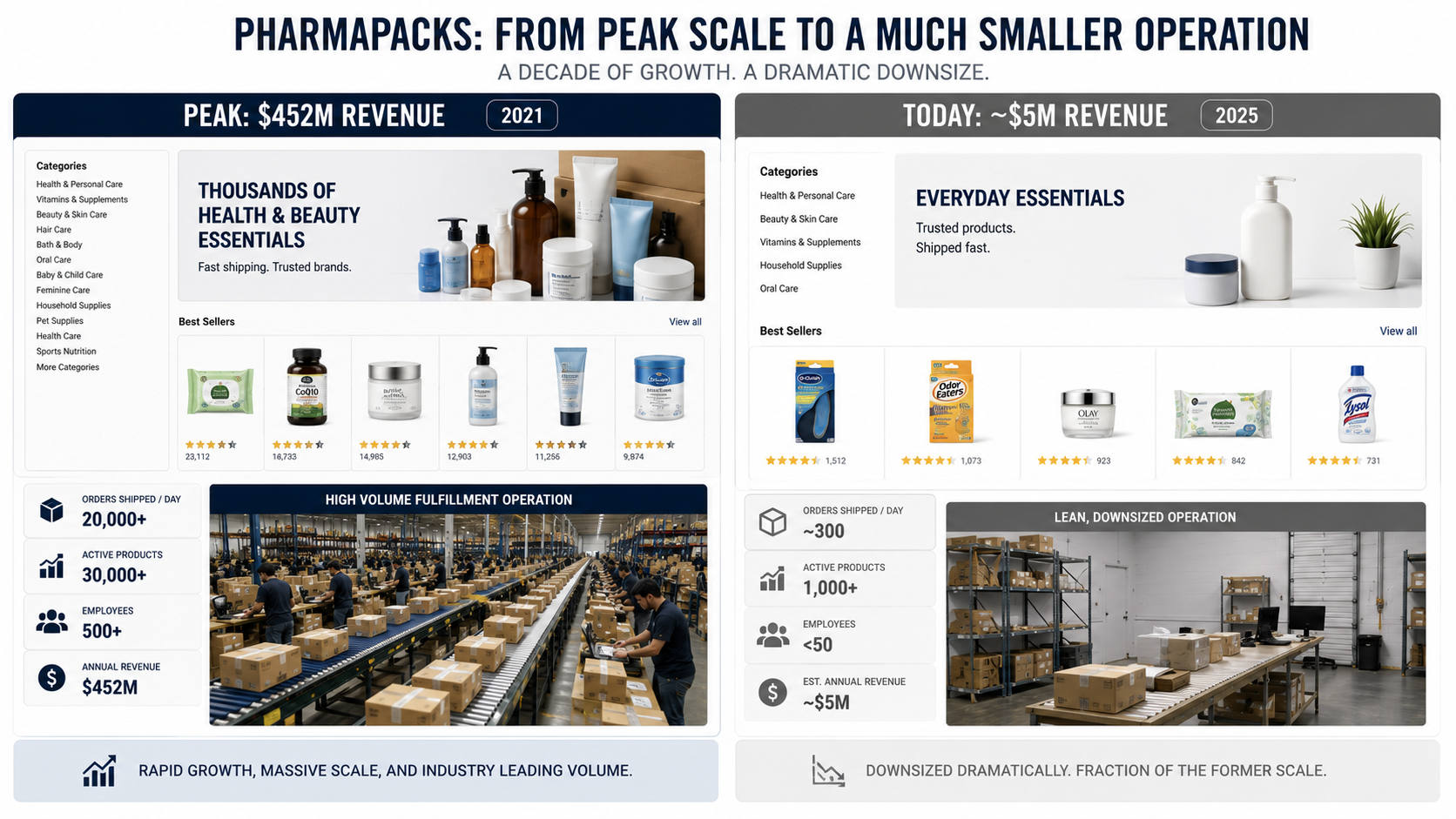
A much smaller Amazon account continues trading as “Pharmapacks_.”
The current Seller Snooper profile identifies the business behind the account as Pharma Packs Corp, with an address at 1516 Motor Parkway in Islandia, New York.
As of June 2026, Seller Snooper estimated that the account generated approximately $5 million in annual revenue and carried 32 products. It also had more than 1.2 million lifetime seller-feedback ratings.
The current operation is tiny compared with the former business, which generated more than $450 million in annual revenue at its peak.
The account’s large lifetime-feedback total suggests continuity with the original Pharmapacks marketplace presence. However, Pharma Packs Corp, Webb Enterprises LLC, PP Liquidating LLC and the former Pharmapacks LLC are different legal names.
The shared address, overlapping personnel, trademark history and continued seller feedback strongly suggest a relationship. They do not establish exactly how the account was transferred, purchased or reorganized.
The public records reviewed for this article do not conclusively identify:
- Who purchased or received the Amazon seller account
- Whether the account was formally sold through the bankruptcy
- Whether Pharma Packs Corp is owned or controlled by Webb Enterprises
- What was paid for the trademark or marketplace assets
The safest conclusion is that the Pharmapacks name and marketplace presence survived in a smaller form, while the original operating company was liquidated.
Where Are Pharmapacks’ Former Leaders Now?
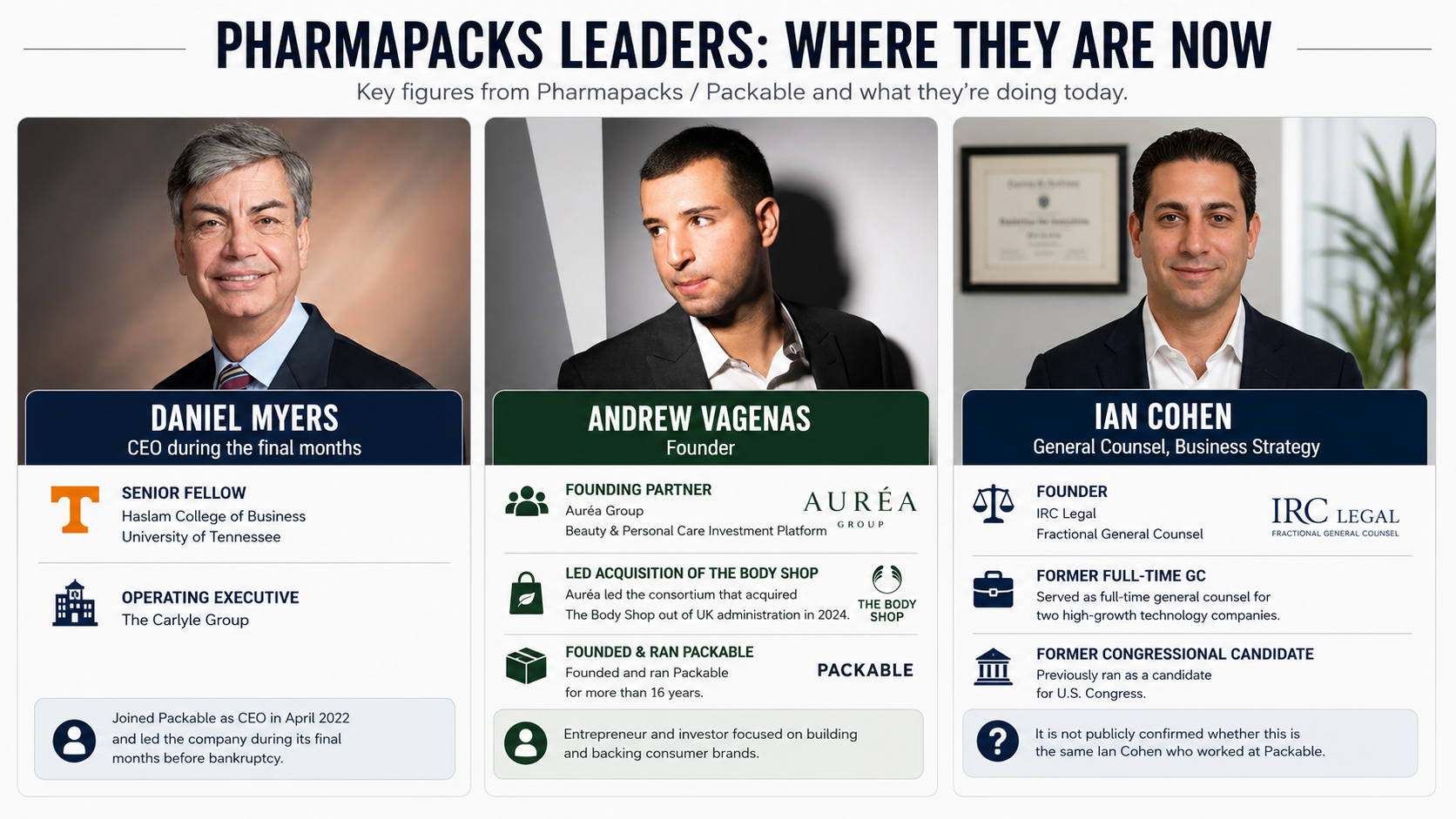
Andrew Vagenas
Vagenas is now a founding partner at Auréa Group, an investment company focused on beauty, wellness and personal-care brands.
His company biography credits him with founding and leading Packable and developing experience in Amazon strategy, ecommerce, logistics and brand growth.
In 2024, Auréa led a consortium that acquired The Body Shop after the retailer entered administration in the United Kingdom.
Daniel Myers
Myers became Packable’s CEO during its final months.
He is now listed as a senior fellow at the University of Tennessee’s Global Supply Chain Institute and an operating executive with Carlyle.
Ian Cohen
Cohen served as Pharmapacks’ general counsel and later became Packable’s vice president of business strategy.
He later founded IRC Legal, a fractional general counsel practice, and has also worked with TechGC and The Roebling Group.
What Ecommerce Sellers Can Learn From Pharmapacks
Pharmapacks did not fail because nobody wanted its products. It failed after becoming one of the largest online sellers in the country.
That makes its collapse especially useful for other ecommerce operators.
Track contribution margin, not only revenue
Pharmapacks’ sales grew rapidly, but direct selling and fulfillment expenses left little money to cover the rest of the company.
Revenue can make a business look successful. Contribution margin and operating cash flow determine whether it can support itself.
Treat warehouses as long-term commitments
Internal fulfillment can create an advantage at sufficient scale, but it becomes dangerous when order volume falls below expectations.
Before building a warehouse network, sellers should compare its full cost with FBA, a 3PL and a hybrid operation. The calculation should include unused capacity, insurance, management time, technology and the cost of scaling down.
Reduce dependence on any single marketplace
Amazon produced most of Pharmapacks’ revenue while also controlling many of the fees, standards and rules affecting its margins.
A business does not need to abandon Amazon, but it should understand what would happen if its largest marketplace suddenly became less profitable.
Use outside funding to fix the model
Pharmapacks repeatedly raised capital without reaching sustainable profitability.
Funding can give a company time to repair its economics. It cannot permanently replace profitable economics.
Do not spend a financing deal before it closes
Packable expanded in anticipation of hundreds of millions of dollars that never arrived.
A signed merger agreement, financing proposal or investor presentation is still different from money in the bank.
Pharmapacks’ collapse also took place during a wider downturn among heavily financed Amazon businesses. EcomCrew has separately covered the rise and fall of Amazon FBA aggregators, many of which faced similar problems involving debt, overhead and unrealistic growth assumptions.
What Actually Happened to Pharmapacks?
Pharmapacks did not collapse because it failed to grow. It collapsed because growth made its financial problem larger.
The company built an impressive ecommerce and fulfillment operation, but each new stage required more inventory, more employees, more warehouse capacity and more outside capital.
The SPAC transaction might have extended its runway. It would not automatically have repaired the economics underneath the business.
When that funding disappeared, Pharmapacks had no profitable core strong enough to support the operation it had built.
Its operating business was dismantled beginning in 2022, but the legal wind-down continued for years. By January 2026, only about $4.6 million remained in the estate, and even that appeared insufficient to cover the administrative claims ahead of ordinary unsecured creditors.
The Pharmapacks name and Amazon account survived in a much smaller form. However, the public record does not provide a complete trail showing who acquired every piece of Packable’s technology, brand portfolio and marketplace operation.
Pharmapacks is a reminder that ecommerce scale can be misleading. A company can dominate marketplace rankings, ship millions of orders and attract a billion-dollar valuation while remaining financially fragile underneath.
Related Articles