Shopify Q2 2026 Earnings Reveal a Growing Payments Reliance

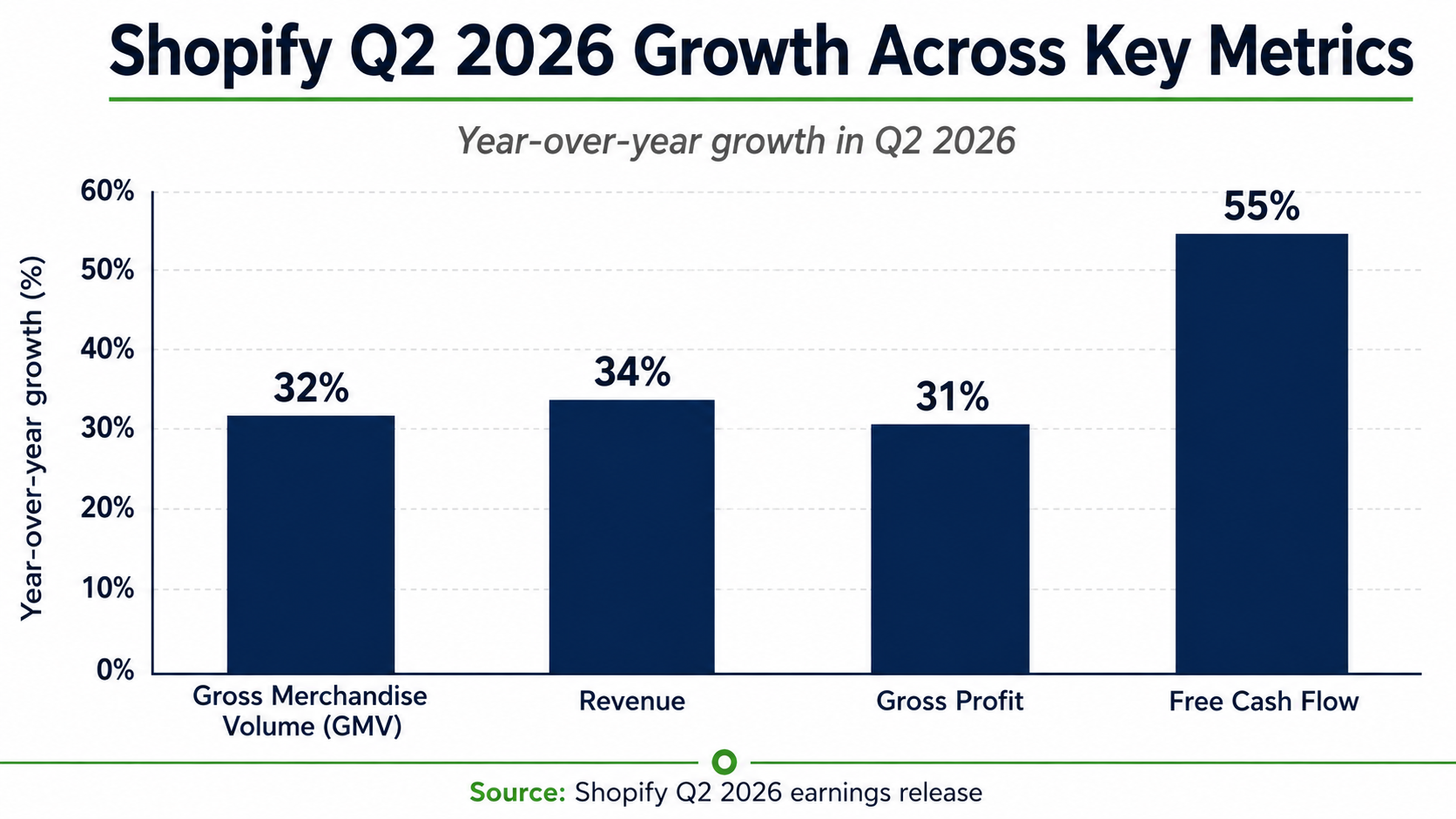
Shopify reported another quarter of 30%+ growth across several major metrics. According to its Q2 2026 earnings release, gross merchandise volume reached $115.6 billion, revenue increased 34% to $3.58 billion, gross profit rose 31% to $1.71 billion, and free cash flow climbed 55% to $654 million.
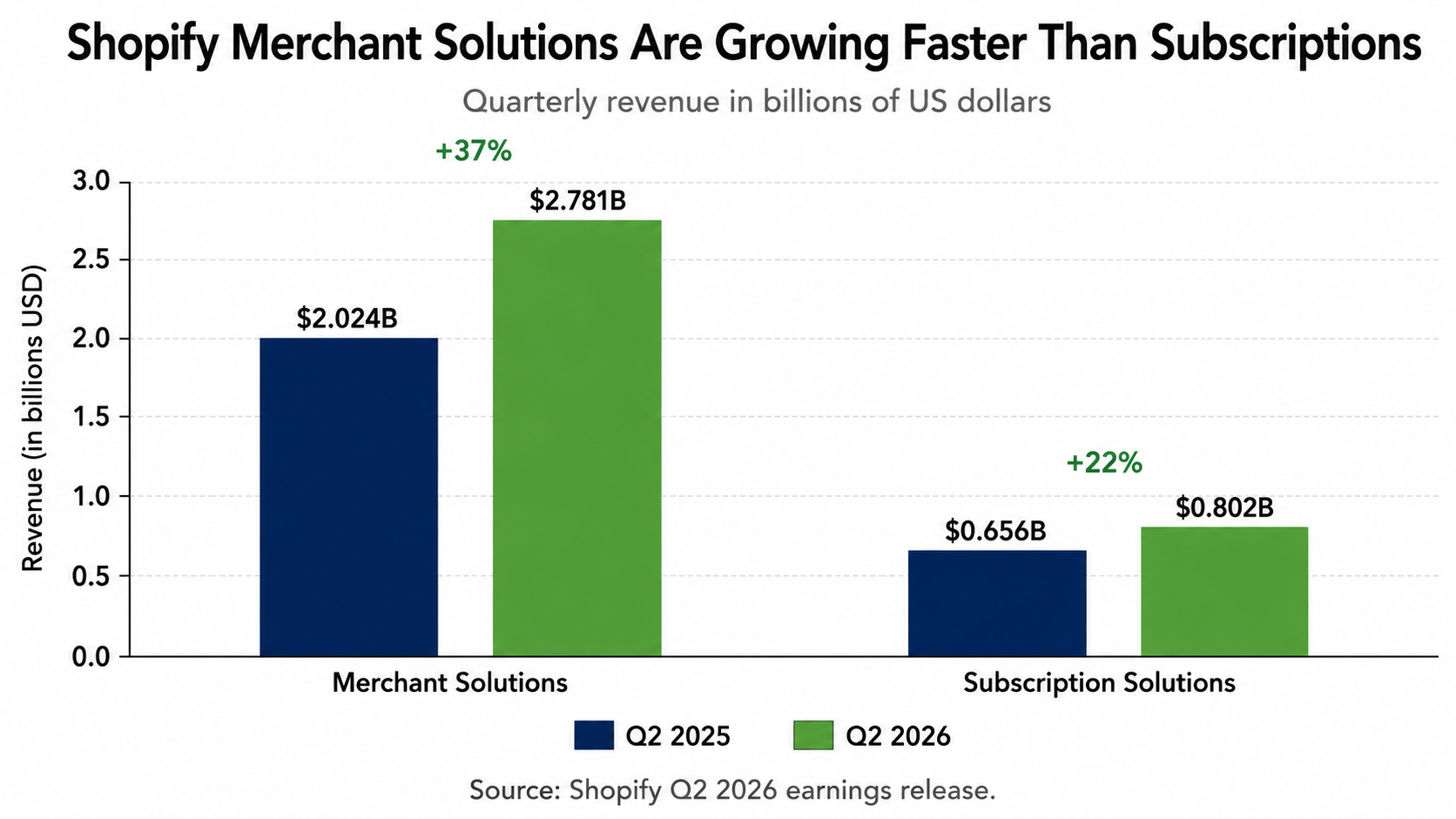
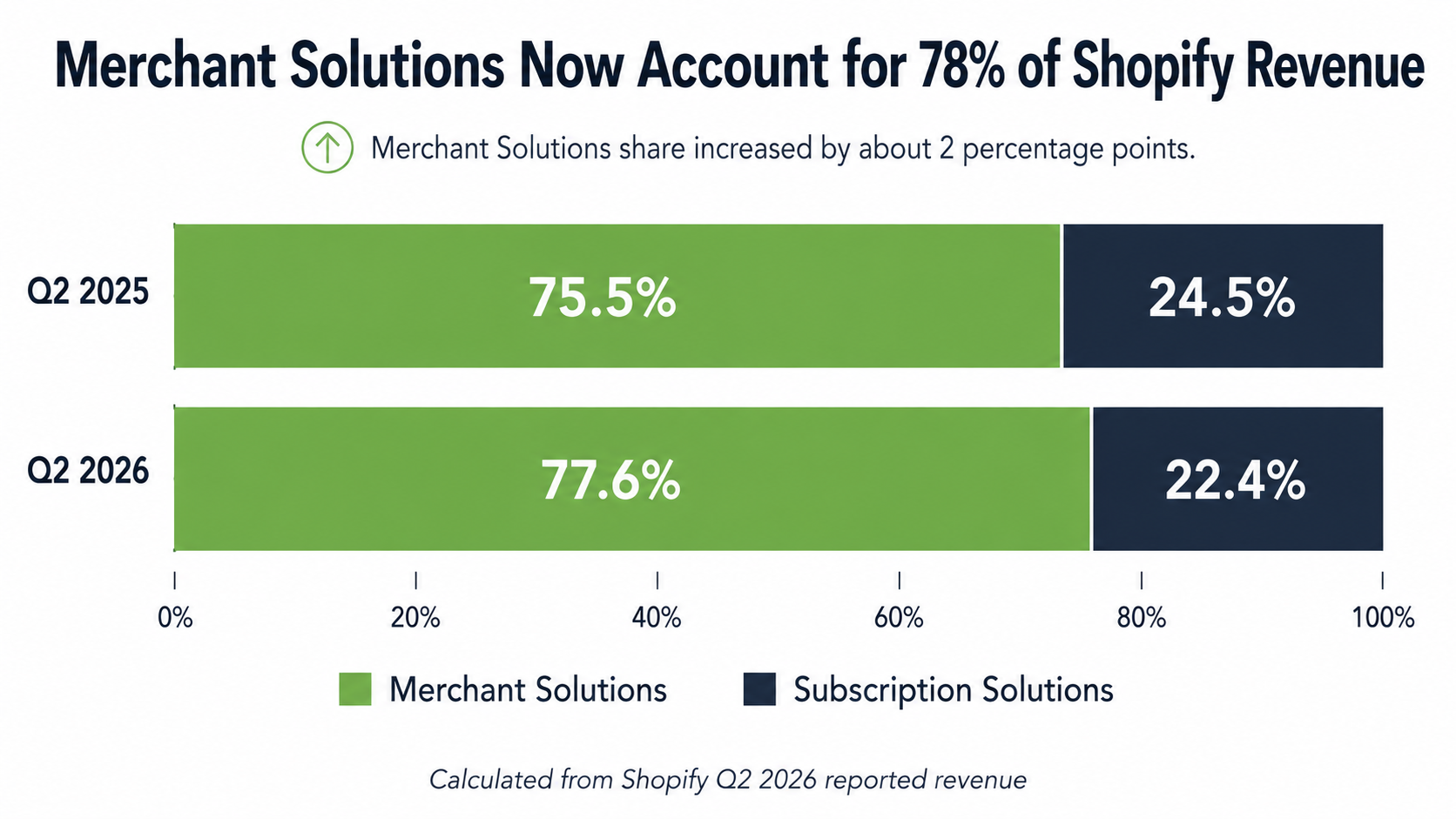
Merchant Solutions grew faster than Shopify’s subscription business. Revenue from Merchant Solutions increased 37% to $2.78 billion, while Subscription Solutions increased 22% to $802 million. Merchant Solutions accounted for approximately 78% of Shopify’s total Q2 revenue.
Payments were a major driver of that growth.
Shopify Q2 2026 GMV, Revenue, and Free Cash Flow Growth
Shopify merchants generated $115.6 billion in GMV during Q2 2026, up from $87.8 billion a year earlier. That represents 32% year-over-year growth.
Revenue increased from $2.68 billion to $3.58 billion, a 34% increase. Gross profit rose from $1.30 billion to $1.71 billion, while operating income increased from $291 million to $488 million.
Free cash flow increased from $422 million to $654 million, a 55% jump. Shopify’s free cash flow margin also expanded from 16% to 18%.
Monthly recurring revenue reached $221 million, up from $185 million in Q2 2025.
Shopify has grown well beyond the monthly subscription model it started with. The platform still collects subscription fees, but more of its revenue now comes from the services merchants use once transactions begin flowing through their stores.
Those costs vary by plan and payment setup, which we break down further in our guide to Shopify seller fees.
Merchant Solutions Accounted for 78% of Shopify Revenue
Shopify generated $2.78 billion from Merchant Solutions in Q2 2026, compared with $2.02 billion a year earlier.
Subscription Solutions generated $802 million, up from $656 million.
Shopify’s Q2 2026 Form 10-Q shows Merchant Solutions growing 37% year over year, compared with 22% growth for Subscription Solutions.
Based on those reported figures, Merchant Solutions represented approximately 77.6% of Shopify’s Q2 2026 revenue, compared with about 75.5% a year earlier.
Subscription Solutions fell from approximately 24.5% of revenue to 22.4%.
Merchant Solutions is broader than Shopify Payments. The category also includes revenue from Shopify Capital and other financial products, shipping labels, referral fees, POS hardware, advertising, and other merchant services.
Payments are still its largest growth driver. In its quarterly filing with the SEC, Shopify says the largest component of the year-over-year increase in Merchant Solutions came from Shopify Payments.
It would therefore be inaccurate to say that 78% of Shopify’s revenue comes directly from payment processing. It is more accurate to say that 78% now comes from Merchant Solutions, with Shopify Payments driving most of the growth inside that category.
Our history of Shopify shows how payments and transaction-related services became a larger part of the company as it expanded beyond ecommerce software.
Shopify Payments Drove Most of Merchant Solutions Growth
Merchant Solutions revenue increased by approximately $757 million between Q2 2025 and Q2 2026.
Shopify attributed $624 million of that increase to additional Shopify Payments revenue from payment processing and currency conversion fees. That means Shopify Payments accounted for roughly 82% of the year-over-year increase in Merchant Solutions revenue.
Shopify Payments also processed substantially more of the merchandise sold through Shopify stores.
Shopify Payments Penetration Reached 68% of GMV
Shopify Payments processed $78.1 billion in GMV during Q2 2026, up 38% from $56.6 billion a year earlier.
Its penetration rate increased from 64% of Shopify GMV to 68%.
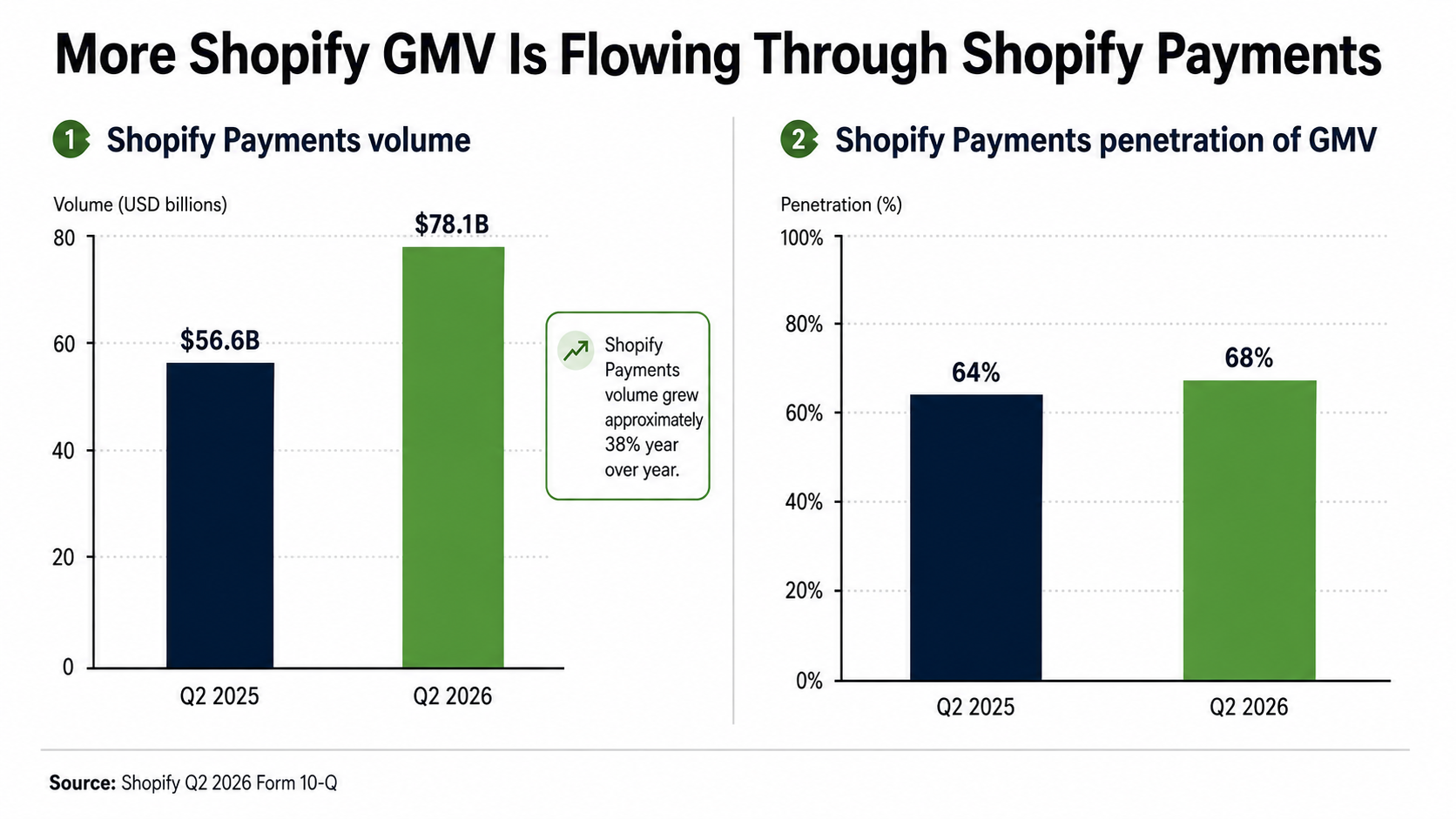
Shopify benefited from two things at once. Total GMV grew 32%, and a greater percentage of that GMV passed through Shopify Payments.
Payment processing also carries direct costs. Shopify reported that the cost of Merchant Solutions revenue increased 36% during the quarter, driven largely by higher payment processing fees as more GMV flowed through Shopify Payments.
Merchants that use outside payment providers may also face additional transaction fees depending on their Shopify plan. Our comparison of ecommerce payment gateways covers some of the alternatives available to online sellers.
How Shopify B2B Payments Differ From DTC Checkout
Shopify has been expanding its B2B tools as it pursues larger merchants and enterprise commerce.
B2B transactions can follow a different payment cycle from a typical consumer checkout. Shopify’s deferred payment options for B2B orders support terms including Net 7, Net 15, Net 30, Net 45, Net 60, and Net 90, allowing businesses to place orders before payment is due.
That creates a different relationship between the order and the payment transaction.
A normal DTC purchase using Shopify Payments can generate processing revenue immediately. A B2B order may instead be invoiced, paid later, or settled through another payment method.
Shopify has been adding ways to keep more of those B2B transactions inside its own payment ecosystem. Its Spring ’26 Edition introduced automated vaulted payments for B2B customers, allowing stored payment methods to be charged based on fulfillment, due dates, or invoicing. It also expanded integrations that sync B2B orders, purchase order numbers, and company information with tools such as QuickBooks.
Shopify’s deferred payment tools and its growing payments business are therefore developing alongside each other. The platform can accommodate longer B2B payment cycles while creating more opportunities to process the eventual payment itself.
Shopify’s Spring ’26 B2B Updates Were a Small Share of the Release
Shopify’s Spring ’26 product release included more than 150 updates across areas such as AI, checkout, retail, marketing, international commerce, and B2B. The B2B section included features such as automated vaulted payments and integrations with QuickBooks and Mailchimp.
Claims that Shopify dedicated only 3% of its engineering resources to B2B cannot be established from the public release.
Counting B2B features as a percentage of Shopify Editions can show how prominently B2B appeared in the product announcement. It does not reveal engineering hours, headcount, or research and development spending by product area.
Shopify spent $445 million on research and development during Q2 2026, up 13% from $394 million a year earlier. Its financial filings do not break that spending down between B2B, payments, AI, checkout, retail, or other products.
The public release supports the argument that B2B represented a relatively small portion of the announced Spring ’26 features. It does not support treating the percentage of announced features as Shopify’s engineering allocation.
Shopify Q3 2026 Revenue Guidance
In its Q2 earnings guidance, Shopify said it expects revenue to continue growing at a low-thirties percentage rate in Q3 2026.
Gross profit dollars are expected to grow at a mid-to-high twenties percentage rate. Shopify expects operating expenses to represent 33% to 34% of revenue, while its free cash flow margin is expected to remain in the high teens to low twenties.
The guidance follows 34% revenue growth in Q2 and another 34% increase during the first quarter of 2026. Shopify had already crossed $100 billion in quarterly GMV in Q1 before reaching $115.6 billion in Q2.
Merchant Solutions Continue to Outgrow Subscription Solutions
Shopify’s Q2 numbers were strong across GMV, revenue, gross profit, operating income, and free cash flow.
The revenue mix continued moving toward Merchant Solutions.
Merchant Solutions grew 37% and reached $2.78 billion. Subscription Solutions grew 22% to $802 million. Merchant Solutions now account for approximately 78% of Shopify’s quarterly revenue.
Shopify Payments generated $624 million of the $757 million increase in Merchant Solutions revenue. Payments penetration climbed from 64% to 68% of GMV, while the amount processed through Shopify Payments increased from $56.6 billion to $78.1 billion.
Shopify remains an ecommerce platform, but subscriptions are becoming a smaller part of how the company makes money. More of its growth now comes from the transactions, payments, and financial services running through the stores it powers.