TikTok Shop Affiliate Commissions: What Q4 Sales Really Cost

On a $40 product, a 20% creator commission is $8. In the hypothetical example below, the sale leaves $8.60 after the modeled costs. Apply a 20% holiday discount and add $5 in advertising per order, and contribution falls to −$2.32, before overhead and income taxes.
Creator content and paid promotion also feature in a major retailer’s Q4 plans. Best Buy announced on September 22 that it plans to bring nearly 10,000 products to TikTok Shop beginning in late October, with creator content and paid advertising supporting the launch.
For sellers planning their own holiday campaigns, the calculation depends on their product costs and campaign terms. Below, we work through how discounts, advertising, and commission rates affect contribution per order, then explain which commission rules to check before setting an offer.
The Affiliate Commission Is One Part of the Bill
TikTok Shop affiliate commissions pay creators for qualifying sales of your products. They are separate from the platform’s referral fee and your advertising spend.
Under TikTok’s U.S. collaboration guidance, Open Collaboration makes selected products available to creators, with an approval option. Target Collaboration lets you invite specific creators. If both apply to the same creator and product, the target commission takes precedence over the open rate. These aren’t two creator commission rates to add together.
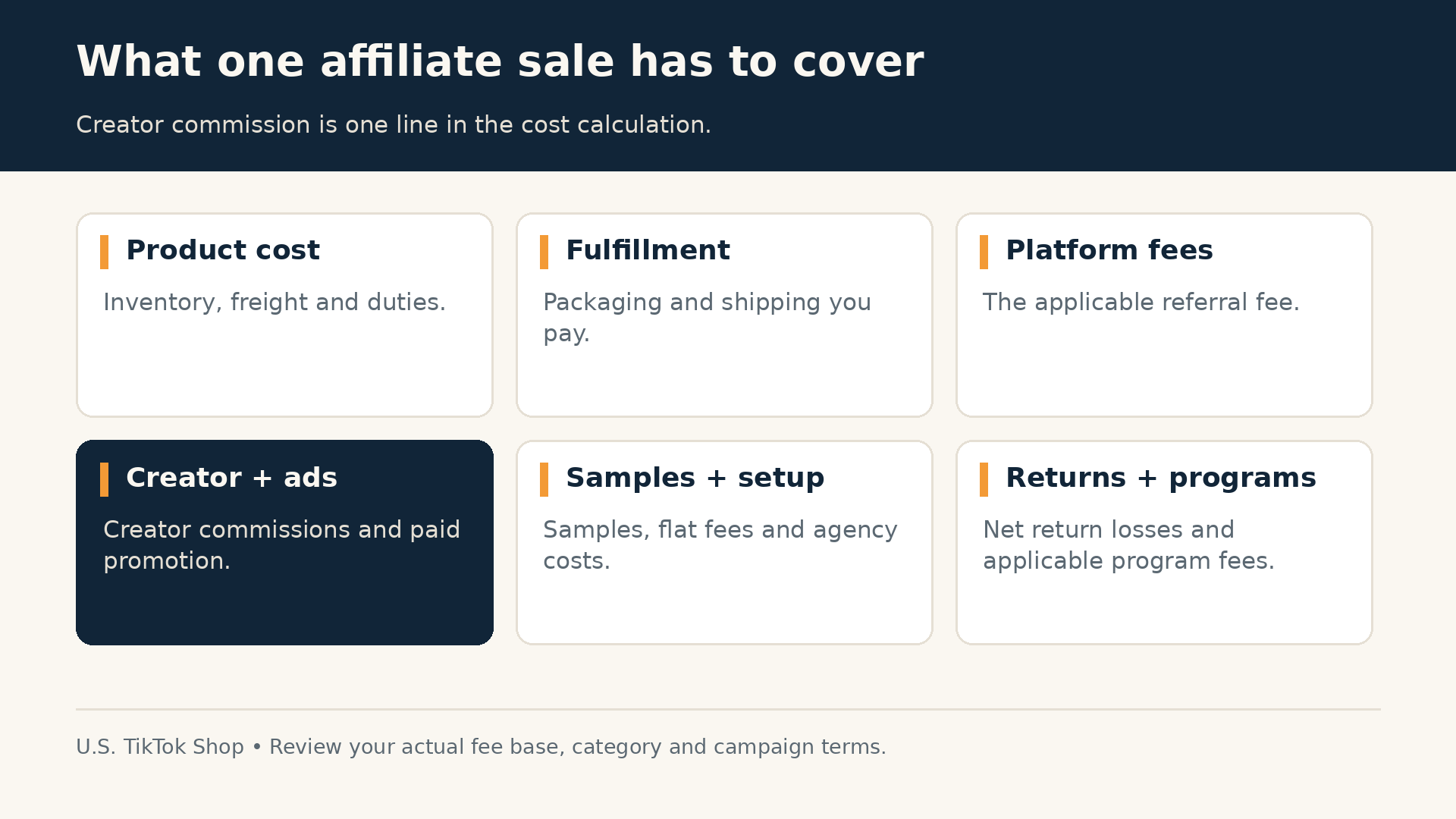
Your product economics still need to carry the rest of the campaign:
- Landed product cost, including freight and duties where applicable.
- Packaging and the fulfillment or shipping costs you actually bear.
- The applicable platform referral fee.
- Creator commissions and paid advertising.
- Samples, creator flat fees, or agency charges where relevant.
- Expected losses from returns and refunds.
- Marketing-program charges that apply to your shop.
TikTok’s published U.S. referral-fee policy sets a 6% rate for qualified transactions and points sellers to category-specific rates. Its calculation includes platform-funded discounts and excludes tax. Check your actual category, incentives, and fee base before applying a percentage to an order.
For the example below, we assume a product charged at 6%, no platform-funded discount, and no customer-paid shipping. That makes the fee base equal to the seller’s discounted product price. It isn’t a complete fee schedule for every TikTok Shop seller.
How a $40 Product Becomes a Money-Losing Holiday Offer
Consider an illustrative insulated bottle with a $40 regular price. These assumptions are invented to show the calculation:
| Cost assumption | Amount |
|---|---|
| Landed product cost | $12.00 |
| Packaging and seller-paid fulfillment/shipping | $5.00 |
| Expected net return/refund losses, allocated per order | $2.00 |
| Samples and creator setup costs, allocated per order | $2.00 |
| Referral fee | 6% of the product price in this example |
| Standard affiliate commission | 20% of the product price in this example |
| Ad spend on paid-promotion scenarios | $5.00 per order |
The $2 sample allocation could represent $200 of sample and setup spending spread across 100 orders. If only 50 orders come through, that allocation becomes $4. The sample bill stays put even when the sales forecast wanders off.
Now compare four ways to sell the same bottle:
| Per-order calculation | Full price, organic affiliate | 20% discount, organic affiliate | 20% discount, paid promotion at standard commission | 20% discount, paid promotion at a custom ad commission |
|---|---|---|---|---|
| Product revenue after seller discount | $40.00 | $32.00 | $32.00 | $32.00 |
| Landed product cost | −$12.00 | −$12.00 | −$12.00 | −$12.00 |
| Packaging and fulfillment/shipping | −$5.00 | −$5.00 | −$5.00 | −$5.00 |
| Expected return/refund loss | −$2.00 | −$2.00 | −$2.00 | −$2.00 |
| Allocated sample/setup cost | −$2.00 | −$2.00 | −$2.00 | −$2.00 |
| Referral fee at assumed 6% | −$2.40 | −$1.92 | −$1.92 | −$1.92 |
| Creator commission | −$8.00 at 20% | −$6.40 at 20% | −$6.40 at 20% | −$3.20 at 10% |
| Advertising | $0.00 | $0.00 | −$5.00 | −$5.00 |
| Contribution per order | $8.60 | $2.68 | −$2.32 | $0.88 |
Here, contribution is what remains after the costs shown, before general overhead and income taxes. The return-loss line is a planning allowance for expected net losses; replace it with your own data and avoid counting the same loss twice when reconciling actual results.
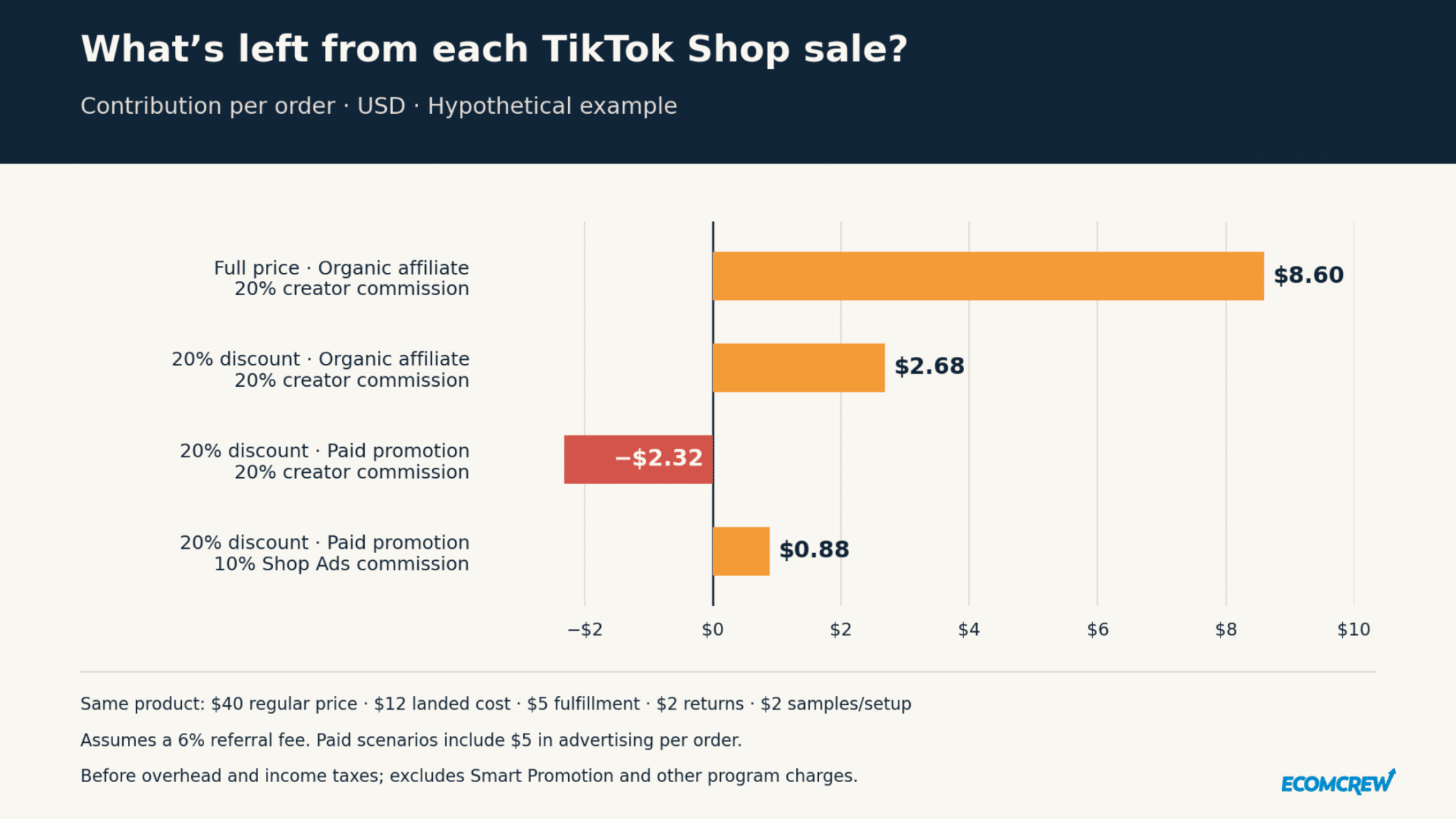
The seller-funded discount removes $8 of revenue. Percentage fees fall as the price falls, but manufacturing and fulfillment don’t shrink along with it. Then the $5 advertising allocation pushes the third scenario below zero.
At 1,000 orders, that scenario produces $32,000 in product revenue and a modeled $2,320 contribution loss. A bigger revenue screenshot won’t improve the arithmetic.
The fourth scenario assumes an eligible seller has a 10% Shop Ads commission that actually applies to those orders. It demonstrates the effect of the rate change; it doesn’t establish that lowering a commission will preserve creator participation or sales volume.
Paid Promotion Can Still Carry a Creator Commission
Don’t assume paying for the ad replaces the affiliate commission.
TikTok’s Shop Ads commission guidance says eligible, invited sellers can specify a separate rate for ad-supported orders. Without a specified Shop Ads commission, qualifying ads using affiliate posts still earn the standard rate.
A custom ad rate replaces the applicable standard creator rate for those orders. You don’t automatically pay both creator rates on the same sale. Ad spend is an additional cost.
The practical check is simple: open the product and collaboration settings and confirm the rate that applies to each creator. Account for target collaborations as well as the open setting. Use actual commission entries to verify the outcome.
If you are considering a lower ad commission, discuss it with the creator and model the economics at the rate that is active. Access to a setting doesn’t mean changing it immediately changes every existing creator’s payout.
You May Have to Carry the Higher Rate After Editing It
TikTok’s U.S. standard commission guide describes commission protection for creators already promoting products in Open Collaboration. It aligns Shop Ads rate decreases with 30-day protection; increases apply immediately.
The guide also distinguishes collaboration settings and displays active periods and commission history. Don’t treat the protection as a universal 30-day rule for every collaboration: the same document describes different timing for Target Collaboration edits.
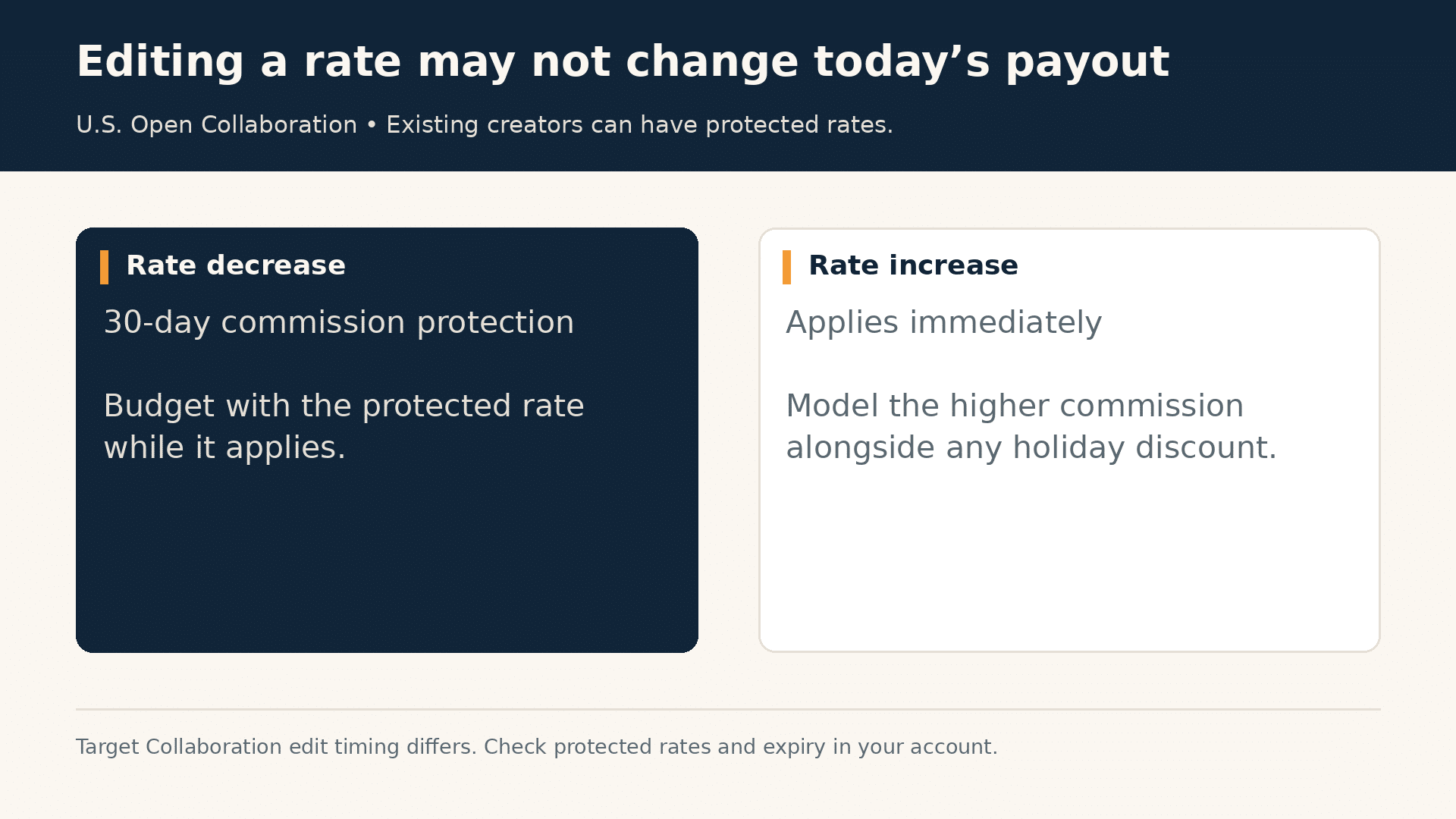
For October planning, calculate the offer using the rates that will actually be active during the promotion. Confirm any protected rate and its expiry in your collaboration history before assuming a reduction has taken effect.
That matters if you raise commissions to recruit creators, then intend to cut them while offering a holiday coupon. Budget for the overlap shown in your account. The coupon and the protected rate may be eating from the same margin.
Check Smart Promotion Before Adding Another Discount
Creator commissions aren’t the only marketing charge to review.
TikTok’s U.S. Smart Promotion FAQ describes a program charging a percentage of store GMV, with rates that increase during campaign periods. It also describes platform discount support and enrollment as a prerequisite for major platform campaigns.
The important point for your offer is the actual charge in your enrollment terms and campaign calendar. Check which products are included and how the fee is calculated. The main worked example above excludes Smart Promotion and other additional program charges.
Don’t automatically subtract every customer-facing coupon as a seller cost. Identify the amount you fund and any platform support separately. Conversely, a promise of platform discount resources shouldn’t be booked as extra seller profit.
Run the campaign with the program fee included and the seller-funded discount correctly assigned. Compare the resulting contribution with an offer outside that program where available. The program may help you sell more; the decision is whether those orders produce enough contribution to justify participating.
Work Backward to an Affordable Commission
Choosing a commission because it looks competitive reverses the calculation. First decide what contribution the offer needs to leave.
Use this planning formula, with a commission base that matches the applicable rules:
Maximum creator commission amount = seller revenue − all other allocated costs − desired contribution.
Maximum creator commission rate = maximum commission amount ÷ applicable commission base.
For the discounted, paid-promotion bottle, suppose you want $2 per order after the modeled costs:
$32 − $12 − $5 − $2 − $2 − $5 − $1.92 − $2 = $2.08 available for creator commission.
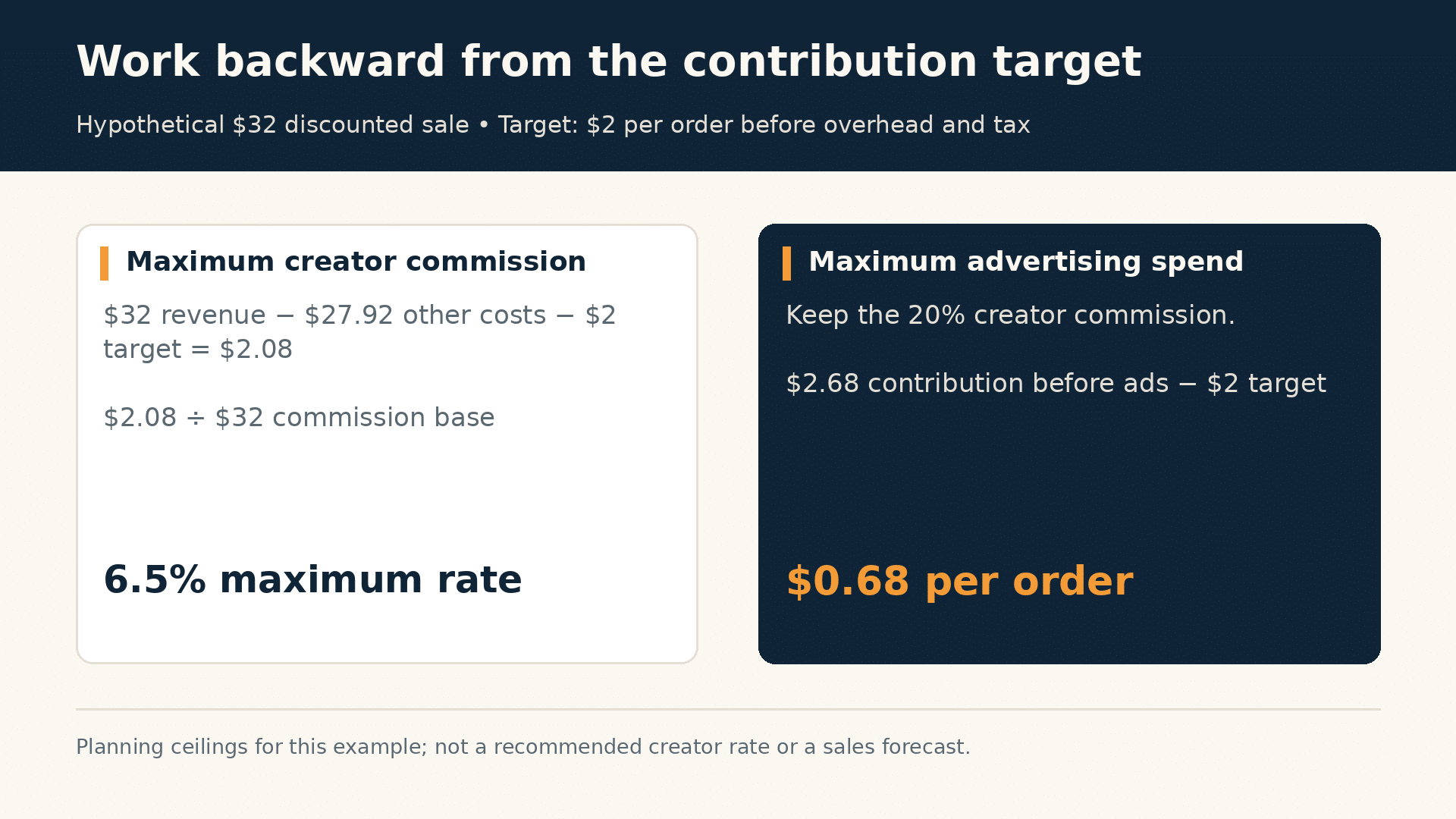
With the example’s $32 commission base, that is a 6.5% maximum rate. At 10%, the table leaves only $0.88. At 20%, it loses money.
This doesn’t mean 6.5% is a sensible offer for the creator. It means the seller’s proposed price and cost structure cannot support a higher rate while reaching that $2 target. You may need a smaller discount, cheaper acquisition, or a different product.
The reverse calculation is useful too. At the example’s 20% commission, the discounted bottle has only $0.68 available for advertising per order if you still want $2 in contribution. If a campaign needs substantially more than that, adjust the offer before increasing its budget.
October’s Useful Test Is Whether the Offer Survives Settlement
Start with a product that has room to carry the campaign. A clear demonstration and a healthy margin are more useful than putting your entire catalog into a creator offer you haven’t costed.
Set the seller discount and commission together, then establish a limited test budget. Include sample spending and any agency or creator flat fees. Our coverage of TikTok’s agency recruitment push provides context for that ecosystem; your own agreement determines what you pay.
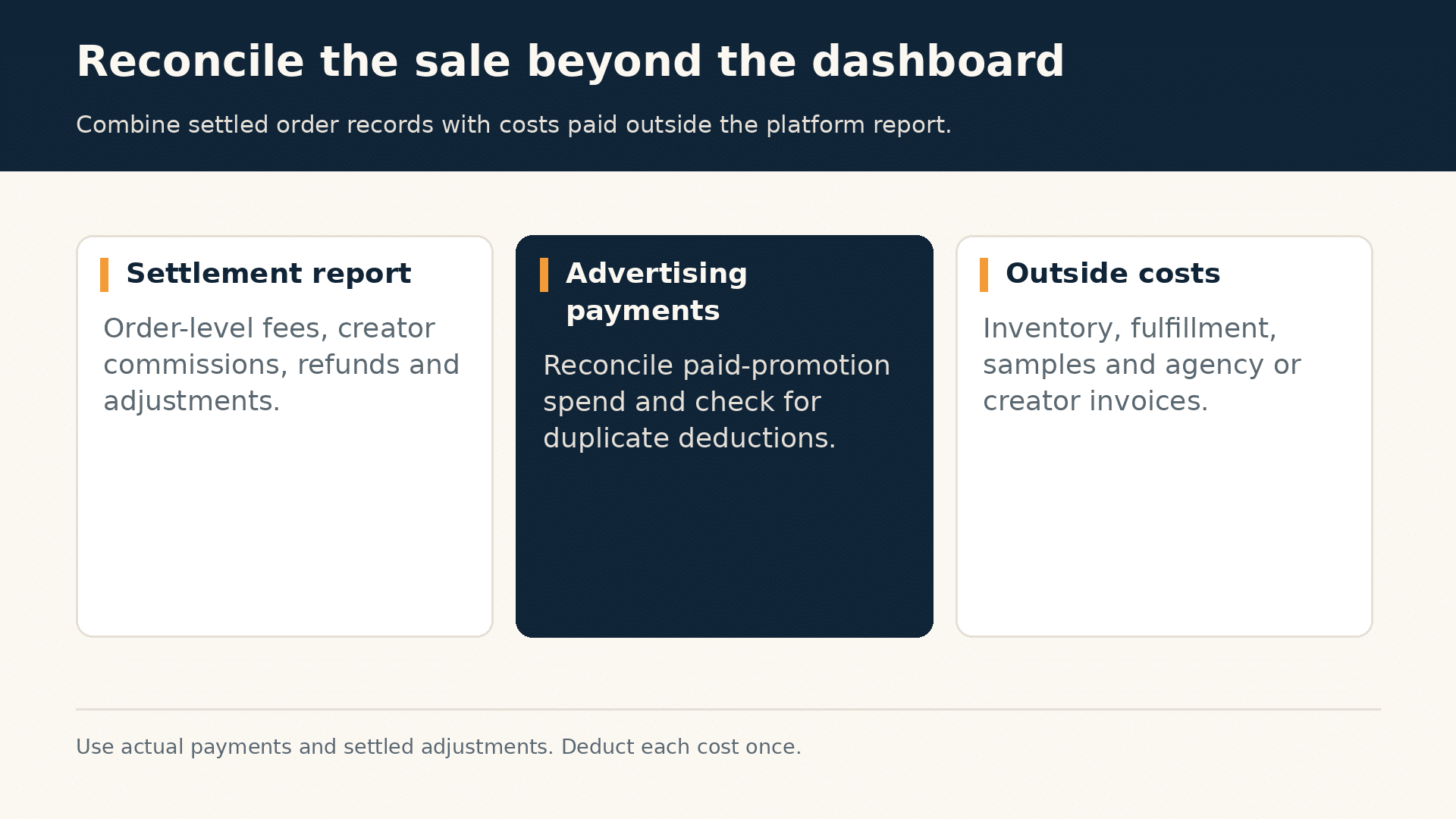
Measure enough to distinguish an attractive video from a workable offer. Track product revenue after seller discounts, active creator rates, paid-promotion spend, and fulfillment costs. Treat ad-dashboard attribution as a reporting view, rather than proof that every attributed order was additional to the sales you would otherwise have made.
Use TikTok’s settlement report to reconcile order-level fees and adjustments, then add costs outside the report, such as inventory, samples, and agency invoices. Reconcile advertising payments too so the same spend isn’t deducted twice.
Return timing deserves attention. For applicable orders, TikTok’s settlement guidance says creator commissions are refunded when a return or refund occurs before commission payout, but are non-refundable when the return or refund is initiated afterward. A returned order can therefore have a different final cost depending on timing.
Let that information inform the next test and your inventory forecast. Don’t place a larger purchase order because one discounted week looked impressive before refunds and campaign costs caught up.
If the offer needs a repeat purchase to pay back its first-order loss, label that as an acquisition experiment and put a limit on the loss. Count repeat-purchase contribution when it happens. Until then, it’s an assumption on the spreadsheet.
Before approving the next creator rate, write the discounted price beside it and calculate what you’ll keep. If the answer is negative, fix the offer while the product is still on your desk.