Q4 E-Commerce Calendar: 8 Big Sales Events for 2026

You can have a record sales month in Q4 and still wish you had skipped half the promotions.
A discount takes a bite out of every order. Advertising takes another. Meanwhile, the inventory you rushed in for one event may be the same stock you need for the next one. A busy sales dashboard can hide some very expensive decisions.
The opportunity is deciding where your products have a reason to sell and putting your budget behind those moments. A Halloween decoration, a replacement air filter, and a gift set should have very different Q4 plans.
This Q4 e-commerce calendar covers the major shopping events ahead, who should consider each one, and what needs to happen before you start paying for traffic.
Q4 2026 Shopping Dates at a Glance
This calendar focuses on sellers serving U.S. customers, with Boxing Day included for businesses selling into Canada and the UK. The product examples are editorial suggestions, not forecasts of which categories will perform best.
| Event | 2026 date | Products or businesses to consider | Decision to make first |
|---|---|---|---|
| Amazon Prime Big Deal Days | October 6–7 | Existing Amazon products with stock available and room for a promotion | Can you sell profitably without exhausting inventory needed later? |
| Halloween | October 31 | Costumes, decorations, party supplies, and relevant accessories | Can customers receive and use the product before their event? |
| U.S. Thanksgiving | November 26 | Cookware, serving products, home entertaining, and travel accessories | When will customers need these products for their preparations? |
| Black Friday | November 27 | Proven products with a viable offer and enough inventory | How much profit remains after the promotion? |
| Small Business Saturday | November 28* | Independent brands with a customer community or distinctive product story | Can your story or service give shoppers a reason to choose you? |
| Cyber Monday | November 30 | Online stores and marketplace sellers with stock left to promote | Does the offer still work after the weekend's sales and ad spend? |
| Christmas Day | December 25 | Gifts, toys, hobby products, and relevant household items | What is your last realistic order date for delivery before Christmas? |
| Boxing Day and post-Christmas sales | December 26 onward | Canadian and UK audiences; selected excess stock in other markets | Which items should you clear, and which should keep their price? |
Small Business Saturday's November 28 date follows the organizer's standing rule: the Saturday after U.S. Thanksgiving. Retailers' promotional windows can extend beyond the dates shown. Christmas Day is the occasion, not a shipping cutoff.
Decide Whether to Participate, Test, or Skip
Before adding an event to your calendar, give it a specific job. You might want to move slow inventory, acquire customers for a replenishable product, or sell a gift bundle at a worthwhile margin.
“Everyone else is running a sale” is a weak reason to spend money.
| Decision | When it makes sense | What to do |
|---|---|---|
| Participate | The product fits the occasion, the economics work, and fulfillment is ready | Set a sales target, spending limit, and minimum acceptable contribution per order |
| Test | There is a plausible opportunity, but little evidence from your own customers | Limit the test to selected products and a budget you can afford to lose |
| Skip | Delivery is doubtful, inventory is needed elsewhere, or the offer fails the margin check | Keep normal sales running and put the promotional budget toward a stronger opportunity |
For example, a small kitchenware brand might test a utensil set in October, promote serving products before Thanksgiving, and reserve its best gift bundle for November. It could leave Halloween alone entirely.
Skipping an event doesn't require closing the store. It means declining the extra discount or advertising expense.
October Prime Big Deal Days: Protect Your November Stock
Amazon has confirmed that Prime Big Deal Days runs October 6–7, 2026. Its announcement includes early holiday gifting, home products, and Halloween shopping.
For sellers already prepared, the event can provide evidence about which products convert at a promotional price. Use that information to adjust later campaigns, while recognizing that an October deal buyer may behave differently from a December gift shopper.
Start with sellable inventory and confirmed replenishment dates. If your next shipment won't be ready until late November, an aggressive October discount could leave you short for Black Friday.
Build your promotion around the units you can spare after allowing for normal sales and later commitments. EcomCrew's guide to demand forecasting explains how historical sales, seasonality, and lead times fit into that calculation.
Check your account's current promotion eligibility, submission windows, and fees before building the campaign. The public event announcement does not tell you whether your products still qualify for a particular deal placement.
If you're starting from scratch in late September, use October to improve listings and prepare for November. Rushing stock through the supply chain can make a modest promotion very expensive.
Halloween and Thanksgiving: Sell Before Customers Need the Product
For occasion-specific products, work backward from the customer's plans.
A shopper decorating a house needs decorations before Halloween. Someone hosting Thanksgiving needs the serving tray before guests arrive. The date on the calendar is the end of the useful buying window for many of these orders.
Use product pages and ads to show a clear use: how many guests a serving set accommodates, the dimensions of a decoration, or what is included in a party pack. These details help buyers judge whether the product solves their immediate problem.
Give seasonal stock a sell-through deadline, too. Decide when to reduce promotion, change the offer, or stop promising arrival for the occasion. Don't keep paying for Halloween traffic once your delivery estimate makes the purchase impractical.
Our analysis of World Cup ecommerce sales explored the risk of arriving late to an event-driven opportunity. Apply that lesson to the products you already have before ordering a new holiday range.
Black Friday and Cyber Monday: Set Your Margin Floor First
Black Friday and Cyber Monday fall on November 27 and November 30. Plan the weekend as one campaign with inventory and budget shared across its offers.
The first calculation is what each order contributes after its variable costs: product cost, fulfillment, applicable selling or payment fees, advertising, and an allowance for returns.
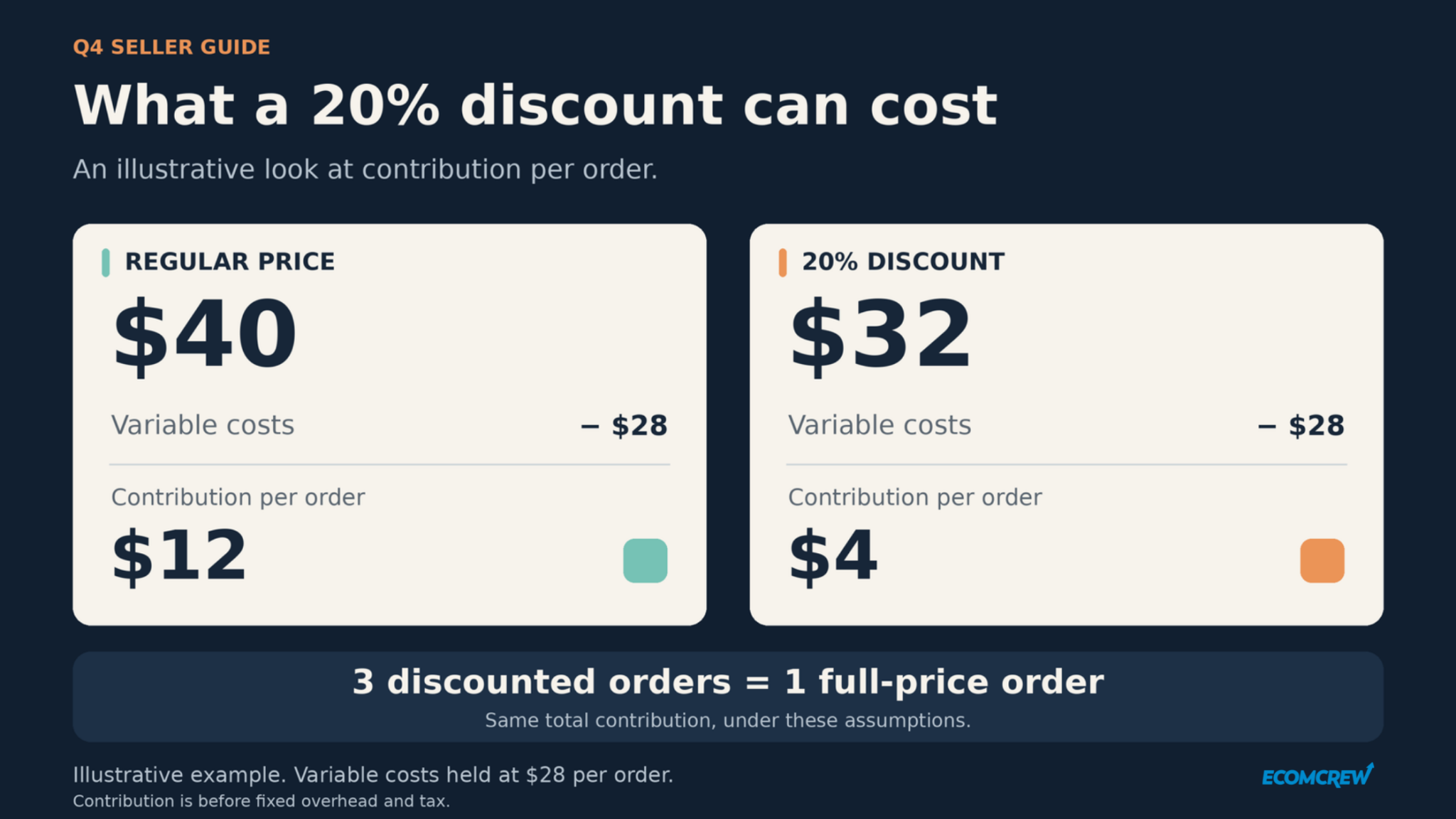
Consider this simplified hypothetical example, with $28 in variable costs per order held constant to isolate the discount's effect:
| Per-order calculation | Regular price | 20% discount |
|---|---|---|
| Selling price | $40 | $32 |
| Assumed variable costs | $28 | $28 |
| Contribution before fixed overhead and tax | $12 | $4 |
At those assumptions, you need three discounted orders to generate the contribution of one full-price order. Actual percentage-based fees and acquisition costs will change the calculation, so replace the assumptions with your own figures.
More orders also mean more work. Your packing team does not get a 20% discount on effort.
For Amazon, use the current FBA cost information and Revenue Calculator, then add costs the estimate does not capture for your business. Review advertising limits alongside the offer; our Amazon PPC guide explains how advertising cost relates to margin.
For your own store, compare a percentage discount with a relevant bundle or a minimum-spend offer. Shopify supports several discount types, including percentage, fixed-amount, buy-X-get-Y, and free-shipping offers. Calculate the economics of each before choosing one.
Decide in advance what would make you reduce spending: contribution below your floor, insufficient remaining stock, or a fulfillment backlog. Reassess before Cyber Monday rather than automatically extending every Black Friday promotion.
Use Small Business Saturday to Explain Why Your Brand Exists
Small Business Saturday sits between Black Friday and Cyber Monday. For an independent brand, it is a useful occasion to show the people and decisions behind the product.
An email about why you designed a particular feature, a short demonstration, or a practical gift guide can give existing followers something more useful than another sale banner. Keep any offer within the weekend's margin limits.
This is most compelling when you have a real story to tell and an audience that wants to hear it. Being small alone isn't the entire sales pitch.
Christmas: Your Delivery Promise Becomes Part of the Offer
As December progresses, review your campaigns against the delivery dates customers can actually expect.
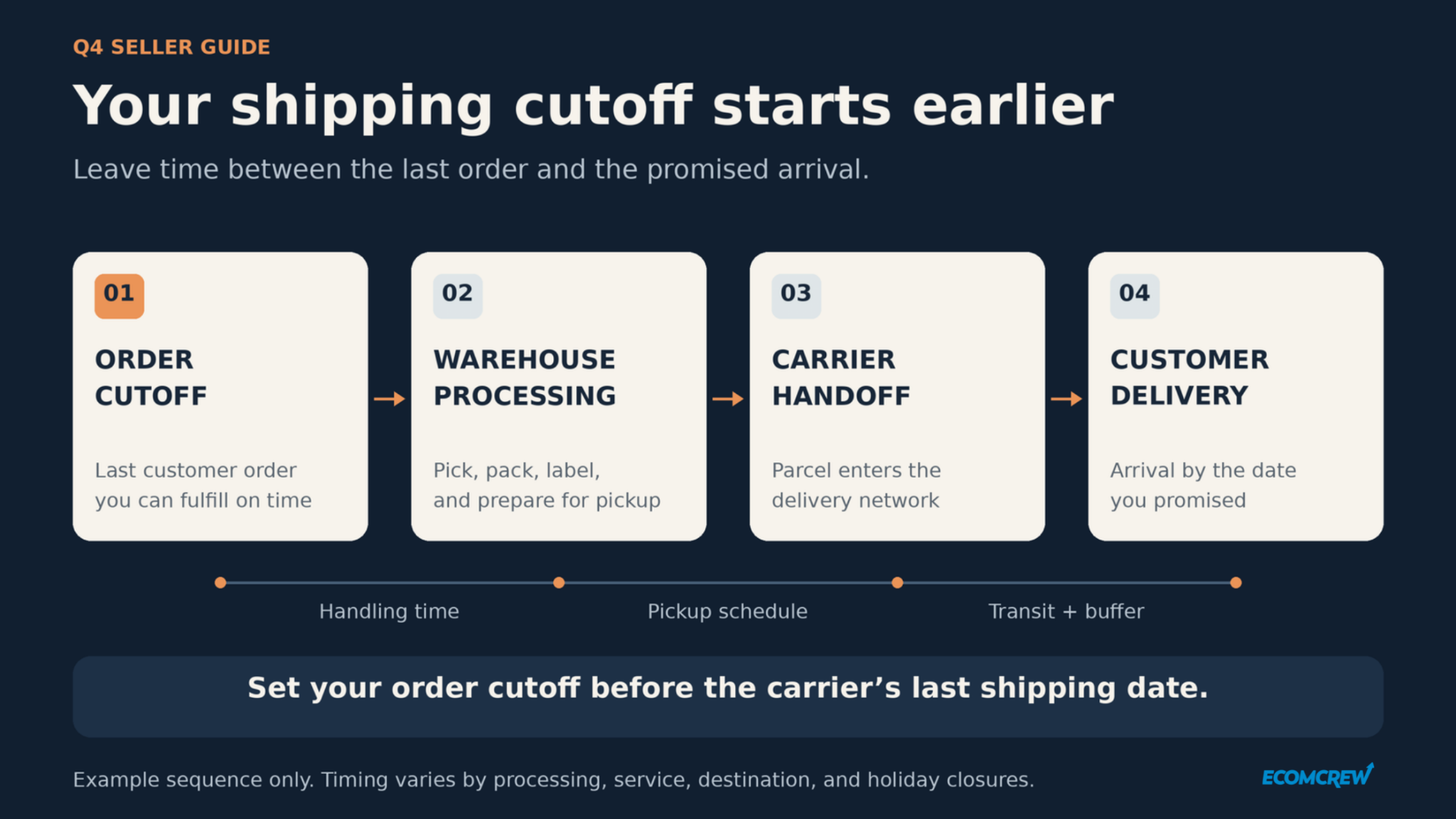
Set order cutoffs using your processing time, the carrier's service and destination, warehouse closures, and a buffer for disruption. A carrier's last shipping date is not automatically your store's last order date.
For a concrete 2026 example, UPS's U.S. holiday schedule lists no UPS Ground pickup on December 24 and no regular pickup or delivery on December 25. A label printed on Christmas Eve won't move the parcel by itself.
For Fulfillment by Amazon, monitor available stock and customer-facing delivery estimates. For orders fulfilled by your own warehouse or a third-party logistics provider, confirm the actual pickup schedule with the team handling them.
When delivery before Christmas becomes unrealistic, change the promotion. Depending on your business, that could mean local pickup, digital gift cards, or offers for customers happy to receive products afterward.
Update ads and product-page promises together. Paying for “arrives before Christmas” traffic after you can no longer support that claim creates a problem with a tracking number attached.
Boxing Day: Clear the Right Inventory
Boxing Day falls on December 26 and is associated with post-Christmas sales in Canada and the UK. For U.S. customers, a straightforward after-Christmas promotion may be a better fit for your messaging.
Choose clearance products individually. A dated holiday design, an evergreen kitchen tool, and a product expiring soon have different reasons for being discounted.
Compare the cash you could recover now with the expected proceeds from selling later, after storage, financing, and further selling costs. Holding an evergreen product can make sense when it still sells steadily. Holding a weak seasonal product for another year needs a stronger argument than “we already paid for it.”
Include returned inventory in the plan. EcomCrew's analysis of the resale market explains how returned and excess products can reappear as lower-priced competition. Know where those units will go before clearing them in bulk.
Put Preparation Deadlines Beside the Sales Dates
A useful Q4 calendar needs dates for the work behind each campaign. Use these as planning targets, then bring them forward wherever supplier, marketplace, or carrier requirements demand it.
- Now through the end of September: Confirm available inventory, incoming shipments, promotion eligibility, and the offers you can support. October's Amazon event is close.
- During October: Finalize November pricing and creative, test your store's checkout, and confirm warehouse capacity. Record the current marketplace submission and receiving deadlines that apply to your account.
- Before Thanksgiving week: Check sellable stock, spending limits, customer-service coverage, and fulfillment handoffs. Schedule a review before extending the campaign into Cyber Monday.
- At the start of December: Publish delivery guidance by service and destination. Assign someone to update ads and storefront messages when those promises change.
- Before Christmas: Choose any clearance products and prepare the returns workflow so the team isn't inventing it during the holiday break.
For inventory sent to Amazon, record dispatch, receiving, and sellable availability separately. Amazon's FBA process includes shipment tracking and receiving before fulfillment; a shipment leaving your warehouse is not the same as stock being ready for customer orders.
Pick your strongest event, assign the products and budget, and write down the condition that would make you stop spending. Then check the next event against the stock and cash you will have left. That's how the calendar becomes a plan you can afford to run.