Pre-Owned, Pre-Empted: How the Resale Market Is Quietly Eating New E-Commerce Sales

Picture the last person who bought your product.
Before clicking “add to cart,” did they open another tab and search eBay, Facebook Marketplace, Poshmark, ThredUp, or a refurbished-products site to see whether they could get the same item used?
In a growing number of categories, that search is now part of the buying process. The resale market has become large enough that brands can no longer treat it as a niche occupied by thrift stores, sneaker collectors, and people selling old phones from a kitchen drawer.
A used product can take a sale away from new inventory. It can also introduce a shopper to your brand, make an expensive purchase easier to justify, or give an existing customer the money to upgrade.
The threat is real, but it is not evenly distributed.
TL;DR
The resale market is becoming a direct competitor to new e-commerce sales, particularly for durable, branded, and easy-to-inspect products. Used, refurbished, open-box, and returned inventory can now appear alongside new products on Amazon, eBay, Walmart, and other marketplaces. However, resale can also increase a product’s perceived value, encourage upgrades, and keep customers inside a brand’s ecosystem through trade-in credit. Sellers should audit their top products, control where returns and excess inventory end up, make the benefits of buying new obvious, and test resale or trade-in programs before investing in a full secondhand operation.
First, What Counts as Resale?
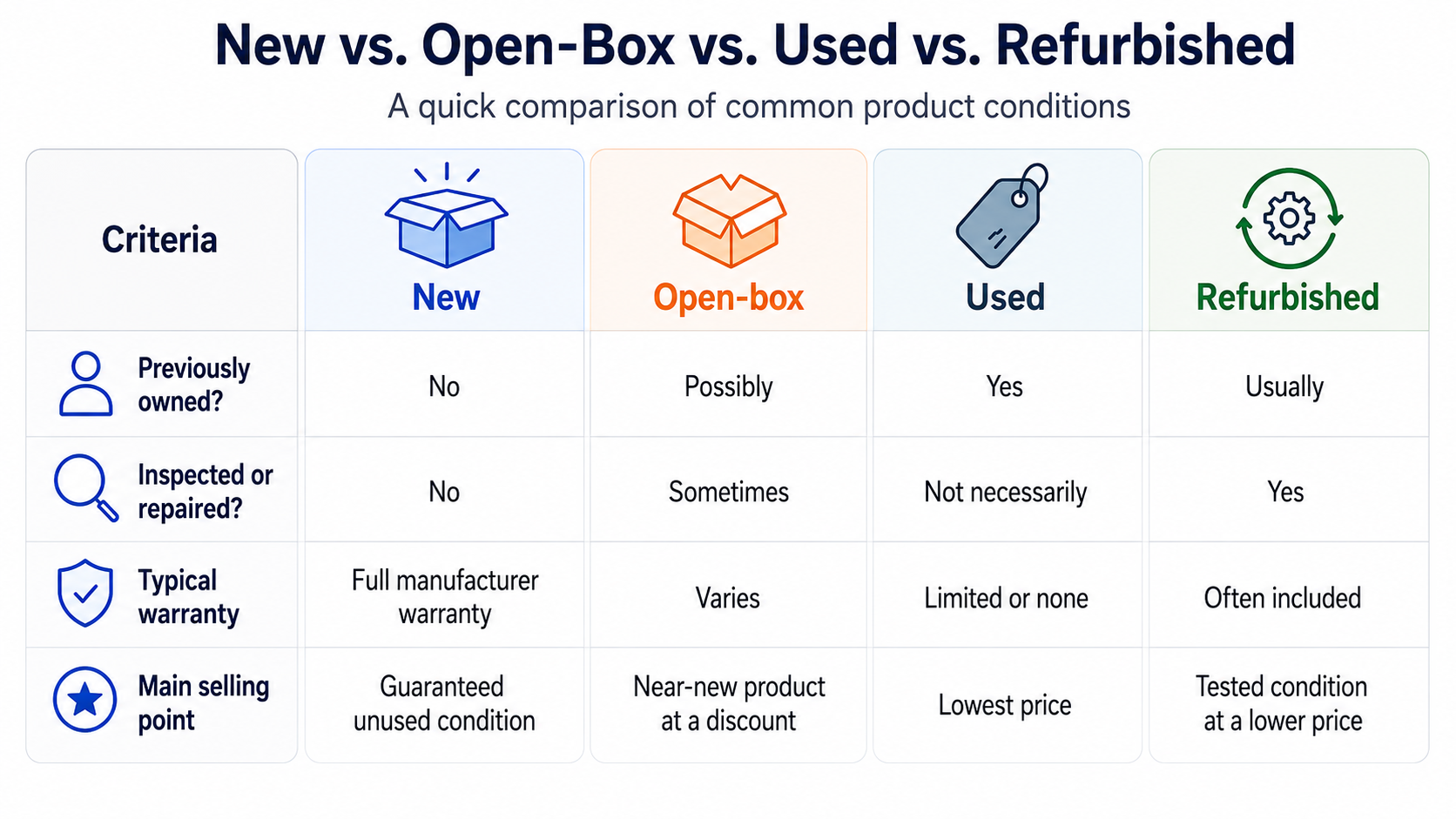
Resale and recommerce are often used interchangeably, but the market contains several different types of inventory:
- Secondhand or pre-owned: A product previously owned and used by a customer.
- Open-box: A product whose packaging has been opened but that may never have been used.
- Refurbished: A returned or used product that has been inspected, tested, cleaned, repaired, or restored.
- Trade-in: A product surrendered in exchange for cash, store credit, or credit toward an upgrade.
- Returns and liquidation: Returned, overstocked, discontinued, or otherwise unwanted inventory sold through secondary channels.
- Peer-to-peer resale: A transaction between consumers through a marketplace such as eBay or Facebook Marketplace.
- Branded resale: A trade-in or secondhand program operated by the original brand or on its behalf.
These products may all compete with new inventory, but they have different costs, risks, warranties, and customer expectations. Treating them as one pile marked “used stuff” makes it impossible to build a sensible strategy.
The Resale Market Is Already Huge
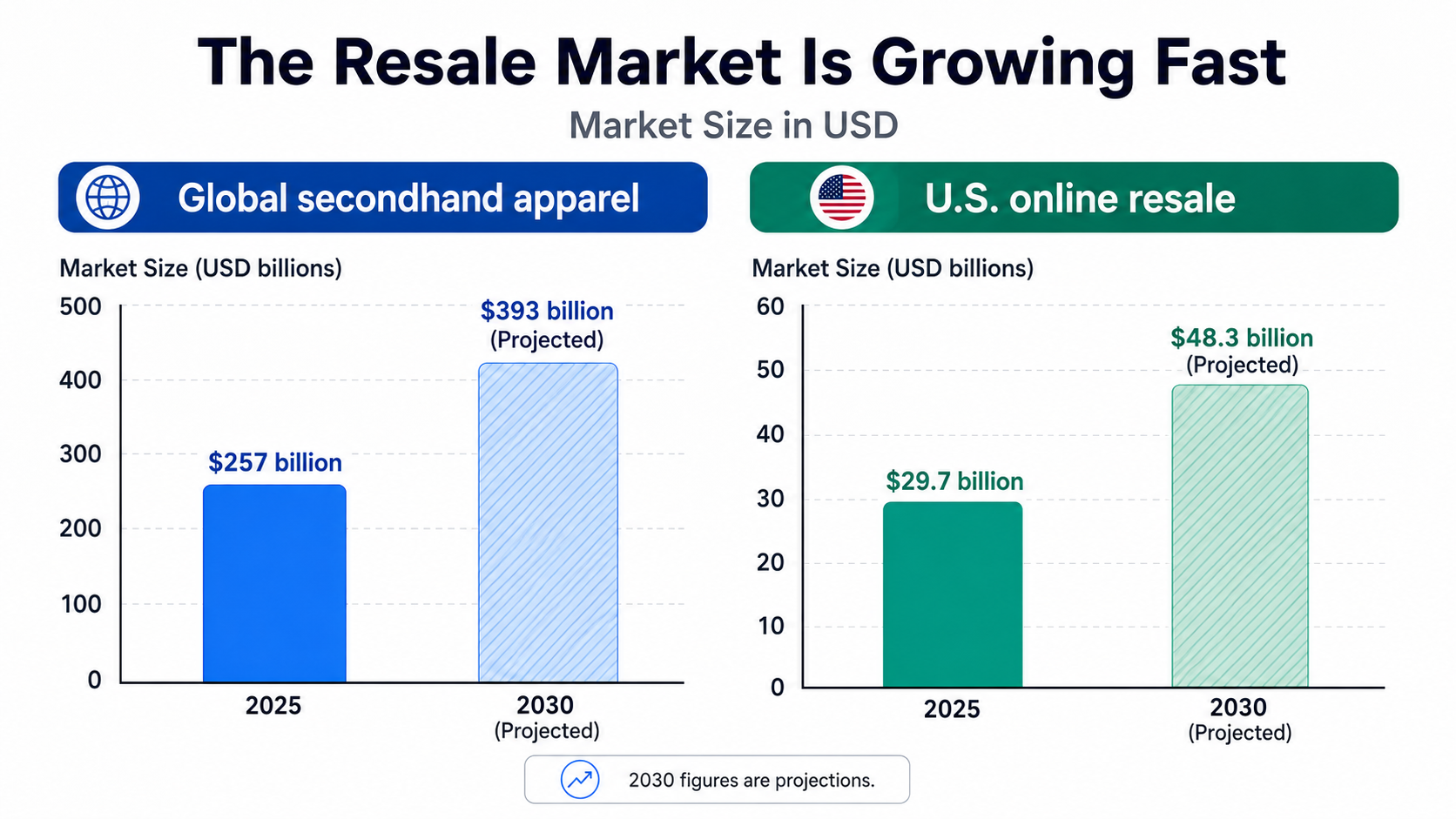
According to the 2026 ThredUp Resale Report, the global secondhand apparel market reached an estimated $257 billion in 2025. It is projected to reach $393 billion by 2030, accounting for roughly 10% of global apparel spending and growing more than twice as fast as the broader apparel market.
In the United States, secondhand apparel generated approximately $55.5 billion in 2025, an increase of about 13%. The narrower online resale segment reached $29.7 billion and is expected to grow to $48.3 billion by 2030.
New retail clothing, by comparison, grew by approximately 3.6% in 2025. New clothing crawled. Used clothing sprinted.
Fashion receives most of the headlines, but the market extends much further. OfferUp’s 2025 Recommerce Report estimates that clothing represents only 25% of the more than $200 billion U.S. multi-category recommerce economy.
Electronics, furniture, home goods, sporting equipment, tools, auto parts, toys, and other durable products make up the remaining 75%.
That does not mean resale threatens every physical-product seller. It means durable-goods brands should find out how much of their catalog is already circulating without them.
Is Resale Actually Cannibalizing New Sales?
In some categories, almost certainly.
ThredUp found that 46% of consumers browse resale before purchasing new clothing. That increases to 58% among Gen Z and 55% among millennials. Consumers also said they expected to direct 34% of their clothing budgets toward secondhand purchases during the following year.
ThredUp executives now describe the shift as measurable cannibalization of new retail.
That is meaningful evidence, but it does not prove that 46% of new-product purchases are being lost. Browsing a used listing is different from buying it. Some shoppers compare prices and still choose new because of product condition, availability, delivery speed, returns, warranties, or included accessories.
The report is also heavily focused on apparel and is based partly on consumer surveys and market modeling. ThredUp operates a resale marketplace and sells resale services to brands, so it has a commercial interest in the category’s growth.
What this means for sellers
Resale has entered the customer’s consideration set. When the used version of a product is a credible substitute, some demand will move away from new inventory. Do not assume every resale search results in a lost sale, but do assume that a growing share of shoppers is comparing your full-price offer against a cheaper version of the same product.
What Changes When Used Products Appear Beside New Ones
Resale becomes more dangerous when marketplaces remove the work required to find it.
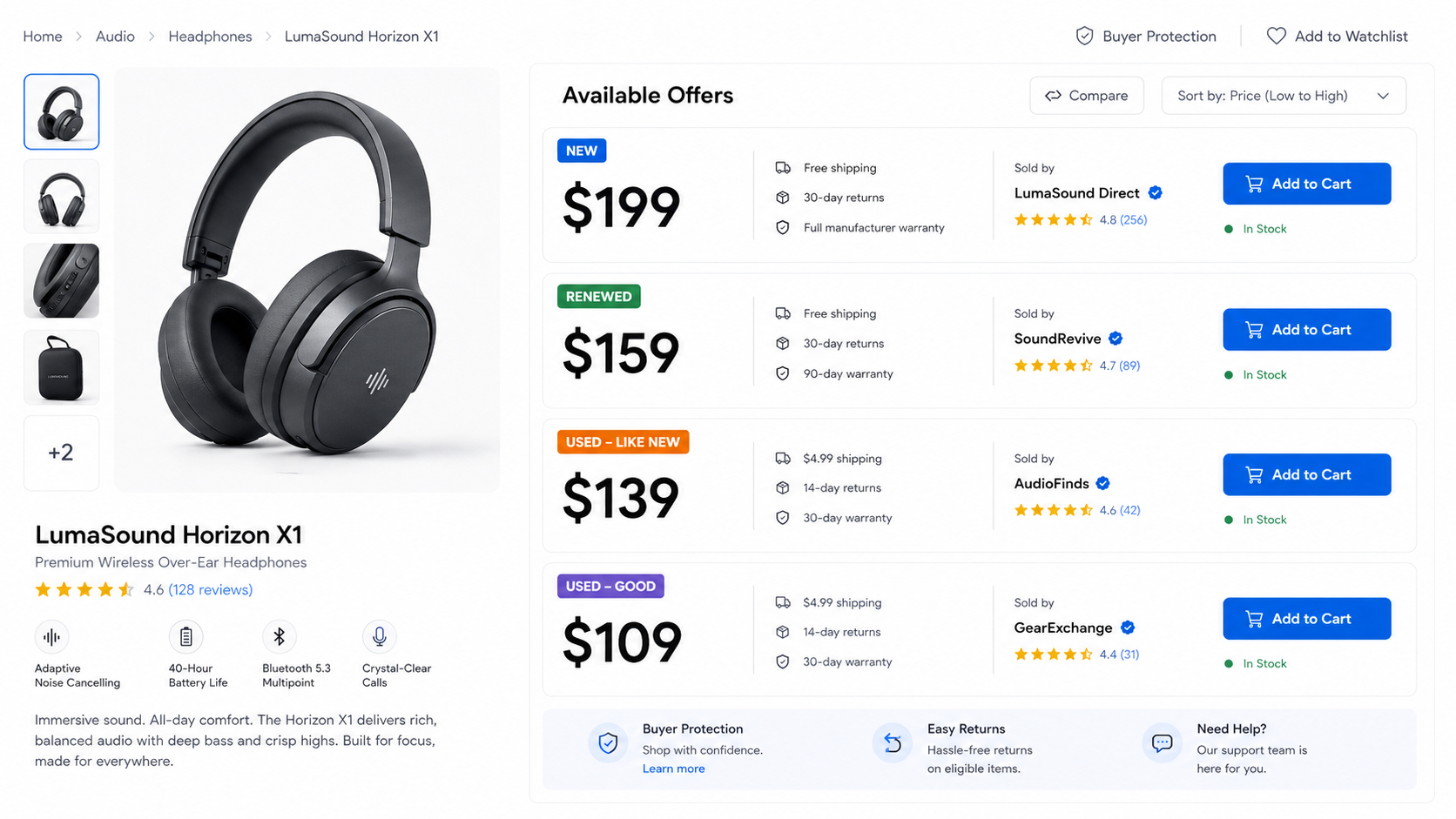
Amazon allows sellers to list products under conditions such as New, Used–Like New, Used–Very Good, Used–Good, and Used–Acceptable. These Amazon condition rules create a standardized way for shoppers to compare used offers against new inventory.
For sellers, that means a secondhand offer can appear close to the main listing rather than being buried on a separate resale site. The categories that allow these offers, along with the rules sellers need to follow, are covered in our breakdown of used-product eligibility.
Amazon has also made refurbished products easier to trust through Amazon Renewed requirements. Qualified sellers can use the program to offer refurbished electronics, appliances, tools, and other eligible products without presenting them as ordinary used inventory.
eBay has taken a similar approach by introducing standardized condition grades and warranties for professionally restored items. These rules are a major part of eBay’s refurbished standards and help reduce some of the uncertainty buyers normally associate with secondhand products.
Walmart is moving in the same direction. Approved marketplace sellers can use Walmart’s resale program for pre-owned, open-box, restored, and remanufactured inventory.
This is more than another sales channel. Marketplaces are building condition standards, warranties, pricing rules, and search placements that make used products easier to trust and simpler to compare with new ones.
Returns Are Quietly Feeding Your Used-Product Competition
The resale market does not rely only on customers cleaning out their closets and garages.
Returns, damaged packaging, open-box units, overstock, discontinued products, and liquidation inventory all feed secondary marketplaces.
Amazon may inspect a returned product and place it back into sellable inventory. Other units can be graded as used, sold through Amazon’s secondary channels, liquidated in bulk, returned to the seller, or marked for another form of disposition.
Our breakdown of Amazon’s return process explains how products move through inspection, grading, resale, liquidation, donation, and disposal.
Discounted Amazon Warehouse offers can then appear on the original product detail page. Because these are authentic returned units, they are generally different from counterfeit or unauthorized products.
Units that cannot be resold individually may flow into liquidation auctions. Buyers purchase Amazon return pallets, sort the usable inventory, and relist it through Amazon, eBay, discount stores, independent websites, and local marketplaces.
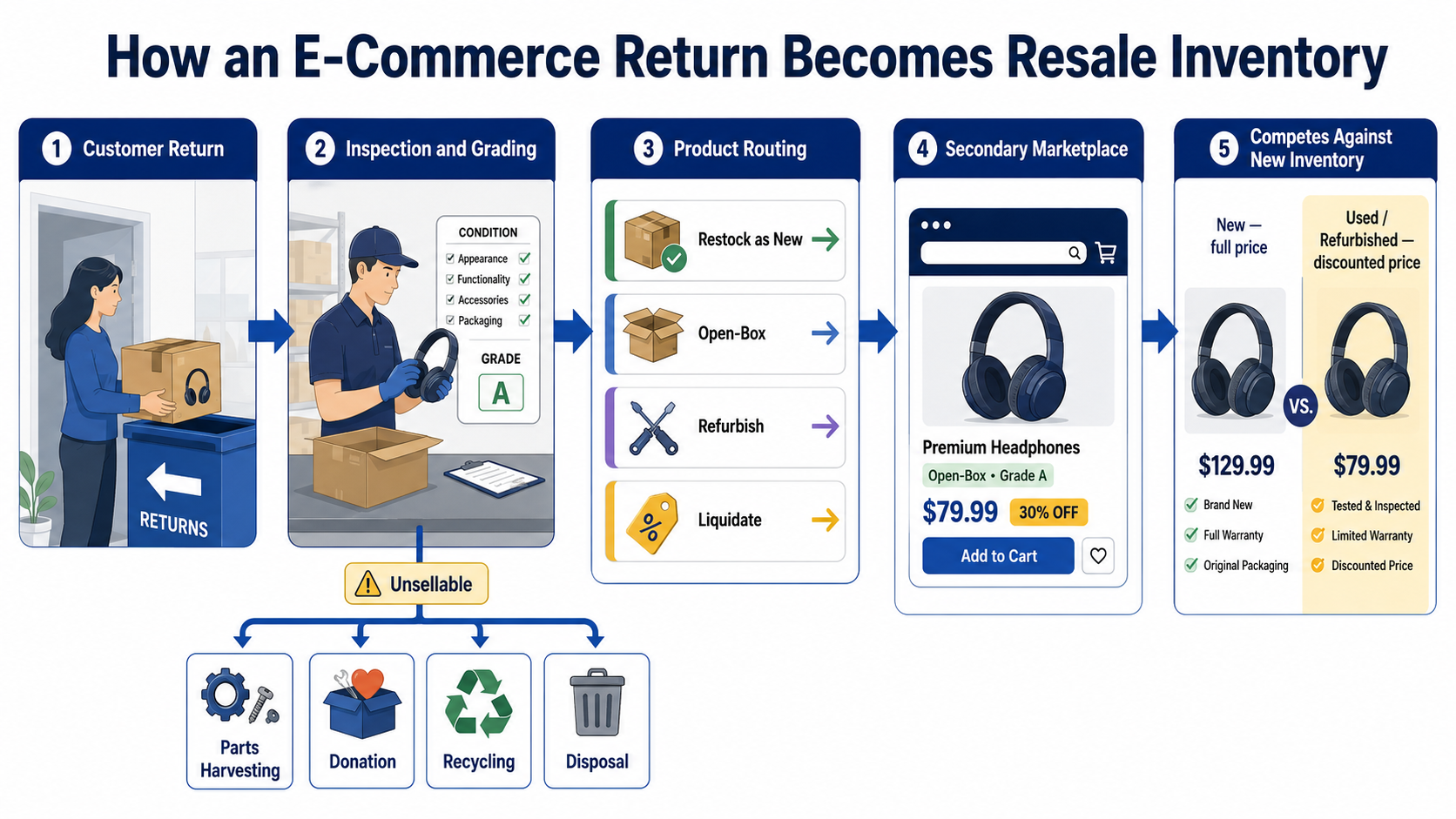
Reducing returns therefore does more than protect the original transaction. It can reduce the amount of discounted inventory that later competes with your new products.
Better product pages, accurate measurements, clearer images, realistic descriptions, and improved customer expectations are still among the best ways to reduce e-commerce returns.
For Amazon sellers
Every returned unit needs a defined destination. Decide in advance whether it should be restocked, sold as open-box, refurbished, liquidated, donated, or disposed of. Otherwise, Amazon or a liquidation buyer may make that decision for you, and the product can eventually return to the marketplace as discounted competition.
Which Products Are Most Exposed?
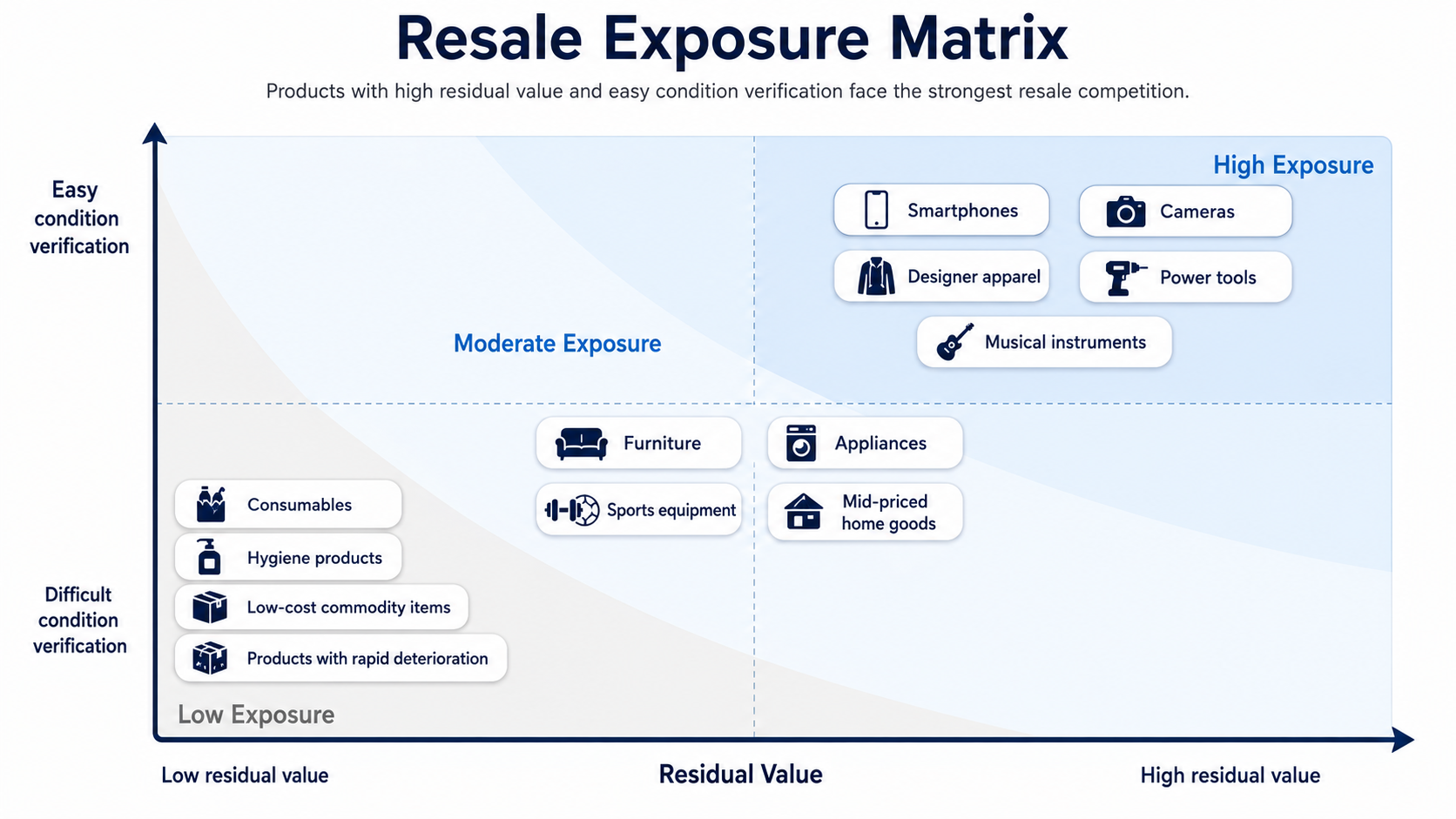
Instead of judging exposure solely by product category, examine five characteristics.
Durability
Can the product remain useful after its first owner?
Jackets, furniture, cameras, musical instruments, bicycles, and power tools can. Food, supplements, skincare, and most disposable goods cannot.
Searchability
Can shoppers search for the exact brand, model, or SKU?
A used iPhone competes directly with the same iPhone sold new. A generic used kitchen utensil is less likely to displace a specific private-label product.
Recognizable brands, model numbers, and standardized products make resale comparison easier.
Verifiable Condition
Can the buyer confidently judge whether the product still works?
Serial numbers, battery-health readings, authentication, standardized grading, detailed photographs, and inspection programs reduce the risk of buying used.
When condition is difficult to verify, shoppers have a stronger reason to buy new.
Residual Value
Does the product retain enough value to justify listing, processing, and shipping it?
A $600 jacket may support an active resale market. A $14 commodity shirt usually will not unless it becomes collectible.
Transaction Convenience
Can the product be sold and delivered without creating a logistical migraine?
Small electronics and apparel are easy to ship. Furniture may retain value but remain concentrated in local marketplaces because national delivery costs are impractical.
The products facing the greatest exposure are durable, branded, searchable, easy to inspect, and valuable enough to resell.
Consumables, hygiene-sensitive goods, low-priced commodities, and rapidly deteriorating products remain much less exposed.
Quick resale exposure test
Search your five bestselling products on Amazon, eBay, Facebook Marketplace, and the largest resale platform in your category. If you find plenty of active listings, consistent condition grades, and used prices that remain close to retail, you already have a meaningful secondary market. Whether your company participates in it is a separate question.
Resale Is Different From Counterfeiting
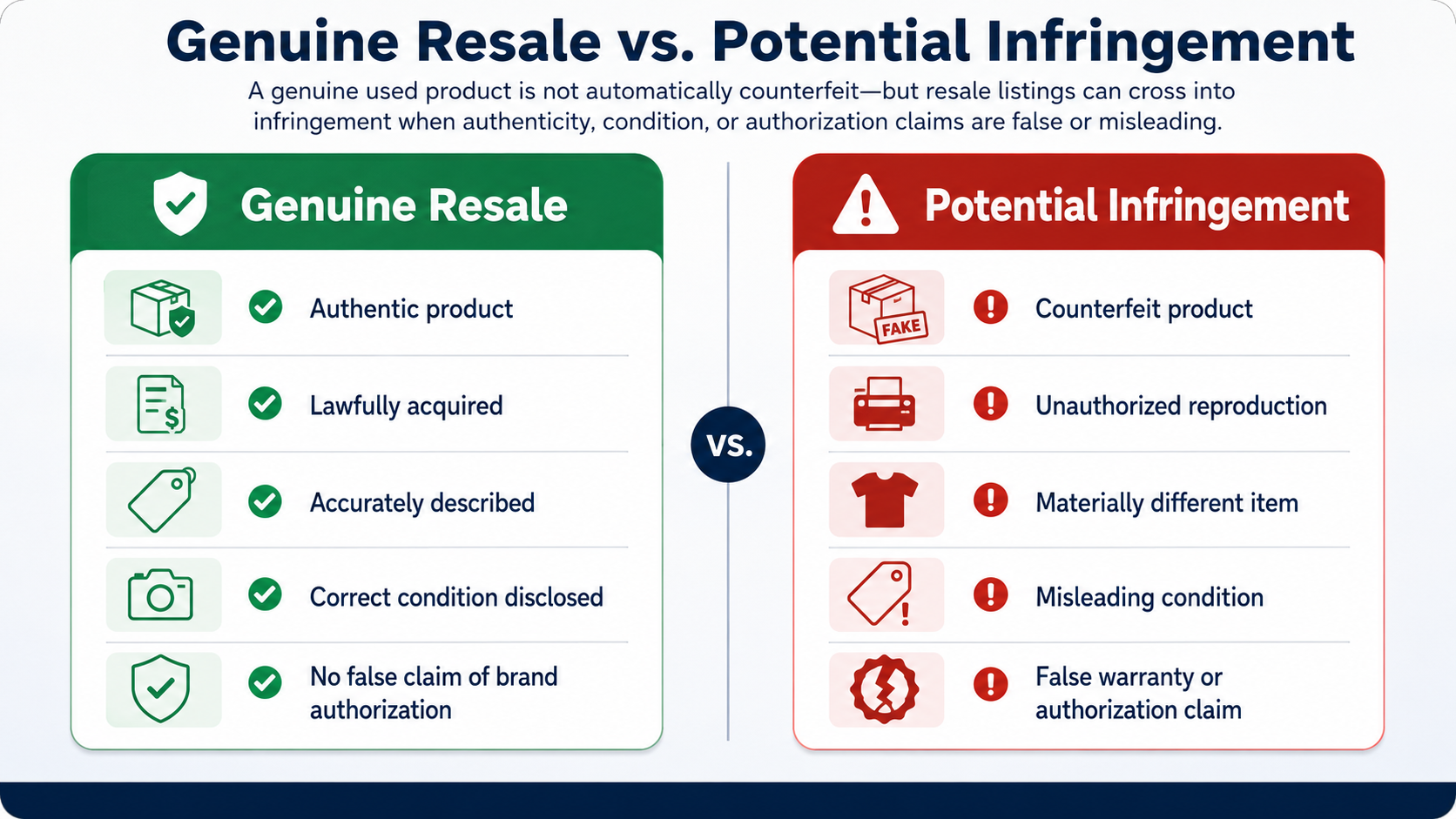
A genuine used product is not automatically a counterfeit, a listing hijack, or an intellectual-property violation.
In the United States, the first-sale doctrine generally limits certain intellectual-property rights after a lawfully produced product has been sold. A lawful owner can ordinarily dispose of that particular product, including by reselling it.
Counterfeit goods, unauthorized reproductions, misleading warranty claims, material product differences, imports, licenses, and contractual restrictions can create different legal issues. Brands dealing with those situations should seek advice specific to their products and distribution arrangements.
The Department of Justice provides a general explanation of the first-sale doctrine, although it should not be treated as a substitute for legal advice.
This distinction matters on Amazon.
Amazon Brand Registry gives brands greater control over listing content and access to infringement-reporting tools, but it does not ordinarily stop another seller from offering genuine products they lawfully obtained.
When the product is fake or materially different, the problem becomes closer to an Amazon hijacking case. Successfully dealing with Amazon hijackers usually requires evidence such as test buys, product photographs, packaging differences, missing components, serial numbers, or invalid authentication codes.
Brands should also avoid assuming that pricing rules will solve the used-product problem. MAP policies primarily govern authorized resellers and advertised prices. They may not bind individual consumers, liquidators, or every downstream seller that obtains genuine inventory.
Your strongest protection is usually operational: control distribution, track inventory leaks, clearly define warranty eligibility, serialize high-risk products, and give buyers a visible reason to prefer an authorized new unit.
Why the Resale Market Is Accelerating
Price pressure is one driver.
OfferUp’s recommerce consumer data found that shoppers become more likely to buy or sell pre-owned goods when financial news is negative or the economy feels uncertain.
Concerns about inflation, tariffs, and the cost of living make used products more attractive without requiring the used seller to change anything.
These findings measure reported intentions and behavior rather than guaranteeing that every concerned shopper will buy secondhand. They still show how quickly resale becomes part of the conversation when new-product prices rise.
Discovery is changing too.
ThredUp’s resale shopping data indicates that nearly half of secondhand discovery now happens outside dedicated resale platforms through social feeds, creators, influencers, and in-person browsing.
Used products increasingly appear in the same feeds where brands pay to advertise new ones.
Listing technology is also reducing friction on the supply side. Image recognition, automated descriptions, suggested prices, product databases, and AI-assisted search make it easier for consumers and professional resellers to list and discover inventory.
More supply means a greater chance that a shopper will find the exact product they were considering buying new.
Resale Can Also Help Sell New Products
Cannibalization is only part of the equation.
A healthy secondary market gives a product residual value. That can make a new purchase easier to justify because the customer expects to recover part of the price later.
This is common with cars, smartphones, cameras, luxury products, and high-quality outdoor gear. The original price becomes less intimidating when the customer thinks in terms of total ownership cost.
Harvard Business School’s branded recommerce research found that shoppers showed greater interest in pre-owned products when the original brand operated the resale program. Its experiments also found that buyback programs could increase interest in purchasing new products.
Poor execution, however, could damage perceptions of the main brand. A resale store full of inconsistent grading, battered packaging, and confusing warranties can make the entire company look less reliable.
Trade-in credit is particularly useful because it keeps the recovered value inside the company’s ecosystem.
Patagonia’s trade-in program gives customers merchandise credit for qualifying used gear. Levi’s trade-in program accepts selected jeans and jackets in exchange for gift cards. Apple Trade In applies eligible device values toward a new purchase or an Apple Gift Card.
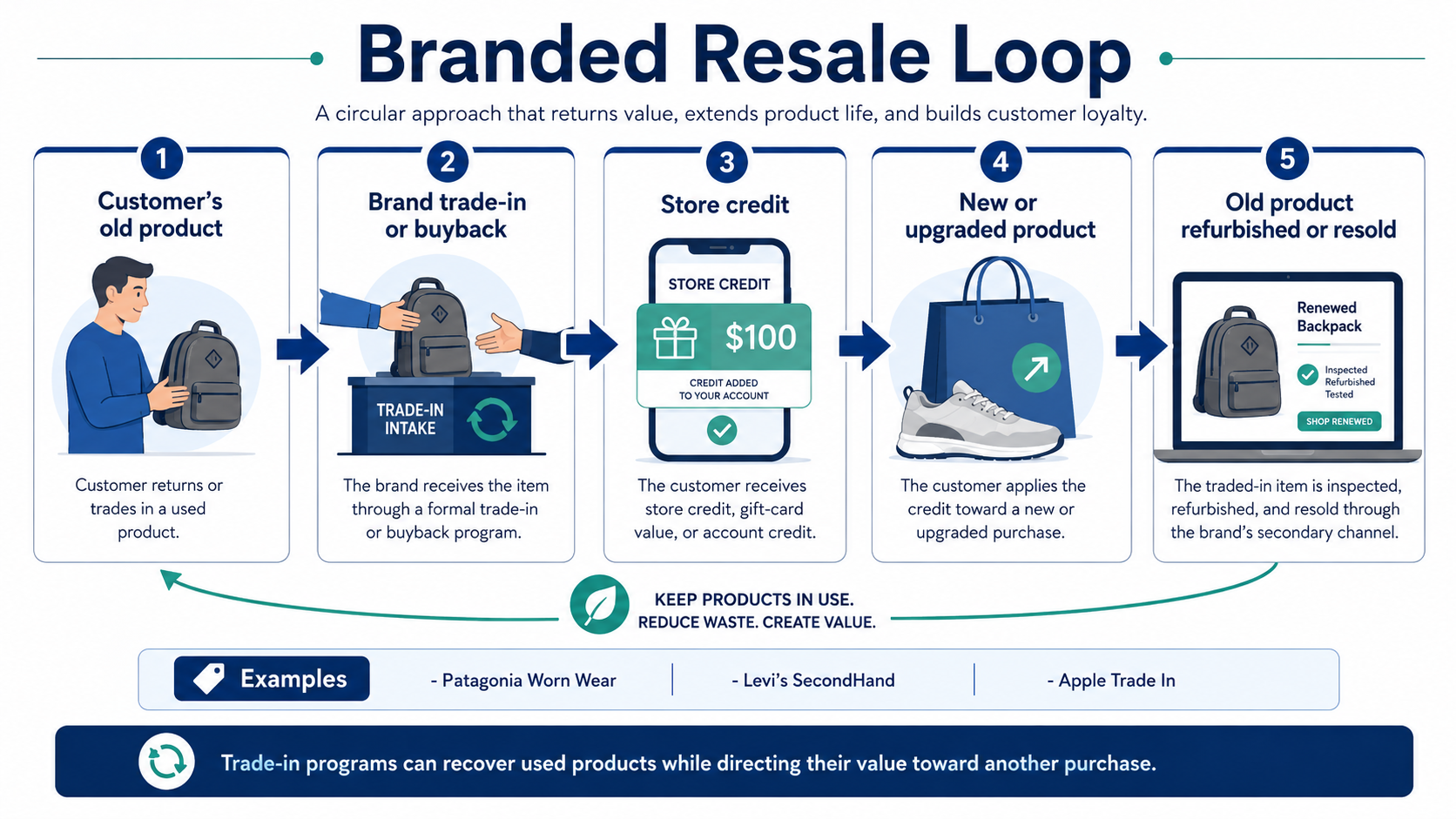
In each case, the old product helps finance another transaction with the brand.
Four Ways Sellers Can Respond
1. Make the new-product premium obvious
Do not assume customers understand why new is worth more.
Put the differences directly on the product page:
- Full manufacturer warranty
- Guaranteed condition
- Latest specifications
- Faster delivery
- Easier returns
- Included accessories
- Replacement parts
- Setup or installation assistance
- Customer support
- Personalization
- Loyalty benefits
“Brand new” is no longer a complete value proposition. Clear comparison charts, accurate product details, strong images, video, and conversion-focused copy can help improve the listing without immediately cutting the price.
2. Control your returns and open-box channel
Decide what happens to returned units before a marketplace or liquidator decides for you.
Create written standards for:
- Restocking as new
- Selling as open-box
- Refurbishing
- Harvesting parts
- Liquidating
- Donating
- Recycling or disposal
Keep refurbished and open-box inventory clearly separated from new inventory. Use distinct condition descriptions, warranties, SKUs, and packaging where appropriate.
Condition ambiguity is a lovely way to generate returns from the inventory that already got returned once.
3. Offer trade-in credit without building a resale store
A trade-in program does not need to begin with a complete branded marketplace.
Start with a few high-resale SKUs. Offer store credit based on product age and condition. Send accepted units to an established refurbishment, recycling, or resale partner.
The immediate goal can be customer retention and upgrade demand rather than earning margin on the used item itself.
4. Launch branded resale where the economics work
A full branded resale program gives the company more control over authentication, grading, warranties, pricing, and customer experience.
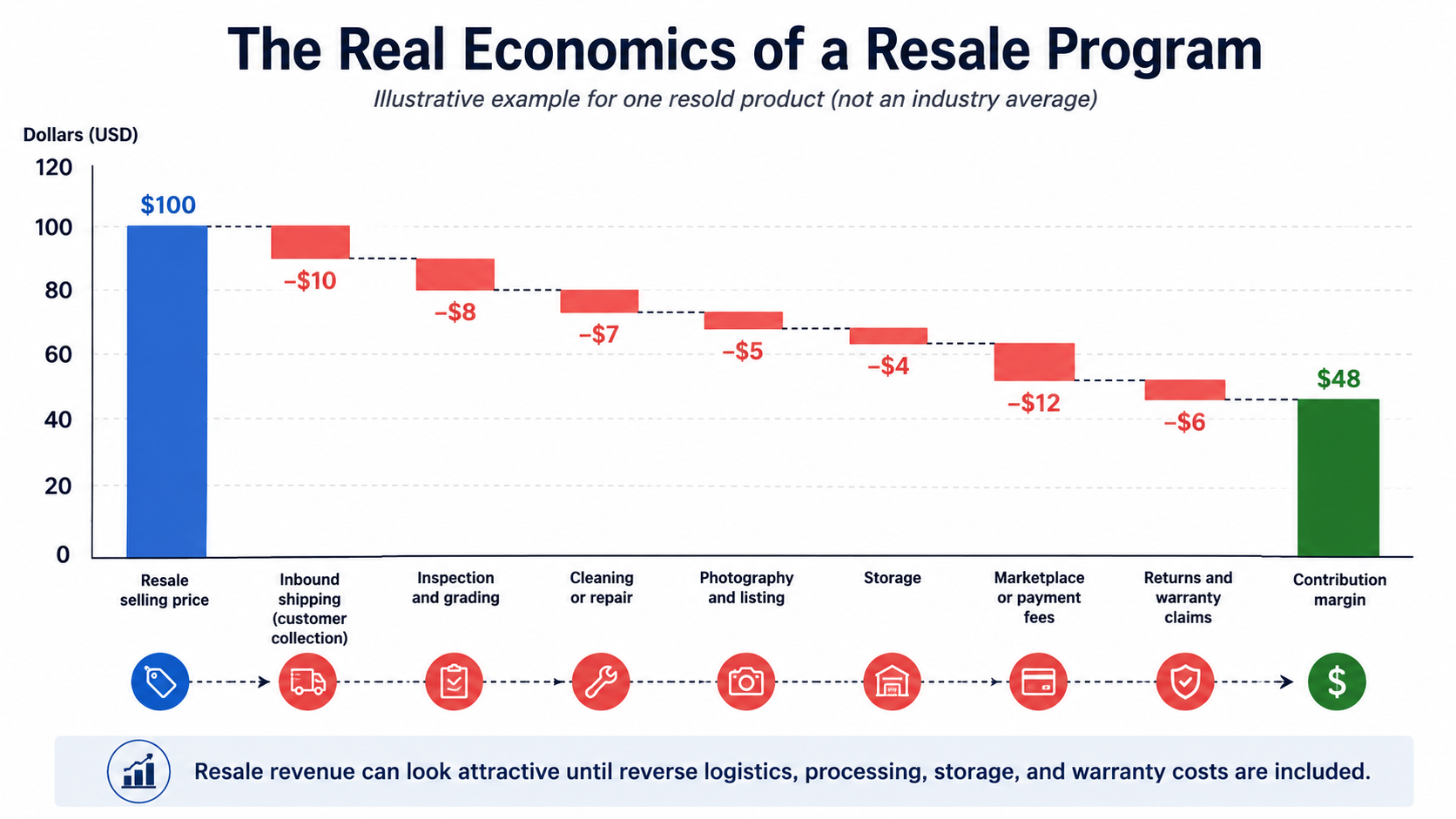
It also adds real costs:
- Collection and return shipping
- Inspection
- Authentication
- Cleaning
- Repairs
- Photography
- Storage
- Fraud prevention
- Customer service
- Warranty claims
- Unsold inventory
- Software and marketplace fees
Smaller sellers may be better served by a third-party partner, a limited trade-in program, or a controlled open-box store rather than a full consumer-to-consumer marketplace.
Before you build a resale program
Start with one product group that already has visible resale demand. Define the acceptable conditions, expected recovery value, processing costs, warranty, and destination of unsold units. A smaller pilot will reveal whether resale produces incremental demand or simply moves existing customers away from higher-margin new inventory.
What to Measure Before Calling a Resale Program Successful
Resale revenue alone tells you very little. A program can generate sales while moving existing customers away from higher-margin new products.
Track the following:
- Recovery rate: Resale revenue as a percentage of the product’s original retail value.
- Processing cost per unit: Shipping, inspection, cleaning, repairs, photography, storage, and customer service.
- Sell-through rate: The percentage of accepted inventory sold within a defined period.
- Time to resale: The number of days between trade-in and the second sale.
- Trade-in redemption rate: The percentage of issued credits used on another purchase.
- Upgrade rate: The percentage of trade-in customers who buy a newer or higher-value product.
- New-customer rate: The percentage of resale buyers with no previous purchase history.
- Repeat purchase rate: Whether resale buyers later purchase new products.
- Contribution margin: The revenue left after every resale-related variable cost.
- Cannibalization rate: The estimated share of resale purchases that replaced a likely new-product purchase.
- Return and dispute rate: Condition complaints, warranty claims, fraud, and returns on pre-owned units.
Run the pilot against a control group where possible. Compare similar customers, products, or markets that did not receive a trade-in or resale offer.
Otherwise, every transaction will look incremental because the spreadsheet has been politely instructed not to ask difficult questions.
A Practical 90-Day Resale Audit
Before launching anything, spend one quarter gathering evidence.
Days 1–30: Map the market
Search your top 20 products across Amazon, eBay, Facebook Marketplace, Walmart, and the largest resale platform in your category.
Record:
- Number of active used listings
- Median used price
- Discount compared with new
- Product condition
- Seller type
- Included warranty
- Review volume
- How long listings remain active
Days 31–60: Identify the source
Determine where the used supply is coming from:
- Customer-owned products
- Retail returns
- Liquidation
- Unauthorized distributors
- Damaged packaging
- Counterfeit products
- Previous product generations
- Your own excess stock
Each source requires a different response.
Days 61–90: Run one controlled test
Choose a high-value SKU with measurable resale activity.
Test one intervention:
- Stronger warranty messaging
- A new-versus-used comparison
- Store-credit trade-ins
- An open-box offer
- A refurbishment partner
- Serial-number authentication
- A controlled resale landing page
Measure conversion, margin, returns, repeat purchases, and whether full-price sales decline.

The Takeaway
The resale market is not quietly eating every new e-commerce sale.
It is taking a more noticeable bite in categories where products are durable, recognizable, easy to inspect, and valuable enough to sell again. In those categories, a new product may already be competing against an older version of itself on the same marketplace.
Resale can also lower the perceived cost of ownership, encourage upgrades, generate store-credit spending, and bring price-sensitive shoppers into a brand.
The useful question is no longer whether resale is good or bad.
It is how much secondary demand already exists for your products, where the inventory comes from, how it affects new-product conversion, and whether someone else is capturing all the value when your product gets sold again.